


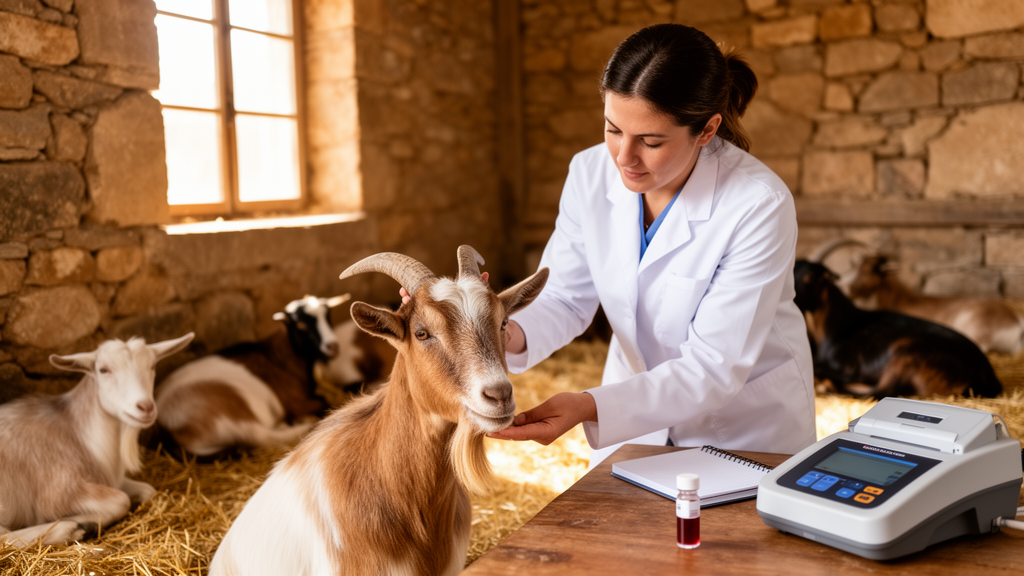
Researchers have produced the first comprehensive survey of genetic variation in the prion protein gene (PRNP) across Spanish goat breeds, and their findings reveal a picture of remarkably conserved DNA with pockets of variability that could matter for future scrapie control. The study, published in Frontiers in Animal Science, analysed hundreds of animals from ten native Spanish breeds spanning the Iberian Peninsula and the Atlantic and Mediterranean islands, alongside two external comparison populations. Its central message is twofold: the PRNP gene in Spanish goats is overwhelmingly dominated by the ancestral, wild-type sequence, yet the resistance-associated variants S146 and K222 are already present, at low frequencies, in some populations.
Classical scrapie is one of the best-known transmissible spongiform encephalopathies (TSEs), a family of fatal neurodegenerative diseases that affect sheep, goats, mouflons and cattle. These diseases are caused by an abnormal form of the prion protein, PrPSc, which accumulates in the brain, forms plaques that damage nerve cells, and is derived from the normal prion protein PrPC but folded into a conformation that resists degradation and can induce normal protein to convert into the pathological form. Classical scrapie has spread to nearly all regions of the world and is transmitted primarily through horizontal contact with contaminated environments and fluids, with serious consequences for animal health and livestock production.
Why the PRNP gene matters here is straightforward: susceptibility and resistance to scrapie in goats are influenced by polymorphisms in this gene, which sits on chromosome 13 and carries its entire protein-coding sequence in the third exon. According to the European Food Safety Authority, the variants S146, D146 and K222 are the PRNP polymorphisms most strongly associated with reduced susceptibility to classical scrapie, while the role of Q211 appears less consistent across studies. Under EU Regulation (EC) No 999/2001, genotyping of codons 146 and 222 is required for confirmed scrapie cases within the European Union, underlining how directly this genetics feeds into official disease-control policy.
The research team, based at the University of Córdoba and Animal Breeding Consulting in Spain, sampled 487 goats from ten Spanish native breeds: Florida, Malagueña, Murciano-Granadina, Payoya, Blanca de Rasquera, Mallorquina, Pitiüsa, Tinerfeña, Majorera and Palmera. The sample covered the country’s main production systems, including milk, cheese and meat breeds, and included Pitiüsa and Mallorquina, which are listed as endangered in the Spanish Catalogue of Livestock Breeds. To provide an external genetic reference, the researchers added ten Saanen goats and 39 animals from a locally adapted Tunisian Bedouin population, bringing the total to 546 animals. Samples were drawn from official herd-book records to avoid closely related individuals, and no clinical cases of scrapie had been reported on the participating farms at the time of sampling.
Genotyping focused on six codons of the PRNP gene, positions 142, 143, 146, 154, 211 and 222, selected in line with EFSA recommendations as the primary polymorphic positions associated with susceptibility or resistance to classical scrapie in goats. The team amplified exon 3 of the gene and used the SNaPshot technique, reading the results on a capillary genetic analyser. In total, 536 goats were successfully genotyped across the twelve populations. Statistical work included allelic frequencies, observed and expected heterozygosity, inbreeding coefficients, Hardy-Weinberg testing with false-discovery-rate correction, analysis of molecular variance, Nei’s genetic distances and maximum-likelihood inference of haplotypes from the multilocus genotypes.
The headline result is a strong predominance of the ancestral alleles. Most populations were homozygous for I142, H143, N146, R154, R211 and Q222, although moderate variability was detected at codons 142, 154, 211 and 222. Expected heterozygosity ranged from a low of 0.038 in the Palmera breed to a high of 0.183 in the Payoya breed, with an overall mean of about 0.11, indicating generally low genetic variability at the analysed loci. The number of alleles per population ranged from four to six, with Murciano-Granadina showing the greatest allelic diversity. Inbreeding coefficients were negative in most Spanish populations, suggesting a slight excess of heterozygotes and an absence of significant inbreeding, with only Mallorquina, the Tunisian population and Saanen showing positive values. Hardy-Weinberg equilibrium held across nearly all population-codon combinations, the sole exception being codon 222 in the Tinerfeña breed.
Some of the most striking patterns emerged at individual codons. At position 146, nearly all breeds were homozygous for the ancestral asparagine allele, with the scrapie-associated S146 variant detected only in a few individuals from the Murciano-Granadina and Tinerfeña breeds, at frequencies below three percent. At position 222, which the authors describe as one of the most relevant positions in the gene, the lysine variant K222 was present in all populations except Majorera, with the highest frequencies in Tinerfeña at 40 percent, Florida at about 24 percent and Blanca de Rasquera at about 21 percent. Homozygous K222K individuals appeared only in the Tunisian population, at 2.56 percent, and none of the Spanish breeds carried this genotype. The Majorera breed was completely fixed for the wild-type glutamine at codon 222, with a total absence of the K allele. Codon 142 showed moderate variation, with the methionine variant M142 reaching its highest frequencies in Florida and Payoya but absent entirely from Majorera and the Tunisian population.
Haplotype reconstruction from the six codons identified ten inferred haplotypes. The wild-type haplotype H1, carrying I142, H143, N146, R154, R211 and Q222, was the most prevalent in every population, ranging from 0.33 in Tinerfeña to 0.51 in Majorera, where it accounted for more than half of the animals analysed. The second most frequent haplotype, H2, carries the K222 variant associated with resistance to classical scrapie and was most common in Tinerfeña (0.24) and the Tunisian population (0.22), followed by Payoya and Saanen, while Palmera and Mallorquina showed the lowest frequencies, below 0.10. Haplotype H9, containing the S146 substitution, was rare overall but most represented in Tinerfeña and Payoya. Additional haplotypes carrying combinations of variants at two or more codons occurred at generally low frequencies, and the most frequent diplotype across all populations was the wild-type combination IHNRRQ/IHNRRQ.
The population-structure analysis reinforced the picture of a highly conserved gene. Analysis of molecular variance showed that 99.17 percent of the genetic variation occurred within individuals, while variation between breeds represented only 0.79 percent, indicating very limited differentiation among breed groups at this locus. A Neighbor Net network built from genetic distances showed patterns only partially consistent with geography: some Canary Island breeds, Majorera, Tinerfeña and Palmera, occupied peripheral positions in the network, several peninsular populations formed a more compact cluster, and the Balearic breeds Mallorquina and Pitiüsa sat at intermediate positions. The authors suggest that the low heterozygosity, allele conservation and limited differentiation probably reflect historical selective pressures or functional constraints imposed by the gene’s role in prion physiology.
The practical significance of the work lies in disease control. Spain’s National TSE Reference Centre diagnosed the country’s first scrapie cases in purebred Alpine and Saanen goat herds in Zaragoza in 2002, and cases were diagnosed frequently between 2002 and 2010. According to the 2024 Spanish surveillance report cited in the study, 18 cases of scrapie were reported in goats in 2024, a 42 percent decrease from the 31 cases in 2023, of which fourteen were classical and four atypical. Because S146 and K222 are already segregating in some Spanish goat populations, the authors argue that these alleles could be considered in future breeding programmes, while stressing that any breeding strategy aimed at increasing resistance should consider the overall PRNP genotype rather than codon 146 alone. They also caution that the biological effects of the rare allele combinations they detected have not been evaluated experimentally, and that their study describes apparently healthy populations rather than disease outcomes, so the findings serve as a baseline for conserving PRNP diversity and monitoring allele distributions relevant to breeding strategies.
Subject of Research: Genetic diversity of the prion protein gene PRNP across Spanish goat breeds and its relevance to classical scrapie resistance
Article Title: Genetic diversity and population structure of the prion protein gene (PRNP) in Spanish goat breeds
Article References: Canales Vergara, A. M., Nicar Parra, S., Macrì, M., Delgado Bermejo, J. V., & Martínez Martínez, A. (2026). Genetic diversity and population structure of the prion protein gene (PRNP) in Spanish goat breeds. Frontiers in Animal Science, 7, Article 1926472. https://doi.org/10.3389/fanim.2026.1926472
Image Credits: AI Generated
DOI: 10.3389/fanim.2026.1926472
Keywords: goats, PRNP, scrapie, genetic diversity, haplotypes, Spanish breeds, prion protein, codon 222, codon 146, animal genetics, breeding strategies, Spain
News Source: Juliet Wilcox. (October 28, 2026). Goat PRNP Gene Study Maps Scrapie Resistance Variants Across Spanish Breeds. Scienmag.



