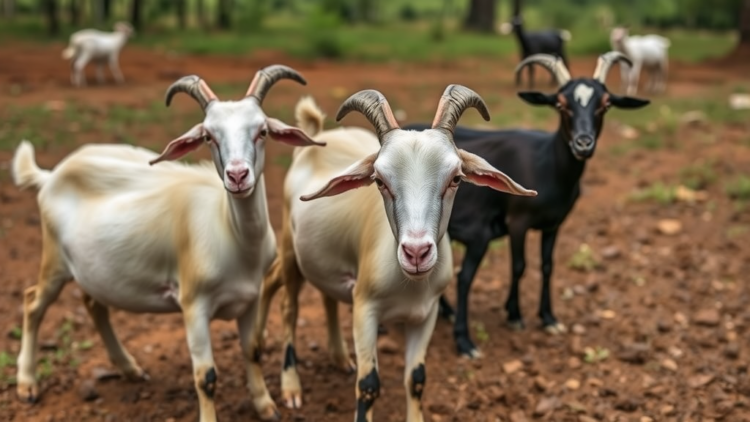
In the semi-arid heartlands of central Tanzania, goats are more than livestock; they are walking savings accounts, insurance policies against drought, and often the only buffer between a rural household and financial disaster. Yet a comprehensive new survey of 450 goat-keeping households in the Dodoma region reveals a striking paradox: farmers trust these hardy animals with their livelihoods, but largely leave the science of raising them behind, clinging to traditional practices even as productivity lags far below its potential.
The study, conducted by researchers at the University of Dodoma and published in BMC Agriculture, spanned three districts—Chemba in the north, Dodoma Urban in the center, and Mpwapwa in the south—chosen to represent the full geographic and agro-ecological range of the region. Using structured questionnaires translated into Swahili and analyzed with statistical tools including chi-square tests, negative binomial regression, and logistic regression in R, the team painted the most detailed picture yet of how smallholder goat production actually works in one of Tanzania’s driest agricultural zones.
The demographic findings set the stage. Nearly three-quarters of surveyed households relied primarily on agriculture, most farming modest plots of one to five hectares. Household heads averaged 42 years of age, with families averaging seven members. About two-thirds of respondents were men, and just over half had completed only primary education. The region itself, receiving a mere 300 to 800 millimeters of rainfall annually and enduring temperatures that swing between 15 and 30 degrees Celsius, is unforgiving terrain for crop farming—which is precisely why goats, with their legendary resilience to heat, water scarcity, and poor forage, dominate the livestock economy here.
When it came to the goats themselves, the picture was one of remarkable genetic uniformity. A staggering 99.8 percent of animals were local breeds, predominantly the Small East African goat, with only a single household in the entire survey raising an improved breed. Herd sizes varied dramatically, ranging from just 2 to as many as 130 goats per household, with a median of 13. The researchers found that households in Mpwapwa kept about 34 percent more goats than those in Chemba, while Dodoma Urban farmers kept roughly 11 percent more. Larger households and those with more land also maintained bigger herds, underscoring the central role of family labor and land availability in scaling production.
But the real story emerged in the management practices. Free-range grazing on communal land dominated completely, employed by 90.4 percent of households, and nearly 70 percent of farmers housed their animals in traditional kraals—simple enclosures that offer minimal protection from predators and harsh weather. Vaccination rates were impressively high at 96.2 percent, and deworming reached 98 percent, suggesting farmers readily adopt interventions with immediate, visible benefits for animal survival. Yet the productivity-enhancing practices told a different story: only 34.4 percent provided supplementary feeding, 32.2 percent offered mineral supplements, a mere 17.1 percent practiced flush feeding to boost reproduction, and just 29.8 percent controlled mating. Reasons for skipping these interventions ranged from financial constraints and limited feed availability to simple lack of awareness, with some farmers genuinely believing that grazing alone provides adequate nutrition.
Perhaps the most surprising finding was the inverse relationship between access to extension services and supplementary feeding. Households that received agricultural extension support were actually less likely to provide supplementary feeds, with an odds ratio of 0.436. The researchers speculate this may reflect extension messaging that emphasizes improved grazing management or locally available feed resources over purchased supplements. It may also hint at deeper problems in how advisory services are perceived and delivered—a phenomenon documented in other parts of Africa, where farmers’ attitudes toward extension quality strongly shape whether recommendations are implemented at all.
District emerged as the single strongest predictor of nearly every management practice measured. Farmers in Chemba were dramatically more likely to provide supplementary feed, mineral supplements, flush feeding, and controlled mating than their counterparts elsewhere. Households in Mpwapwa had roughly 97.6 percent lower odds of providing mineral supplements relative to Chemba, and not a single household in Dodoma Urban reported offering mineral supplements. These stark regional disparities likely reflect underlying differences in agro-ecological conditions, feed availability, market access, and cultural practices—though the study’s cross-sectional design cannot disentangle these factors definitively.
Record keeping, a practice long championed as essential for sustainable herd improvement, showed its own pattern. Farmers with larger landholdings were slightly more likely to maintain production records, with each additional hectare increasing the likelihood by about 2.5 percent. Notably, every single farmer with college-level education in the survey kept records, though the small sample of 13 such individuals prevented statistical modeling of education’s effect. The researchers argue that expanding record-keeping among smallholders could help farmers track reproduction, health events, and productivity trends, enabling more informed management decisions over time.
The study’s implications stretch beyond Dodoma. Globally, goat populations now exceed 700 million animals, with Africa hosting more than 40 percent of them, and Tanzania alone home to roughly 24.8 million goats. As climate change intensifies pressure on rain-fed agriculture across sub-Saharan Africa, goats are increasingly viewed as a climate-resilient livestock option, able to thrive where cattle and sheep struggle. Yet the Dodoma findings suggest that without targeted, district-specific interventions—improved housing to reduce predation losses, affordable feed strategies using fodder trees and crop residues, and reproductive management training—this potential will remain largely untapped, locked inside a production system that has changed remarkably little despite the enormous stakes involved.
Subject of Research: Smallholder goat production systems and management practice adoption in semi-arid Dodoma, Tanzania
Article Title: Smallholder goat production and management practices in Dodoma, a semi-arid region of Tanzania
Article References: Athumani, P. C., Mramba, R. P., Ngumba, J. A., Ngongolo, K., Mmbaga, N. E., & Nchimbi, H. Y. (2026). Smallholder goat production and management practices in Dodoma, a semi-arid region of Tanzania. BMC Agriculture, 2(1), Article 22. https://doi.org/10.1186/s44399-026-00046-w
Image Credits: AI Generated
DOI: 10.1186/s44399-026-00046-w
Keywords: goat production, smallholder farming, Tanzania, Dodoma, semi-arid agriculture, livestock management, supplementary feeding, vaccination, free-range grazing, controlled mating, extension services, food security
Cite Scienmag News
APA
MLA
Chicago
Alan Morgan. (September 12, 2026). Goat Farming in Tanzania Stays Traditional, New Survey of 450 Households Reveals. Scienmag. https://scienmag.com/goat-farming-in-tanzania-stays-traditional-new-survey-of-450-households-reveals/
Alan Morgan. “Goat Farming in Tanzania Stays Traditional, New Survey of 450 Households Reveals.” Scienmag, 12 September 2026, https://scienmag.com/goat-farming-in-tanzania-stays-traditional-new-survey-of-450-households-reveals/. Accessed 12 September 2026.
Alan Morgan. “Goat Farming in Tanzania Stays Traditional, New Survey of 450 Households Reveals.” Scienmag. September 12, 2026. https://scienmag.com/goat-farming-in-tanzania-stays-traditional-new-survey-of-450-households-reveals/
Copy citation
Download RIS
Tags: agricultural survey Tanzaniacontrolled matingDodomaextension servicesFood securityfree-range grazinggoat as financial buffergoat husbandry practicesgoat productionimpact of drought on livestocklivestock managementlivestock management in Dodomarural economic resiliencerural household livelihoodssemi-arid agriculturesemi-arid agriculture in Tanzaniasmallholder farmingsmallholder goat productionsupplementary feedingTanzaniaTanzania goat farmingtraditional livestock practicestraditional versus modern farming methodsvaccination