New study published in Geology
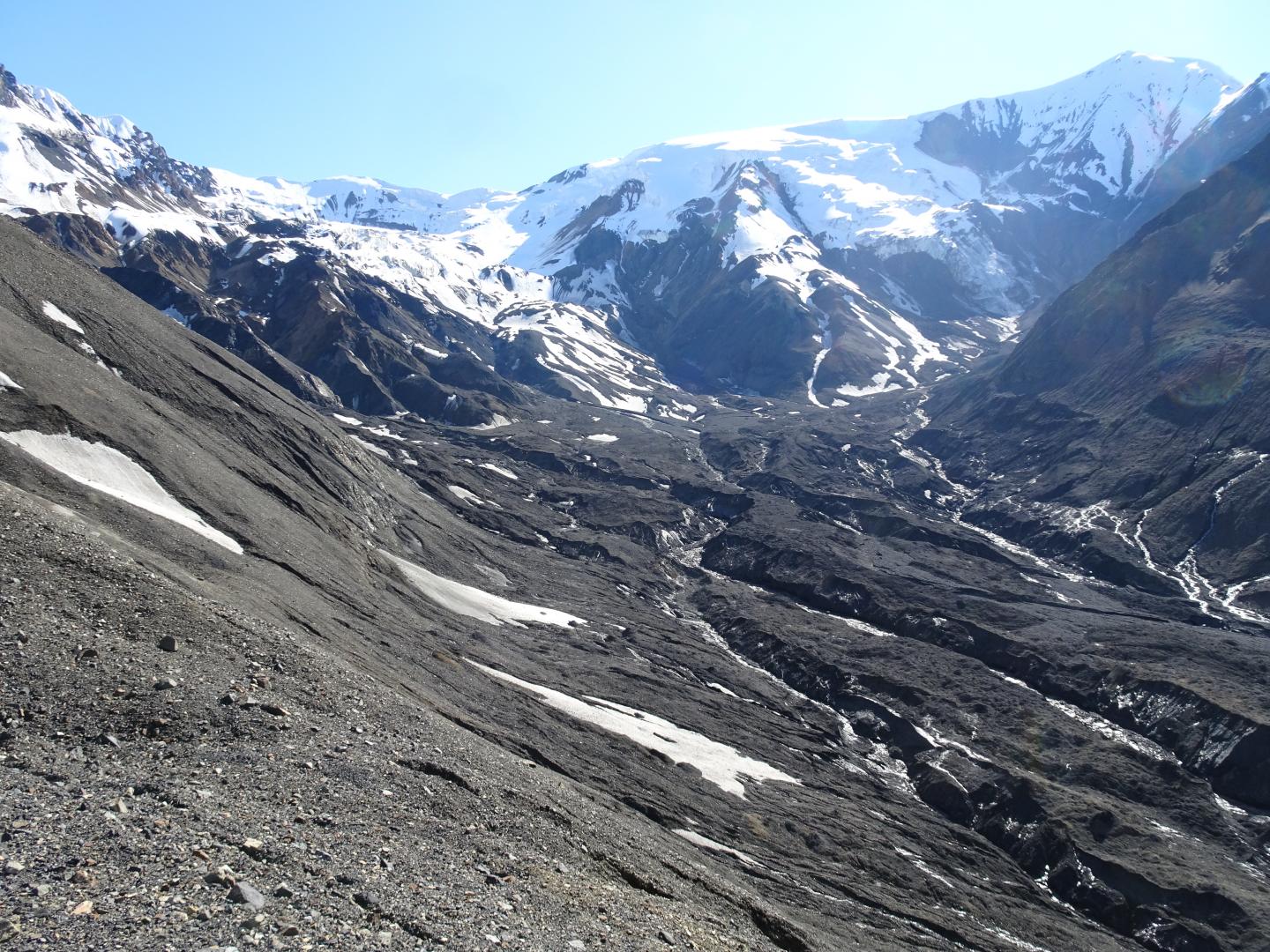
Credit: Photo credit: Mylène Jacquemart.
Boulder, Colo., USA: On the evening of 5 August 2013, a startling event occurred deep in the remote interior of the United States’ largest national park. A half-kilometer-long tongue of Alaska’s Flat Creek glacier suddenly broke off, unleashing a torrent of ice and rock that rushed 11 kilometers down a rugged mountain valley into the wilderness encompassed by Wrangell-St. Elias National Park and Preserve.
After National Park Service geologist Michael Loso documented a similar event in the same location in 2015, he recruited Mylène Jacquemart, a Ph.D. student at the University of Colorado Boulder, to investigate. “We were aware of glacier detachments that had happened in Tibet, Russia, and Argentina, but started out thinking we were investigating a regular landslide,” says Jacquemart. “Then we noticed that the entire glacier was missing.”
The results, published in Geology, indicate the Alaskan detachments occurred at the height of the summer melt seasons and suggest these highly destructive events could occur more frequently in a warming world.
After National Park Service geologist Michael Loso conducted preliminary research that ruled out a seismic trigger for these events, he, Jacquemart, and other experts began a research project to investigate what had happened at Flat Creek. The team used a variety of tools, including satellite imagery, field measurements, digital elevation models, and meltwater modeling, to piece together the sequence of events. “This project was a real sleuthing challenge,” says Jacquemart, “and the pieces finally fell into place when we discovered the bulge on the Flat Creek glacier.”
Although the researchers were aware that an odd ice bulge existed on the glacier’s tongue prior to the first detachment in 2013, it wasn’t until they obtained 10-year-old, high-resolution satellite images and estimated that the bulge was an impressive 70 meters high that they began to understand its implications. “Our data indicate that the lowermost part of the glacier tongue was very thin, stagnant, and firmly frozen to the glacier bed,” Jacquemart says. “We believe this frozen tongue did two things: it blocked ice flowing down from higher on the glacier, forcing it to bulge; and it slowed meltwater drainage, allowing the water to pool under the glacier.” The resulting increase in subglacial water pressure, she says, eventually caused the glacier tongue to suddenly detach, resulting in two mass flows so large that they each buried about 3 square kilometers of 400-year-old forest.
Glaciers are primarily disappearing as a result of their ice melting at a faster pace, says Jacquemart. “But the new insights we’re gaining from places like Flat Creek show that we also need to consider new processes we weren’t previously aware of.” Ultimately, says Jacquemart, scientists will need to develop a better understanding of these new processes and potentially reevaluate hazard assessments in mountain communities.
“Flat Creek is fortunately in a very remote place,” says Jacquemart, “but the detachments that occurred in Russia and Tibet claimed numerous lives.” Given that the mass flows produced by glacier detachments appear to travel quite far, she says, emergency planners also need to consider possible cascading hazards, such as the temporary damming of a river followed by the water’s release. “Suddenly, a remote event can have far-reaching impacts downstream,” says Jacquemart.
The similarity of the glacier detachments in Alaska with those that occurred in Tibet suggest that all of these events shared a common cause. Other detachments elsewhere in the world have also been recently discovered, says Jacquemart, suggesting that large-scale glacier detachments may be exacerbated by global warming. “We conclude that the meltwater produced by increasingly warmer summers has the potential to create unexpected consequences in the form of hazards that we didn’t previously know about”, says Jacquemart, “and that we are only just beginning to understand.”
###
FEATURED ARTICLE
What drives large-scale glacier detachments? Insights from Flat Creek glacier, St. Elias Mountains, Alaska
Mylène Jacquemart et al., [email protected]
URL: https:/
Video: https:/
GEOLOGY articles are online at https:/
https:/
Media Contact
Kea Giles
[email protected]
Original Source
https:/
Related Journal Article
http://dx.