• HOME
  • NEWS
  • EXPLORE
    • CAREER
      • Companies
      • Jobs
    • EVENTS
    • iGEM
      • News
      • Team
    • PHOTOS
    • VIDEO
    • WIKI
  • BLOG
  • COMMUNITY
    • FACEBOOK
    • INSTAGRAM
    • TWITTER
Monday, May 11, 2026
BIOENGINEER.ORG
No Result
View All Result
  • Login
  • HOME
  • NEWS
  • EXPLORE
    • CAREER
      • Companies
      • Jobs
        • Lecturer
        • PhD Studentship
        • Postdoc
        • Research Assistant
    • EVENTS
    • iGEM
      • News
      • Team
    • PHOTOS
    • VIDEO
    • WIKI
  • BLOG
  • COMMUNITY
    • FACEBOOK
    • INSTAGRAM
    • TWITTER
  • HOME
  • NEWS
  • EXPLORE
    • CAREER
      • Companies
      • Jobs
        • Lecturer
        • PhD Studentship
        • Postdoc
        • Research Assistant
    • EVENTS
    • iGEM
      • News
      • Team
    • PHOTOS
    • VIDEO
    • WIKI
  • BLOG
  • COMMUNITY
    • FACEBOOK
    • INSTAGRAM
    • TWITTER
No Result
View All Result
Bioengineer.org
No Result
View All Result
Home NEWS Science News Chemistry

Giant 2D atlas of the universe helps dark energy spectroscopic survey

Bioengineer by Bioengineer
January 14, 2021
in Chemistry
Reading Time: 2 mins read
0
IMAGE
Share on FacebookShare on TwitterShare on LinkedinShare on RedditShare on Telegram

IMAGE

Credit: DESI website

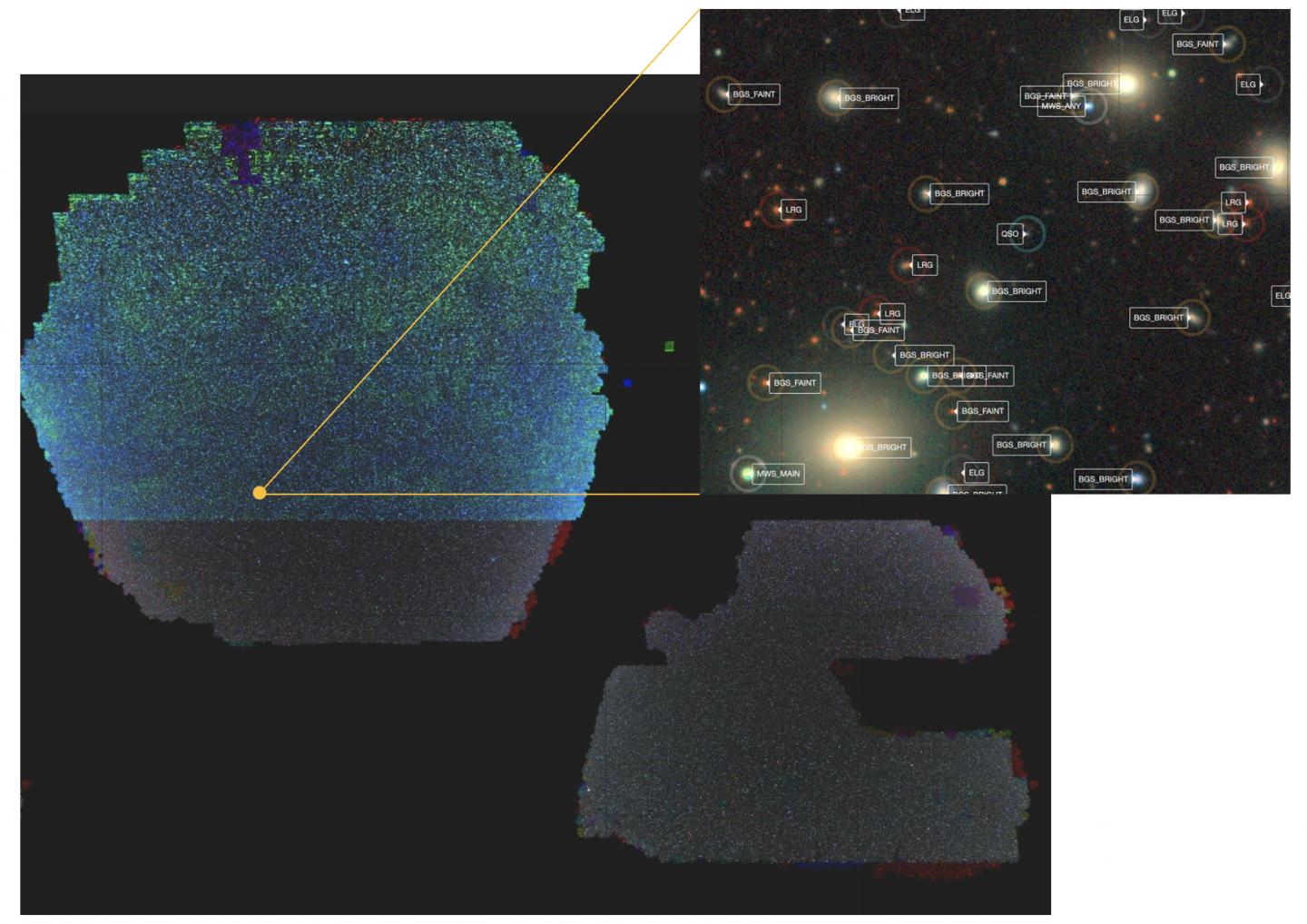
The Beijing-Arizona Sky Survey (BASS) team of National Astronomical Observatories of Chinese Academy of Sciences (NAOC) and their collaborators of the Dark Energy Spectroscopic Instrument (DESI) project released a giant 2D map of the universe, which paves the way for the upcoming new-generation dark energy spectroscopic survey.

Modern astronomical observations reveal that the universe is expanding and appears to be accelerating. The power driving the expansion of the universe is called dark energy by astronomers. The dark energy is still a mystery and accounts for about 68% of the substance of the universe.

Large-scale redshift measurements of galaxies can describe the 3D distribution of the matter and reveal the effect of dark energy on the expansion of the universe.
The DESI project is a new-generation cosmological redshift survey. ZHAO Gongbo, Deputy Director-General of NAOC and a member of DESI, said “DESI will execute a five-year mission to obtain the redshifts of millions of galaxies and construct the largest 3D universe. It is expected to solve the mystery of dark energy.”

“Before DESI begins, researchers need a larger and deeper 2D map of the universe to meet the targeting requirements of such large-scale spectroscopic observations,” said ZOU Hu, one of the BASS co-PIs and an associate professor in NAOC.

Nearly 200 researchers from NAOC and DESI collaborators put much effort on the joint observing and data analyzing in the past six years. They stitch together the observed images and form a giant 2D map of the universe.

Nathalie Palanque-Delabrouille, DESI co-spokesperson and a cosmologist at the French Alternative Energies and Atomic Energy Commission (CEA), said “DESI wouldn’t be getting anywhere without such large imaging surveys.”

“This is the biggest map by almost any measure. The map covers half of the sky, and digitally sprawls over 10 trillion pixelsand contains about two billion objects,” said David Schlegel, the co-project scientist for DESI and leader of the imaging project.

In the 2D map of the universe, the BASS contributes the northern sky. It is an international collaboration between NAOC and University of Arizona in the U.S. XUE Suijian from NAOC said “Chinese astronomers have joined in DESI as the builders due to the BASS contribution.”

The DESI imaging team also released eight versions of data specially for the DESI targeting. This data release is the final release. It includes the largest imaging area and the most precise object measurements, according to CUI Chenzhou, the execute director of National Astronomical Data Center.

This release will ensure to implement the DESI project successfully. In addition, the data will become the legacy data for the astronomical community all around the world and play a valuable role on the scientific applications.

BASS was supported by the Strategic Priority Research Program and External Cooperation Program of the Chinese Academy of Sciences.

###

Media Contact
XU Ang
[email protected]

Original Source

http://english.cas.cn/

Tags: AstronomyAstrophysicsSpace/Planetary Science
Share12Tweet8Share2ShareShareShare2

Related Posts

Miniature Sensor Uses Light to Detect Touch — Chemistry

Miniature Sensor Uses Light to Detect Touch

May 8, 2026
Iron Minerals Determine Whether Dissolved Organic Matter Fuels Microbes or Becomes Long-Term Carbon Storage — Chemistry

Iron Minerals Determine Whether Dissolved Organic Matter Fuels Microbes or Becomes Long-Term Carbon Storage

May 8, 2026

Kate Evans Appointed Associate Lab Director for Biological and Environmental Systems Science at ORNL

May 8, 2026

Advancing Multiscale Modeling and Overcoming Operational Challenges in Autothermal COâ‚‚-to-Methanol Reactors

May 8, 2026
Please login to join discussion

POPULAR NEWS

  • Research Indicates Potential Connection Between Prenatal Medication Exposure and Elevated Autism Risk

    840 shares
    Share 336 Tweet 210
  • New Study Reveals Plants Can Detect the Sound of Rain

    727 shares
    Share 290 Tweet 181
  • Salmonella Haem Blocks Macrophages, Boosts Infection

    61 shares
    Share 24 Tweet 15
  • Breastmilk Balances E. coli and Beneficial Bacteria in Infant Gut Microbiomes

    57 shares
    Share 23 Tweet 14

About

We bring you the latest biotechnology news from best research centers and universities around the world. Check our website.

Follow us

Recent News

New Post-Hoc Analysis Explores Daily Oral Orforglipron Use in Adults Over 65 with Obesity, Regardless of Diabetes Status

Evaluating Digoxin Use in Patients with Symptomatic Rheumatic Heart Disease

Evaluating the Effectiveness and Safety of Digitalis Glycosides in Treating Heart Failure

Subscribe to Blog via Email

Enter your email address to subscribe to this blog and receive notifications of new posts by email.

Join 82 other subscribers
  • Contact Us

Bioengineer.org © Copyright 2023 All Rights Reserved.

Welcome Back!

Login to your account below

Forgotten Password?

Retrieve your password

Please enter your username or email address to reset your password.

Log In
No Result
View All Result
  • Homepages
    • Home Page 1
    • Home Page 2
  • News
  • National
  • Business
  • Health
  • Lifestyle
  • Science

Bioengineer.org © Copyright 2023 All Rights Reserved.