• HOME
  • NEWS
  • EXPLORE
    • CAREER
      • Companies
      • Jobs
    • EVENTS
    • iGEM
      • News
      • Team
    • PHOTOS
    • VIDEO
    • WIKI
  • BLOG
  • COMMUNITY
    • FACEBOOK
    • INSTAGRAM
    • TWITTER
Saturday, July 4, 2026
BIOENGINEER.ORG
No Result
View All Result
  • Login
  • HOME
  • NEWS
  • EXPLORE
    • CAREER
      • Companies
      • Jobs
        • Lecturer
        • PhD Studentship
        • Postdoc
        • Research Assistant
    • EVENTS
    • iGEM
      • News
      • Team
    • PHOTOS
    • VIDEO
    • WIKI
  • BLOG
  • COMMUNITY
    • FACEBOOK
    • INSTAGRAM
    • TWITTER
  • HOME
  • NEWS
  • EXPLORE
    • CAREER
      • Companies
      • Jobs
        • Lecturer
        • PhD Studentship
        • Postdoc
        • Research Assistant
    • EVENTS
    • iGEM
      • News
      • Team
    • PHOTOS
    • VIDEO
    • WIKI
  • BLOG
  • COMMUNITY
    • FACEBOOK
    • INSTAGRAM
    • TWITTER
No Result
View All Result
Bioengineer.org
No Result
View All Result
Home NEWS Science News Chemistry

Get diamonds, take temperature

Bioengineer by Bioengineer
September 11, 2020
in Chemistry
Reading Time: 3 mins read
0
IMAGE
Share on FacebookShare on TwitterShare on LinkedinShare on RedditShare on Telegram

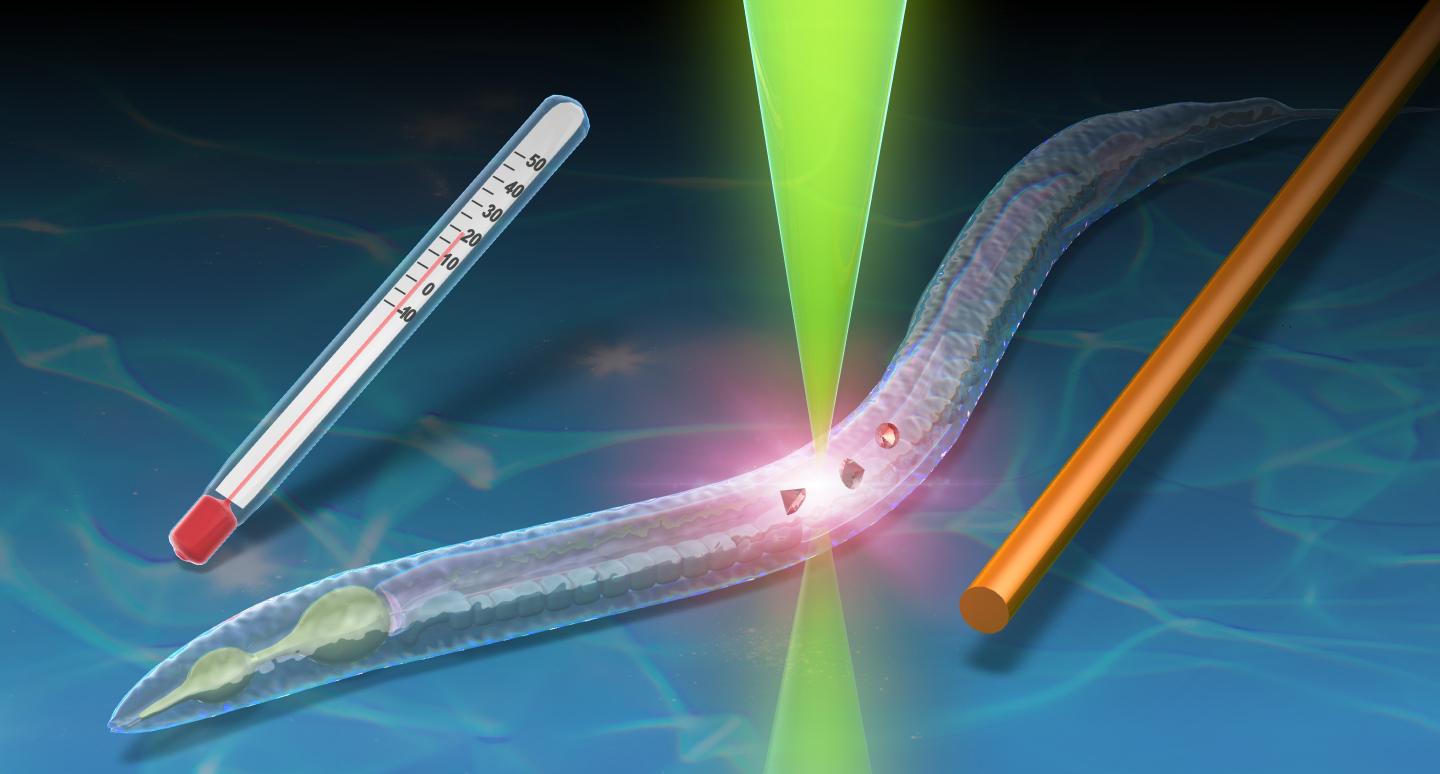
Quantum thermometer using nanodiamonds senses a ‘fever’ in tiny worms C. elegans
IMAGE

Credit: Masazumi Fujiwara, Osaka City University

A team from Osaka City University, in collaboration with other international partners, has demonstrated a reliable and precise microscope-based thermometer that works in live, microscopic animals based on quantum technology, specifically, detecting temperature-dependent properties of quantum spins in fluorescent nanodiamonds.

The research is published in Science Advances.

The optical microscope is one of the most basic tools for analysis in biology that uses visible light to allow the naked eye to see microscopic structures. In the modern laboratory, fluorescence microscope, an enhanced version of the optical microscope with various fluorescent biomarkers, is more frequently used. Recent advancements in such fluorescence microscopy have allowed for live imaging of the details of a structure, and through this, obtaining various physiological parameters in these structures, such as pH, reactive oxygen species, and temperature.

Quantum sensing is a technology that exploits the ultimate sensitivity of fragile quantum systems to the surrounding environment. High-contrast MRIs are examples of quantum spins in fluorescent diamonds and are some of the most advanced quantum systems working at the forefront of real-world applications. Applications of this technique to thermal biology were introduced seven years ago to quantify temperatures inside cultured cells. However, they had yet to be applied to dynamic biological systems where heat and temperature are more actively involved in biological processes.

The research team decorated the surface of the nanodiamonds with polymer structures and injected them to C. elegans nematode worms, one of the most popular model animals in biology. They needed to know the base “healthy” temperature of the worms. Once inside, the nanodiamonds moved quickly but the team’s novel quantum thermometry algorithm successfully tracked them and steadily measured the temperature. A fever was induced within the worms by stimulating their mitochondria with a pharmacological treatment. The team’s quantum thermometer successfully observed a temperature increase in the worms.

“It was fascinating to see quantum technology work so well in live animals and I never imagined the temperature of tiny worms less than 1 mm in size could deviate from the norm and develop into a fever,” said Masazumi Fujiwara, a lecturer at the Department of Science at Osaka City University. “Our results are an important milestone that will guide the future direction of quantum sensing as it shows how it contributes to biology,”

###

Osaka City University’s strategic grant spearheaded this interdisciplinary and international collaboration of six institutions from four countries, consisting of Osaka City University, Keio University, Kyoto University from Japan, Humboldt University of Berlin (Germany), Soochow University (China), and Chapman University (USA).

This research was co-authored by Fujiwara, Sun, Dohms, Nishimura, Suto, Takezawa, Oshimi, Zhao, Sadzak, Umehara, Teki, Komatsu, Benson, Shikano and Kage-Nakadai.

Short Video is available at: https://youtu.be/ypMC2scei6I

Media Contact
James Gracey
[email protected]

Original Source

https://www.osaka-cu.ac.jp/en/news/2020/200912-1

Related Journal Article

http://dx.doi.org/10.1126/sciadv.aba9636

Tags: Biomechanics/BiophysicsBiomedical/Environmental/Chemical EngineeringChemistry/Physics/Materials SciencesMaterialsNanotechnology/MicromachinesOpticsPolymer Chemistry
Share13Tweet8Share2ShareShareShare2

Related Posts

Intelligent Microgrid Management Promises Lower Household Energy Bills and Reduced Diesel Emissions — Chemistry

Intelligent Microgrid Management Promises Lower Household Energy Bills and Reduced Diesel Emissions

July 4, 2026
Graz University of Technology Deciphers the Structural Secrets of MOF Thin Films — Chemistry

Graz University of Technology Deciphers the Structural Secrets of MOF Thin Films

July 2, 2026

Breaking Thermodynamic Limits: Wavelength-Driven Catalysis Advances Ammonia Synthesis

July 2, 2026

From Quantum Mechanics to AI-Powered Materials Discovery: MARVEL Marks 12 Years of Transforming Computational Science

July 2, 2026
Please login to join discussion

POPULAR NEWS

  • Detection of EDCs in Breast Milk and Infant Urine Up to Six Months Highlights Early Exposure Risks

    77 shares
    Share 31 Tweet 19
  • Saying Goodbye to PGY-6: Pediatric Fellowship Realities

    103 shares
    Share 41 Tweet 26
  • New Drug Candidate Developed at McMaster Shows Potential for Treating Brain Cancer

    58 shares
    Share 23 Tweet 15
  • KTU Researchers Explore Ultrasound’s Role in Enhancing Blood Flow Beyond Diagnostics

    53 shares
    Share 21 Tweet 13

About

We bring you the latest biotechnology news from best research centers and universities around the world. Check our website.

Follow us

Recent News

Quasi-Bound States Boost Quantum Well Photoresponse

Lysine Pyruvylation Links Glycolysis to Epigenetics

Multiphysics Coupling: Single vs. Multiple DeepONet Branches

Subscribe to Blog via Email

Enter your email address to subscribe to this blog and receive notifications of new posts by email.

Join 83 other subscribers
  • Contact Us

Bioengineer.org © Copyright 2023 All Rights Reserved.

Welcome Back!

Login to your account below

Forgotten Password?

Retrieve your password

Please enter your username or email address to reset your password.

Log In
No Result
View All Result
  • Homepages
    • Home Page 1
    • Home Page 2
  • News
  • National
  • Business
  • Health
  • Lifestyle
  • Science

Bioengineer.org © Copyright 2023 All Rights Reserved.