


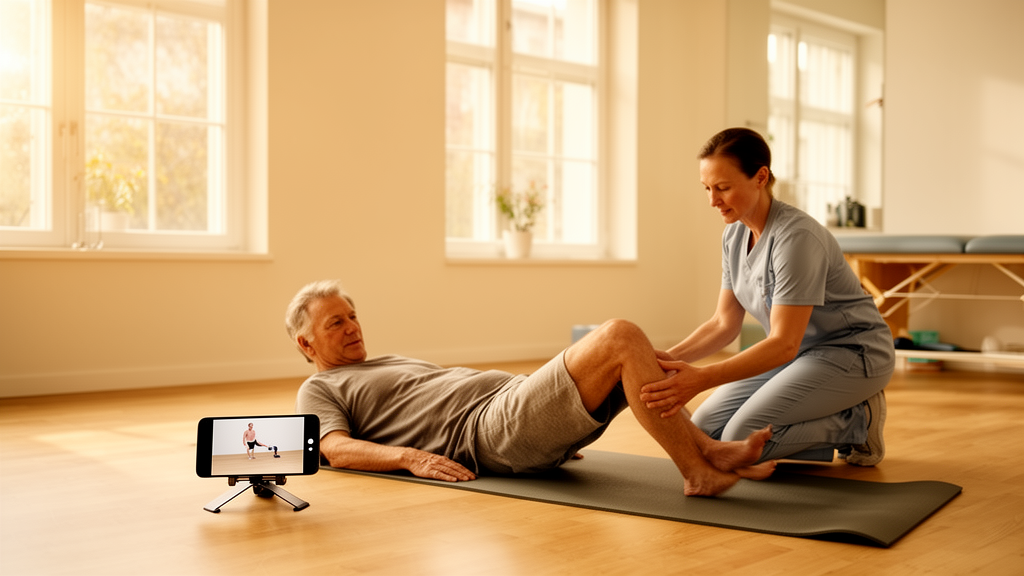
Adults in Germany who were prescribed a digital health application for knee injuries generally welcomed the technology, valuing its flexibility and its ability to bridge gaps in physiotherapy, while flagging limited personalisation, usability problems and administrative delays as key obstacles, according to a qualitative study published in BMC Musculoskeletal Disorders.
The exploratory study took place at an academic outpatient clinic for orthopaedics and trauma surgery in Germany. Researchers recruited ten adult patients aged 18 to 65 years with anterior cruciate ligament rupture or meniscal injury, all of whom had been prescribed the DiGA “Orthopy”, a prescription-based digital health application available within the German healthcare system.
Participants took part in semi-structured telephone interviews at the time of prescription, with all ten interviewed at baseline. Approximately two to three weeks later, six participants completed follow-up interviews, one of which occurred after twelve weeks. The four participants who withdrew from follow-up completed a dropout questionnaire. Data were analysed using qualitative content analysis according to Kuckartz, with main categories derived deductively from the research question and subcategories developed inductively from the data. Baseline and follow-up interviews of the six completing participants were compared within and across cases.
Across the interviews, participants were generally open to using the app and identified its flexibility, location independence and role in bridging gaps in physiotherapy as major advantages. Importantly, the DiGA was primarily perceived as a complementary tool rather than a replacement for conventional therapy, a distinction the researchers highlighted in their conclusions.
The perceived strengths of the application included structured exercise guidance, educational content and easy integration into daily routines, particularly in the prehabilitation period before surgery.
However, the interviews also revealed consistent challenges. Participants reported limited personalisation and insufficient adaptation of the app’s feedback, and noted that the application offered limited motivational benefit when used without accompanying professional guidance. Additional barriers included administrative delays in activating the prescription, usability issues among less digitally literate users, and insufficient guidance from physicians.
Notably, data privacy concerns played only a minor role among the participants, and the interviewed patients did not report serious safety concerns during the short observation period, which the authors caution covered only a limited timeframe.
The study’s authors conclude that participants perceived the DiGA as a suitable complement to physiotherapy in orthopaedic care, particularly for prehabilitation and continuity of care. They suggest that better personalisation, improved usability and stronger integration into existing care structures could further enhance the app’s perceived value. At the same time, they emphasise that long-term adherence, clinical effectiveness, safety and sustainable implementation remain to be established, and that future research should address these questions alongside patient-centred design.
The findings come against a broader backdrop in which musculoskeletal disorders are among the leading causes of chronic pain, functional limitations and reduced quality of life worldwide, and in which prescription-based digital health applications are seen as having potential to improve outpatient care, enhance treatment adherence and address structural challenges such as shortages in physiotherapy services. The authors note that real-world evidence on DiGA use from the patient perspective in orthopaedic settings within the German healthcare context remains limited, which motivated the present study.
The study was registered in the German Clinical Trials Register (DRKS00036514) on 10 April 2025, after data collection had begun in January 2025, and is therefore retrospectively registered. Trustworthiness of the analysis was supported by iterative coding, an intra-coder consistency check and team discussion of the coding frame, although coding was performed by a single researcher. As an exploratory qualitative study of ten patients at a single clinic with a short follow-up period, the findings describe patient perceptions rather than clinical outcomes, and the authors stress that the app’s longer-term value in orthopaedic care still requires further investigation.
Subject of Research: Patient experiences with a prescription-based digital health application for knee disorders in German orthopaedic care
Article Title: Patient experiences with a prescription-based digital health application (DiGA) for knee disorders: a qualitative study in german orthopaedic care
Article References: Burgert, S., Raab, N., Kornfeld, T., Knitza, J., Boy, K., Schwarz, J., May, S., Heinze, M., & Mühlensiepen, F. (2026). Patient experiences with a prescription-based digital health application (DiGA) for knee disorders: a qualitative study in german orthopaedic care. BMC Musculoskeletal Disorders. https://doi.org/10.1186/s12891-026-10550-4
Image Credits: AI Generated
DOI: 10.1186/s12891-026-10550-4
Keywords: digital health application, DiGA, knee disorders, orthopaedics, physiotherapy, qualitative study, patient experience, prehabilitation, anterior cruciate ligament, meniscal injury, Germany, telehealth
News Source: Ophelia Keating. (October 29, 2026). German patients see prescribed knee app as a useful complement to physiotherapy, not a replacement. Scienmag.



