ATLANTA — Georgia State Professor of Physics & Astronomy Stuart Jefferies has been awarded a $5 million, multi-institutional grant by the U.S. Air Force to develop techniques to detect, map and image faint objects in space.
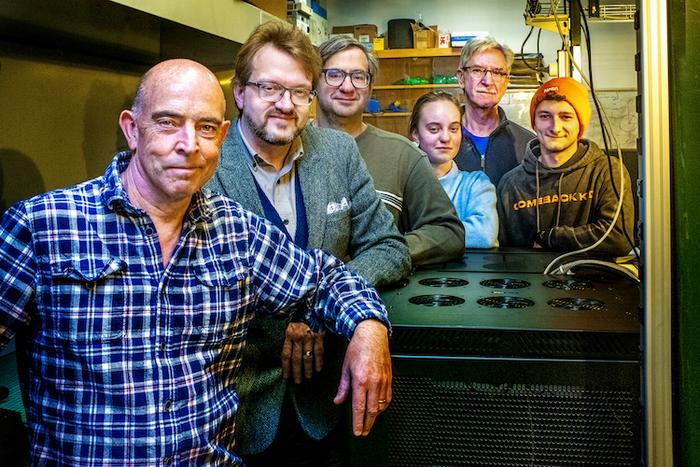
Credit: Credit: Steven Thackston, Georgia State University
ATLANTA — Georgia State Professor of Physics & Astronomy Stuart Jefferies has been awarded a $5 million, multi-institutional grant by the U.S. Air Force to develop techniques to detect, map and image faint objects in space.
The work could have far-reaching impacts, including strengthening national security in an increasingly congested space domain. The work will also advance the next generation of exceptionally large telescopes and improve the capabilities of astronomers studying the universe by providing images that are significantly sharper than those from existing telescopes.
“Detecting objects in the space region between where many communications satellites are located extending to the distance at which the Moon orbits the Earth presents a substantial challenge,” Jefferies said. “The faintness of these objects makes observation difficult using ground-based telescopes, as they are starved of photons from the target of interest, creating a potential vulnerability that adversaries could exploit.”
Jefferies will lead the research under the grant “Space Domain Awareness in a Photon Starved Environment” with experts from academic institutions including the University of Hawai’i, University of Minnesota and the Georgia Tech Research Institute.
The Georgia State team will also collaborate with government contractors and Air Force researchers at the Air Force Maui Optical and Supercomputing (AMOS) Site on Maui and at Kirtland Air Force Base in New Mexico.
“The Air Force recognizes the significance of fostering collaboration among researchers from these diverse domains, each offering unique perspectives,” Jefferies said. “This multidisciplinary approach aims to push the boundaries of telescope technology and advance our understanding of celestial bodies.”
Space Domain Awareness (SDA) is the comprehensive examination and surveillance of objects within the realm of space, specifically focusing on satellites orbiting Earth. It includes detection, tracking, cataloging and identifying artificial entities such as active or inactive satellites, spent rocket stages and fragments from previous missions. SDA plays a crucial role in decision-making across tactical, operational and strategic levels to meet national security objectives.
Jefferies said researchers at the University of Hawai’i are pioneering the development of innovative optics to create financially viable, extremely large-aperture telescopes. This telescope design combines elements of traditional telescopes and interferometers, like Georgia State’s CHARA Array, to create a Hybrid Optical Telescope (HOT). Collaborating with Georgia State researchers, the UH team will work to address the inherent blurring of images caused by Earth’s turbulent atmosphere to achieve the full resolution potential of the telescope.
The University of Minnesota team is investigating ways to use the HOT system to not only identify and describe dim celestial objects but also to laser-light illuminate them in order to improve visibility.
Scientists at the Georgia Tech Research Institute will examine satellite material composition using spectral analysis. Their aim is to understand the effects of weathering caused by radiation on the properties of these materials.
Some of the work that falls under this award will likely tap into the expertise gained from the Imaging Innovation Hub (IIH) which was developed in part with support from a Georgia State Research Innovation and Scholarly Excellence (RISE) grant.
Georgia State’s RISE initiative was established in 2022 to address complex societal problems through interdisciplinary collaboration. The initiative aims to foster an innovative research ecosystem at the university and leverage the strengths of the research community to address complex problems.
Over the past two decades, Jefferies’ research has focused on achieving clear images of objects in space through ground-based telescopes, including images of the Sun. His work to capture high-resolution images of the Sun has taken him to the far reaches of the South Pole.
According to Jefferies, this research over the next five years will be crucial in developing the next generation of exceptionally large telescopes and the related techniques needed to fully utilize them.
“While the James Webb Space Telescope (JWST) is currently transforming our perspectives of the cosmos, envisioning telescopes surpassing JWST in size by more than fivefold and impervious to atmospheric blurring marks a significant leap forward in our quest to deepen our understanding of the universe,” he said.
For more information on Jefferies’ work, visit his website.