Credit: Center for Global Health Science and Security at Georgetown University Medical Center
WASHINGTON (Sept. 14, 2020) — In a new report commissioned by the Global Preparedness Monitoring Board (GPMB), Georgetown global health experts say the success of any effort to redress pandemic preparedness failures demonstrated by COVID-19 requires a re-centering of governance that would include greater accountability, transparency, equity, participation and the rule of law.
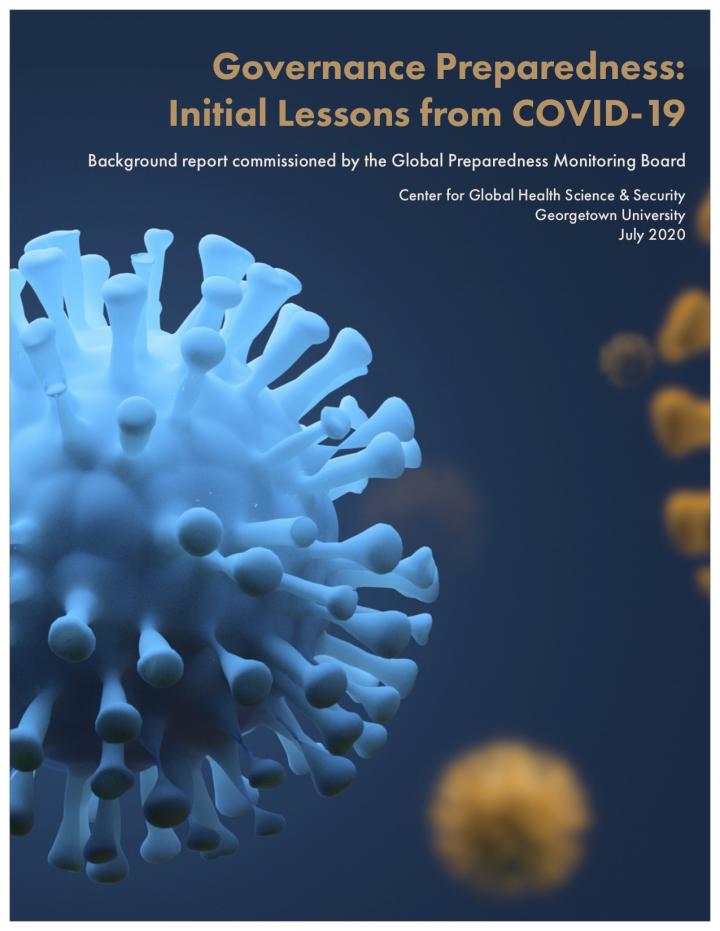
The report, Governance Preparedness: Initial Lessons from COVID-19, was published today by the Center for Global Health Science and Security at Georgetown University Medical Center.
“The COVID-19 pandemic has revealed a failure in preparedness arising from a failure of governance in global collective action, including coordination and engagement with multilateral systems, and financing, including chronic underinvestment in preparedness as well as states withdrawing financial support,” write the report’s authors, global health legal and policy expert Alexandra Phelan, SJD, LLM, LLB and global health security expert Rebecca Katz, PhD, MPH.
The work of this report informed the GPMB 2020 Annual Report also released today.
Phelan and Katz have identified key strategies to re-center and improve governance preparedness:
- 1. Re-establish global norms of solidarity and multilateral cooperation, including through critical reform of the International Health Regulations;
2. Consider new mechanisms to support data sharing, research and development, and equitable access to diagnostics, treatments, vaccines, and medical goods;
3. Immediately address funding constraints on the World Health Organization through increases in assessed contributions;
4. Develop frameworks and processes for more cohesive and responsive coordination between international institutions and instilling pandemic preparedness in all policies at the international level; and
5. Actively incorporate principles of good governance into international and national decision-making bodies and processes.
Using lessons from governance of other global challenges, the authors say these strategies would ensure better preparedness for collective action and financing in the medium- and long-term future.
The opinions expressed in this report are those of the authors. They do not purport to reflect the opinions, views, or recommendations of the GPMB.
###
About the Global Preparedness Monitoring Board
As an independent monitoring and advocacy body, the GPMB urges political action to prepare for and mitigate the effects of global health emergencies. Co-convened by the World Bank Group and the WHO, the GPMB works independently to provide expert assessments and recommendations on the state of global preparedness. The opinions and recommendations of the GPMB are those of the Board and do not necessarily represent the views of the World Bank Group and WHO.
About Georgetown University Medical Center
As a top academic health and science center, Georgetown University Medical Center provides, in a synergistic fashion, excellence in education — training physicians, nurses and other health care professionals, as well as biomedical scientists — and cutting-edge interdisciplinary research collaboration, enhancing our basic science and translational biomedical research capacity in order to improve human health. Patient care and clinical research is conducted with our clinical partner, MedStar Health. GUMC’s mission is carried out with a strong emphasis on social justice and a dedication to the Catholic, Jesuit principle of cura personalis — or “care of the whole person.” GUMC comprises the School of Medicine, the School of Nursing & Health Studies, Biomedical Graduate Education, and Georgetown Lombardi Comprehensive Cancer Center. Designated by the Carnegie Foundation as a “very high research activity university,” Georgetown is home to a Clinical and Translational Science Award from the National Institutes of Health, and a Comprehensive Cancer Center designation from the National Cancer Institute. Connect with GUMC on Facebook (Facebook.com/GUMCUpdate) and on Twitter (@gumedcenter).
Media Contact
Karen Teber
[email protected]