


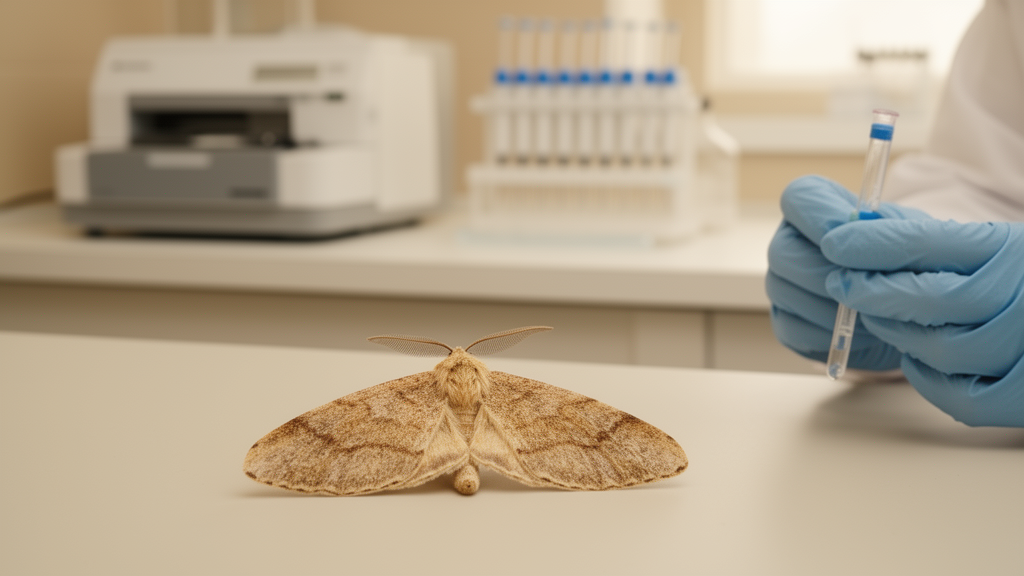
The spongy moth, Lymantria dispar, has long been a model of how taxonomy and pest regulation intertwine. For decades, entomologists and quarantine authorities have sorted this major defoliator into three subspecies—L. d. dispar, L. d. asiatica, and L. d. japonica—largely on the basis of morphology, geographic range, and whether females can fly. A new review published in Frontiers in Insect Science argues that this tidy framework no longer matches what genome-wide data reveal about the species, and that phytosanitary diagnostics must change accordingly.
The review, authored by researchers at the Institute of Plant Biology and Biotechnology and Al-Farabi Kazakh National University in Almaty, Kazakhstan, is a structured narrative review rather than a systematic one, drawing on literature searched through Web of Science, Scopus, PubMed, and Google Scholar with a final search in September 2026. Its central message is that subspecies identity, geographic provenance, genomic ancestry, and traits linked to invasion risk are four distinct kinds of information that have too often been collapsed into a single label.
The stakes are considerable. Lymantria dispar is native to Eurasia and northern Africa and became established in parts of North America after introduction. Its phytosanitary significance stems from a broad larval host range—more than 500 plant species have been recorded as hosts of flight-capable Asian populations—aerial dispersal of young larvae by ballooning, and the passive transport of egg masses on ships and cargo. In East Asian ports, flight-capable females are attracted to artificial lighting and lay viable egg masses on vessels and containers, allowing larvae to emerge far from home and disperse into surrounding vegetation.
Regulatory systems treat the subspecies very differently. In the United States, L. d. dispar is a long-established invasive form regulated through federal and state quarantine, while L. d. asiatica and L. d. japonica fall within the Flighted Spongy Moth Complex, an operational grouping that the Animal and Plant Health Inspection Service treats as exotic and subject to eradication. Notably, the FSMC also includes other Lymantria species—L. albescens, L. umbrosa, and L. postalba—so it extends beyond intraspecific classification within L. dispar. Within the Eurasian Economic Union, L. d. asiatica is regulated as a distinct quarantine pest. The same species-level diagnosis can therefore lead to fundamentally different regulatory outcomes depending on subspecific assignment.
The taxonomic framework itself has a turbulent history. Roughly 15 nominal subspecies have been assigned to L. dispar since Linnaeus described the species. Schintlmeister later synonymized most geographic forms and treated L. d. asiatica as a synonym of L. d. dispar, before Pogue and Schaefer reinstated it and formalized the three-subspecies scheme now widely adopted. Even so, the review emphasizes that the characters supporting this framework are not individually diagnostic: in a comparison of 46 geographic strains, female wing coloration and markings did not accurately predict subspecies identity, forewing dimensions showed notable exceptions, and the genitalia of the major subspecies are highly similar. Female flight capability, the trait most central to regulatory concern, varies clinally across Eurasia and even within single populations.
Early molecular diagnostics were built for a narrower problem: distinguishing newly intercepted Asian moths from the established North American population of European origin. Mitochondrial DNA RFLPs, ITS2 polymorphisms, and RAPD-derived markers performed well in that setting, and informative RAPD fragments were converted into sequence-characterized locus-specific markers such as FS1. But when Reineke and Zebitz applied these systems to more than 1,000 moths from 18 European sources, they found RAPD profiles previously associated with Asian, North American, and hybrid reference samples at varying frequencies across most populations. The lesson, the review argues, is that validation against strongly differentiated populations demonstrates analytical discrimination but not geographic specificity across the species’ continuous range.
Multilocus approaches improved matters by allowing intermediate genetic affinity to be recognized rather than forcing individuals into categorical groups. Bogdanowicz and colleagues, using only four microsatellite loci and four reference populations, found strong assignment for North American and Japanese moths but cautioned that some Asian specimens could appear North American at multiple loci when the baseline was geographically incomplete. A much broader analysis by Wu and colleagues, spanning 1,738 individuals and nine microsatellite loci across the Holarctic, revealed four major genetic clusters and extensive admixture in eastern and central Asia—showing that in contact zones, mixed ancestry may be a biologically meaningful result rather than an assignment failure.
Genome-wide SNP studies have now transformed the picture. Picq and colleagues analyzed more than 2,000 GBS-derived SNPs in 1,445 moths from 65 localities in 25 countries, recovering a pronounced Japanese genetic component, a continuous east–west genetic transition across continental Eurasia rather than a sharp boundary between dispar and asiatica, and a strikingly differentiated group from the Caucasus and Middle East that the authors suggested warrants consideration as a separate subspecific unit. Building on this, the SpongySeq project derived a 283-SNP AmpliSeq panel from 1,156 moths collected at 61 sites in 25 countries, distinguishing 19 geographic reference groups and applying the panel to intercepted egg masses at U.S. ports. Yet the review stresses that validation remains largely dependent on the original reference collections, and broader independent evaluation across laboratories and newly sampled populations is still required.
Perhaps the most consequential complication is mitochondrial–nuclear discordance: the maternally inherited mitochondrial lineage may not reflect an individual’s overall nuclear ancestry. A study of natural populations in Kazakhstan found that all individuals carried the L. d. dispar-associated mitochondrial profile in TaqMan assays, while the Asian-associated FS1 nuclear variant was detected in 92.8 percent of individuals. Because FS1 represents only a single nuclear locus, the authors interpret this as mitochondrial–nuclear marker discordance rather than a genome-wide ancestry estimate. The pattern illustrates a central lesson: a technically correct marker result can still be overinterpreted taxonomically.
The review proposes an integrative framework that separates the questions traditional classification has often conflated: confirming species identity with morphology or DNA barcoding, identifying the mitochondrial lineage independently, estimating nuclear ancestry with a validated SNP panel, and flagging discordant specimens for broader analysis. Female flight capability, meanwhile, remains a multicomponent trait whose genetic architecture is only beginning to be understood; a recent integrative study identified numerous candidate genes but emphasized the need for further validation before any variant can serve as a direct diagnostic marker of phytosanitary risk. Incorporating validated risk-associated traits into routine diagnostics, the authors conclude, remains a future objective requiring substantial additional work.
Subject of Research: Population genomic reassessment of subspecies diagnostics in the spongy moth Lymantria dispar
Article Title: Rethinking intraspecific diagnostics in Lymantria dispar: from traditional taxonomy to population genomics
Article References: Dairbekova, Z., Dulat, B., Makhambetov, A., Sviderskaya, S., Sagitov, A., & Gritsenko, D. (2026). Rethinking intraspecific diagnostics in Lymantria dispar: from traditional taxonomy to population genomics. Frontiers in Insect Science, 6, Article 2009950. https://doi.org/10.3389/finsc.2026.2009950
Image Credits: AI Generated
DOI: 10.3389/finsc.2026.2009950
Keywords: Lymantria dispar, spongy moth, population genomics, molecular diagnostics, phytosanitary regulation, mitochondrial-nuclear discordance, SNP panel, subspecies taxonomy, invasive species, COI barcoding, female flight capability, reference populations
News Source: Juliet Wilcox. (October 29, 2026). Genomics Reshapes How Scientists Identify the Spongy Moth’s Subspecies. Scienmag.



