Pests and diseases may reduce global wheat yields by over 20%. A study published April 11th in the open access journal PLOS Biology by Sergio Latorre at University College London, UK and colleagues suggest that genomic surveillance may be an effective disease management tool with the ability to trace lineages of emerging crop diseases, and to identify genetic traits for breeding disease-resistant lines.
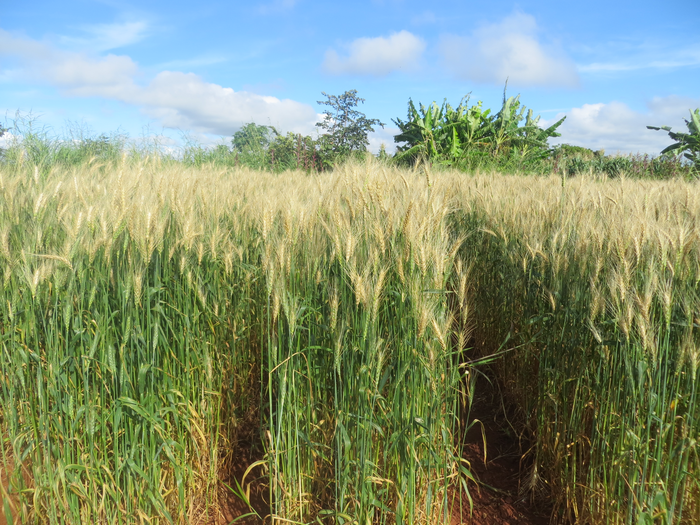
Credit: Batiseba Tembo, Zambia Agriculture Research Institute (CC-BY 4.0, https://creativecommons.org/licenses/by/4.0/)
Pests and diseases may reduce global wheat yields by over 20%. A study published April 11th in the open access journal PLOS Biology by Sergio Latorre at University College London, UK and colleagues suggest that genomic surveillance may be an effective disease management tool with the ability to trace lineages of emerging crop diseases, and to identify genetic traits for breeding disease-resistant lines.
Wheat crops across the globe are threatened by wheat blast, an emerging fungal disease. However, disease-management strategies have been unsuccessful. In order to better understand emerging pathogen genotypes and lineages, researchers conducted both genome analyses and laboratory experiments. They genotyped and sequenced the genome of the pandemic wheat blast fungus and tested different lines of wheat for genetic resistance to blast fungus and susceptibility to fungicide.
The researchers found that the recent emergence of wheat blast in Asia and Africa was caused by a single clonal lineage of the wheat blast fungus and that outbreaks in Zambia and Bangladesh originated independently. They also show that breeds of wheat that carry the Rmg8 gene are resistant to this fungal strain, and that the fungus is sensitive to the fungicide strobilurin. These findings highlight how genomic surveillance may help plant breeders more effectively select traits to develop disease-resistant lines.
The research may provide new tools to help counteract emerging plant pathogens. However, future studies are needed to address the likelihood of crop diseases evolving resistance to pesticides and fungicides and to evaluate other potential strategies that reduce reliance on chemical inputs.
According to the authors, “The emergence of variants that are more damaging than the current genotypes is probable within short timescales. This could happen either through mutations or sexual recombination with endemic blast fungus populations. Such variants could have increased virulence and fungicide tolerance thus adding to the difficulty in managing the wheat blast disease. These findings underscore the need for genomic surveillance to improve tracking and monitoring of the wheat blast fungus on a global scale and identifying variants of concern as soon as they emerge.”
Coauthor Sophien Kamoun adds, “This project builds on the paradigm—best illustrated by the COVID-19 pandemic—that genomic surveillance adds a unique dimension to the coordinated response to infectious disease outbreaks. We need to remain vigilant and continue genomics surveillance of wheat blast in Africa and Asia to identify Variants of Concern (VOCs) as soon as they emerge.”
#####
In your coverage, please use this URL to provide access to the freely available paper in PLOS Biology: http://journals.plos.org/plosbiology/article?id=10.1371/journal.pbio.3002052
Citation: Latorre SM, Were VM, Foster AJ, Langner T, Malmgren A, Harant A, et al. (2023) Genomic surveillance uncovers a pandemic clonal lineage of the wheat blast fungus. PLoS Biol 21(4): e3002052. https://doi.org/10.1371/journal.pbio.3002052
Author Countries: United Kingdom, Japan, Bangladesh, Zambia, Mexico, Switzerland, United States of America
Funding: see manuscript
Journal
PLoS Biology
DOI
10.1371/journal.pbio.3002052
Method of Research
Experimental study
Subject of Research
Not applicable
COI Statement
Competing interests: We have read the journal’s policy and the authors of this manuscript have the following competing interests: KL is a founder of Floodlight Genomics, TI receives funding from Krishi Gobeshona Foundation of Bangladesh, and SK receives funding from industry and has filed patents on plant disease resistance.