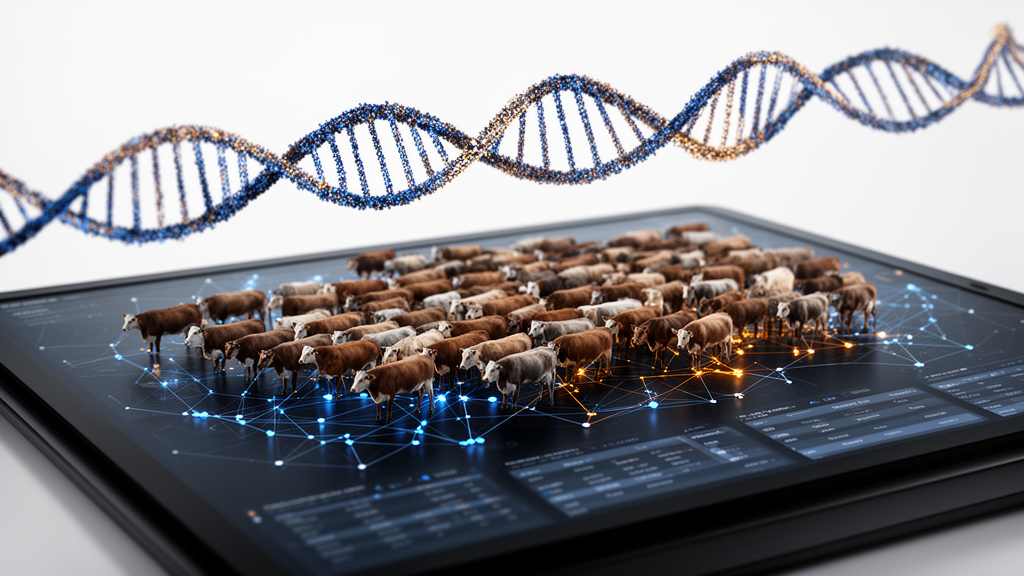
A multi-institutional genomic investigation has revealed that extensive metadata errors, including breed omissions and taxonomic misclassifications, can be identified and systematically corrected across large-scale livestock consortia datasets by evaluating underlying sequence variation. Researchers Johanna-Sophie Schlüter-Bartram, Felix Heinrich, Mehmet Gültas, and Armin O. Schmitt demonstrated this capability by applying an integrated computational framework to Run 9 of the 1000 Bull Genomes Project, a resource comprising whole-genome sequence records for 6,191 individual cattle across more than 115 million genomic positions. In their analysis, the team determined that while consortia repositories aggregate valuable variation across domestic cattle lineages, the associated metadata catalogs frequently suffer from incomplete records, spelling discrepancies, and inaccurate ancestral assignments that compromise downstream statistical workflows if left uncurated.
Domestic cattle descend from two separate domestication events occurring in the Fertile Crescent and the Indus Valley, giving rise respectively to humpless taurine cattle, classified as Bos taurus taurus, and humped indicine cattle, classified as Bos taurus indicus. Taurine breeds historically predominate across Europe, northern Asia, and western and central Africa, whereas indicine cattle are distributed predominantly through southern Asia and northeastern and western Africa, alongside stabilized crossbred lineages such as African Sanga and Zenga populations that feature varying degrees of mixed ancestry. In Run 9 of the 1000 Bull Genomes Project, submitter records cataloged animals within a three-level hierarchical structure that assigns individual identifiers to specific breeds and subsequently assigns breeds to subspecies. Within this dataset, taurine individuals constitute the vast majority of cataloged animals, while indicine animals represent approximately 10 percent of the collection, accompanied by smaller subsets of admixed individuals, ancient samples, and small reference groups.
Despite the structured format of the repository, initial metadata inspections demonstrated notable structural deficits, beginning with an initial absence of breed assignments for approximately 6 percent of the collection, corresponding to 360 individual animals labeled merely as unknown. Furthermore, simple queries revealed a logical contradiction within the catalog: counting breeds within separated subspecies subsets generated 267 distinct breed names, whereas querying the global list of unique breeds yielded only 262 names, indicating that multiple breeds had been simultaneously assigned to conflicting subspecies categories. Because downstream applications frequently rely on metadata to subset data panels, train breed-prediction classifiers, or compute allele frequencies, undetected misassignments present severe risks, including reduced effective sample sizes and biased classification benchmarks that generate silent errors during computational modeling.
To systematically address these discrepancies, the researchers developed a five-step analytical workflow operating directly on filtered variant calls. Starting with non-imputed variant call files filtered to a minimum quality score of 40 and imputed with Beagle version 5.4, the team utilized file compression via PLINK, memory mapping through the BGData package in R, and Autosome sampling to preserve computational efficiency without sacrificing analytical resolution. In the first phase of the curation framework, the investigators targeted missing records by programmatically querying the NCBI BioSample database using rentrez to retrieve associated metadata fields. This initial recovery step successfully restored breed identities for 259 cattle, decreasing the proportion of animals lacking breed annotations from 6 percent down to 2 percent, or 101 individuals, while identifying 24 previously unlisted breeds and increasing the representation of 16 existing breeds.
The second and third steps of the framework addressed subspecies classifications across the global population by combining dimensionality reduction with model-based ancestry estimation. The investigators performed principal component analysis on 50,000 randomly selected autosomal variants across all 6,191 animals, revealing that the first principal component, PC1, clearly separates European Bos taurus breeds at one extreme from Bos indicus breeds at the opposing polar end. To validate these continuous coordinates against ancestral population structure without introducing arbitrary assignment thresholds, the team partitioned PC1 into ten equal segments and sampled 69 individuals per segment, creating a balanced subset of 690 animals that was evaluated across five independent iterations using the unsupervised admixture software SCOPE configured for two ancestral populations.
Calibrating the average admixture observed at the first and third quartiles along PC1 established empirical genomic thresholds for subspecies designation: animals possessing 20 percent or less indicine admixture were classified as Bos taurus, those exhibiting between 20 percent and 70 percent indicine admixture were classified as Taurus-by-Indicus hybrids, and cattle carrying 70 percent or greater indicine ancestry were classified as Bos indicus. When comparing these genomic benchmarks against submitter entries, the team detected 183 subspecies misassignments, representing roughly 3 percent of the entire dataset. In severe instances, submitter annotations inverted fundamental biological realities; for example, the Bohai Black breed had been cataloged as Bos indicus despite clustering firmly with taurine lineages, whereas Wenshan cattle had been recorded as Bos taurus despite grouping alongside indicine populations. Similarly, the Ankole breed, submitted as Bos indicus, displayed approximately equal ancestral proportions, confirming its alignment with the admixed African Sanga group.
Resolving breed-level assignments in steps four and five proved considerably more complex due to typographical errors, naming conventions, and linguistic variations across international reporting sources. Evaluating identity-by-state genomic distances, hierarchical clustering trees constructed using the unweighted pair group method with arithmetic mean, and multi-population SCOPE admixture runs, the researchers resolved 41 distinct cases of breed-level misclassification. These included typographical errors such as the duplicate pairs Sahiwal and Shaiwal or Muturu and Mututu, as well as name component inversions involving 55 cattle split between Red Angus and Angus Red and 57 cattle separated between Finnish Ayrshire and Ayrshire Finnish. In both inverted naming instances, identical genomic clustering and admixture profiles supported merging the divided records into unified, standard breed designations.
More intricate naming extensions and multilingual translations required careful balance between genetic divergence and historical nomenclature. Within the Angler cattle complex, genomic distances and admixture patterns supported combining German Red Angler and Traditional Angler into a single group, whereas Modern Angler cattle exhibited distinct, heterogeneous admixture patterns that precluded simple consolidation. Similarly, evaluations of Danish Red strains revealed that Traditional Danish Red remained genetically distant from modern cohorts, leading the researchers to merge only Modern Danish Red and Danish Red Dairy. In multilingual cases, such as the triplet formed by Tyrolean Grey, Tyrolean Grauvieh, and Grey Cattle, consistent proximity along principal components and shared ancestral components supported merging the cohorts under the single English designation Tyrolean Grey, despite minor sub-population variations revealed at higher ancestral population settings.
The investigation also utilized NCBI database comparisons to detect 42 instances where public repository labels contradicted consortium metadata, ultimately confirming 19 metadata errors and identifying five probable recording mistakes within the BioSample repository itself. Furthermore, screening non-imputed Y-chromosome data alongside BioSample records resolved sex discrepancies in eleven animals, uncovering two male-female metadata misassignments while supplying previously unrecorded sex metadata for an additional 282 animals. Across all five stages of the curation pipeline, 603 individual cattle—nearly 10 percent of the total repository—received verified corrections to their breed or subspecies records, while 1,635 individuals, or 26 percent of the cohort, were directly involved in the reorganization of breed boundaries.
The authors noted that although their framework demonstrates the clear utility of genomic data in curating metadata repositories, specific components of the approach reflect the unique structure of the 1000 Bull Genomes Project and cannot serve as an automatic universal solution for all biological collections. Certain metadata classes, including environmental or physiological variables, cannot be verified through genomic coordinates alone, and external database retrieval depends entirely on the availability of accurate cross-referencing identifiers. To prevent similar metadata degradation in prospective sequencing initiatives, the researchers advocate adopting standardized livestock breed ontologies and controlled vocabularies during primary submission, ensuring that future agricultural genomics initiatives maintain the data integrity required for dependable open-access research.
Subject of Research: Genomic framework for identifying and correcting metadata misassignments in large-scale livestock datasets
Article Title: Genomic solutions to metadata challenges: a case study on the 1000 Bull Genomes Project
Article References: Schlüter-Bartram, J.-S., Heinrich, F., Gültas, M., & Schmitt, A. O. (2026). Genomic solutions to metadata challenges: a case study on the 1000 Bull Genomes Project. Genetics Selection Evolution, 58(1), Article 36. https://doi.org/10.1186/s12711-026-01061-w
Image Credits: AI Generated
DOI: 10.1186/s12711-026-01061-w
Keywords: genomics, bovine genetics, metadata curation, 1000 Bull Genomes Project, bioinformatics, population genetics, Bos taurus, Bos indicus, Genomic, solutions, metadata, challenges
News Source: Juliet Wilcox. (November 13, 2026). Genomic Analysis Uncovers and Resolves Metadata Misassignments in Global Cattle Database. Scienmag.