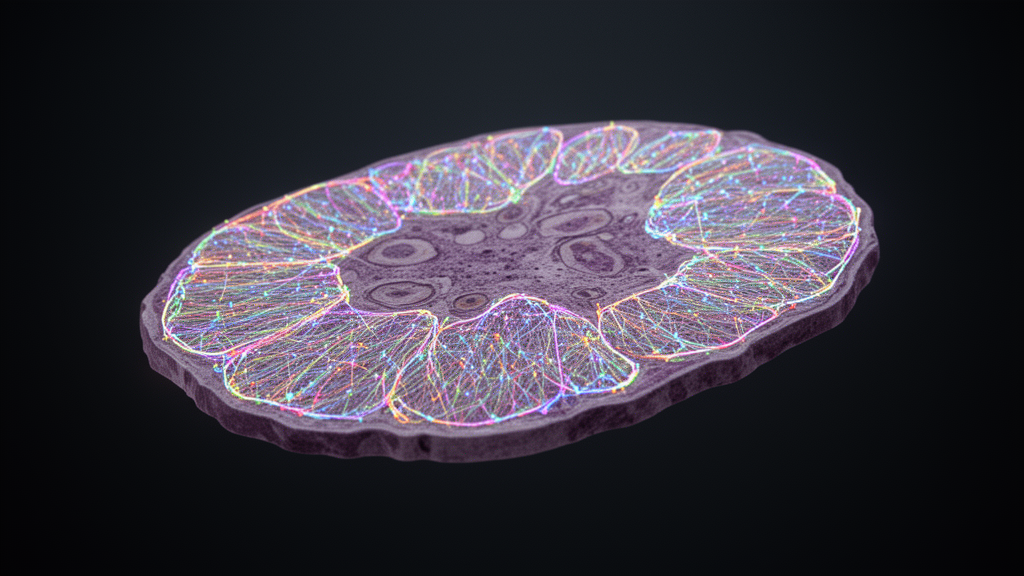
Computational researchers have introduced AnnST, a machine learning framework designed to improve the transfer of tissue domain labels across spatial transcriptomics sections. Transferring structural domain annotations across tissue slices is frequently hindered by technical dropout noise and inter-section batch effects, all while models struggle to preserve native spatial organization. Existing computational techniques typically target only a subset of these issues, frequently failing to maintain reliable and robust annotations across distinct experimental sections.
To overcome these challenges simultaneously, AnnST generates three distinct expression views from spatial transcriptomics data: a clean profile, a dropout-perturbed representation, and a batch effect-perturbed profile. The framework integrates contrastive learning across these representations to strengthen model robustness against technical dropout noise, while employing optimal transport formulations to mitigate systematic variation introduced by experimental batch differences.
In addition to noise and batch mitigation, AnnST incorporates label-aware spatial regularization during a supervised fine-tuning stage. This dedicated regularization step ensures that local tissue architecture and spatial coherence are maintained when transferring domain labels between sections, preventing the loss of structural continuity that can occur during unconstrained data alignment across separate tissue samples.
The research team evaluated AnnST across multiple spatial transcriptomics benchmarks, including the DLPFC 10x Visium dataset, the SEA-AD MERFISH dataset, and human breast cancer 10x Visium data. Across these benchmarks, AnnST demonstrated competitive domain annotation performance, sustained consistent results across different random initialization seeds, and maintained stability when subjected to multiple technical perturbations across sections.
Downstream computational evaluations confirmed that annotations assigned by AnnST preserved cortical laminar organization in brain tissue slices and supported biologically meaningful functional interpretations. The developers concluded that AnnST provides a robust, interpretable tool for cross-section annotation across datasets produced on differing spatial transcriptomics profiling platforms.
A critical barrier addressed by the developers is that transferring tissue domain labels across spatial transcriptomics sections requires reconciling technical dropout and inter-section batch effects without disrupting spatial tissue organization. While earlier analytical approaches frequently targeted only part of these technical hurdles, AnnST was engineered specifically to prevent the degradation of annotation accuracy that typically occurs when models align distinct experimental tissue sections without preserving structural boundaries.
By simultaneously deploying contrastive learning against dropout noise and optimal transport against batch-driven variance, the methodology maintains stable performance across diverse platform technologies. The research team confirmed that the system sustained robust cross-section annotation across Visium and MERFISH profiling modalities, providing a dependable computational foundation for downstream spatial investigations and biologically meaningful functional interpretations in complex tissues.
Subject of Research: Cross-section tissue domain label transfer in spatial transcriptomics using AnnST
Article Title: AnnST: robust cross-section tissue domain label transfer in spatial transcriptomics via contrastive learning and optimal transport
Article References: Guo, M., Cui, Y., Wang, W., Wei, L., Ye, X., & Sakurai, T. (2026). AnnST: robust cross-section tissue domain label transfer in spatial transcriptomics via contrastive learning and optimal transport. BMC Bioinformatics. https://doi.org/10.1186/s12859-026-06754-z
Image Credits: AI Generated
DOI: 10.1186/s12859-026-06754-z
Keywords: AnnST, spatial transcriptomics, label transfer, tissue domain annotation, contrastive learning, optimal transport, spatial regularization, batch effects, dropout noise, DLPFC Visium, SEA-AD MERFISH, breast cancer Visium, cortical laminar organization, computational biology, bioinformatics, cross-section analysis
News Source: Brooke Gardner. (November 13, 2026). AnnST Framework Improves Cross-Section Tissue Annotation in Spatial Transcriptomics. Scienmag.