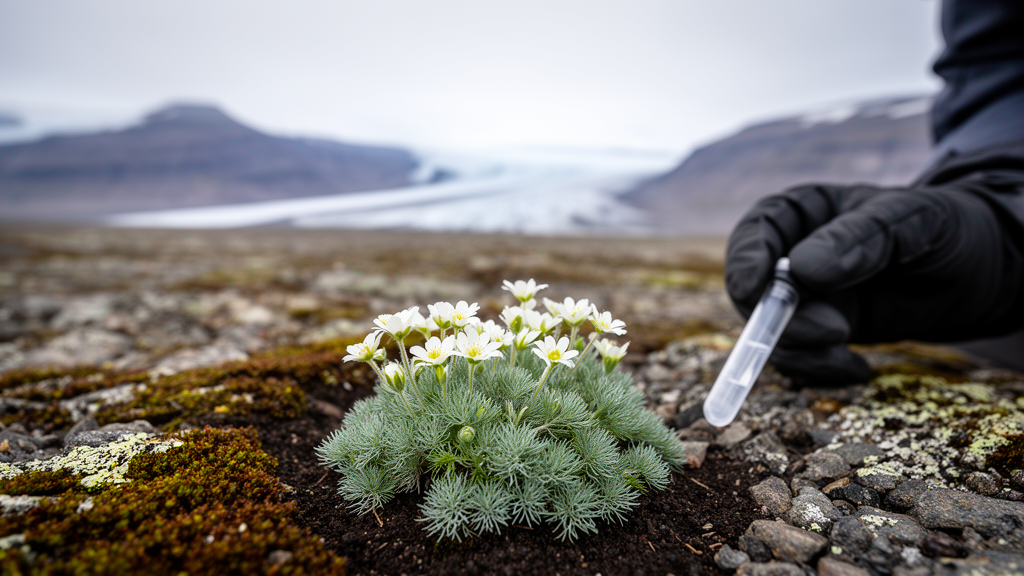
Dryas octopetala, the dominant tundra species of Svalbard, shows a consistent pattern of regional genetic differentiation across the archipelago, according to a new study published in BMC Ecology and Evolution. Using genome-wide single nucleotide polymorphism (SNP) genotyping, researchers found that populations at seven sites split into two major regional clusters corresponding to Longyearbyen and Ny-Ålesund, and that metabolomic profiles of the plants mirror this same geographic split.
The study, led by Moonkyo Kim and colleagues, was designed to fill a gap left by earlier work. Previous amplified fragment length polymorphism and simple sequence repeat studies had provided baseline information on variation in Svalbard’s mountain avens, but the genomic and metabolomic structure within the archipelago’s populations had not been comprehensively characterized. The team therefore sampled D. octopetala across seven sites and applied genotyping-by-sequencing to obtain genome-wide SNP genotypes.
From 33 individuals, the sequencing effort yielded 33,010 high-quality SNPs. Population genetic analysis of these markers revealed moderate but statistically significant differentiation among the seven sites, with a fixation measure of ΦST = 0.154 (p = 0.0001).
Two complementary clustering approaches converged on the same regional picture. ADMIXTURE, a model-based clustering method, identified two major regional clusters separating Longyearbyen from Ny-Ålesund. Principal component analysis and discriminant analysis of principal components, both multivariate techniques that summarize genome-wide variation without assuming a clustering model, similarly distinguished individuals from the two regions. The agreement among these independent analyses strengthened the conclusion that the regional-level structure is real rather than an artifact of any single method.
Beyond characterizing structure, the team translated their genomic findings into practical tools. From a set of 150 polymorphic SNPs that differentiated the two regions, they developed 13 polymerase chain reaction (PCR)-based SNP markers. These markers showed stable amplification and reliably reproduced the regional genetic patterns recovered from the full genome-wide dataset, with the Ny-Ålesund population displaying high allelic richness and heterozygosity.
The metabolomic component of the study added a functional dimension to the population genetic picture. Using both gas chromatography–mass spectrometry and liquid chromatography–mass spectrometry, the researchers profiled the small-molecule chemistry of the plants and detected 1,466 peaks. Of these, 33 metabolites differed significantly between the Longyearbyen and Ny-Ålesund regions, indicating that the genetic split is accompanied by measurable differences in plant chemistry.
Multivariate statistics confirmed the strength of that chemical separation. Orthogonal partial least squares-discriminant analysis, a supervised method designed to find the variables that best separate predefined groups, clearly distinguished the Longyearbyen and Ny-Ålesund samples. Compounds related to adenosine and galactose were among the metabolites contributing to this distinction, suggesting that differences in nucleoside and sugar-related chemistry track the regional genetic divergence.
Crucially, the genomic and metabolomic datasets were not independent stories. Mantel and Procrustes analyses, two statistical approaches for comparing distance matrices and multivariate configurations, revealed a significant correlation between genomic and metabolomic distance matrices. In other words, plants that are more genetically distant also tend to be more chemically distinct, linking the population structure detected in the SNPs to functional variation in the plants’ metabolic profiles.
The authors conclude that the study provides integrated genomic and metabolomic evidence of regional differentiation in D. octopetala across Svalbard, and that the newly developed PCR-based SNP markers can effectively distinguish regional populations while reflecting genome-wide patterns of differentiation. They argue that the concordance between genetic and metabolomic patterns highlights the value of multi-omics approaches for characterizing regional population differentiation and associated functional variation in Arctic plants.
As a model organism for studying population differentiation under extreme environmental conditions, D. octopetala occupies a central place in Svalbard’s tundra vegetation.
Subject of Research: Genomic and metabolomic differentiation of the tundra plant Dryas octopetala across Svalbard, with development of region-specific PCR-based SNP markers.
Article Title: Genetic and metabolomic differentiation of Dryas octopetala in Svalbard: genome-wide SNP evidence and region-specific marker development
Article References: Kim, M., Ryu, Y., Jo, E., Jeong, G., Kim, S.-T., Park, S., Kang, K., & Lee, Y. K. (2026). Genetic and metabolomic differentiation of Dryas octopetala in Svalbard: genome-wide SNP evidence and region-specific marker development. BMC Ecology and Evolution. https://doi.org/10.1186/s12862-026-02601-0
Image Credits: AI Generated
DOI: 10.1186/s12862-026-02601-0
Keywords: Dryas octopetala, Svalbard, population genetics, SNP genotyping, genotyping-by-sequencing, metabolomics, ADMIXTURE, PCR markers, Arctic plants, Longyearbyen, Ny-Ålesund, multi-omics
News Source: Juliet Wilcox. (October 28, 2026). Genome-wide SNPs and metabolites reveal regional differentiation of Svalbard’s dominant tundra plant. Scienmag.