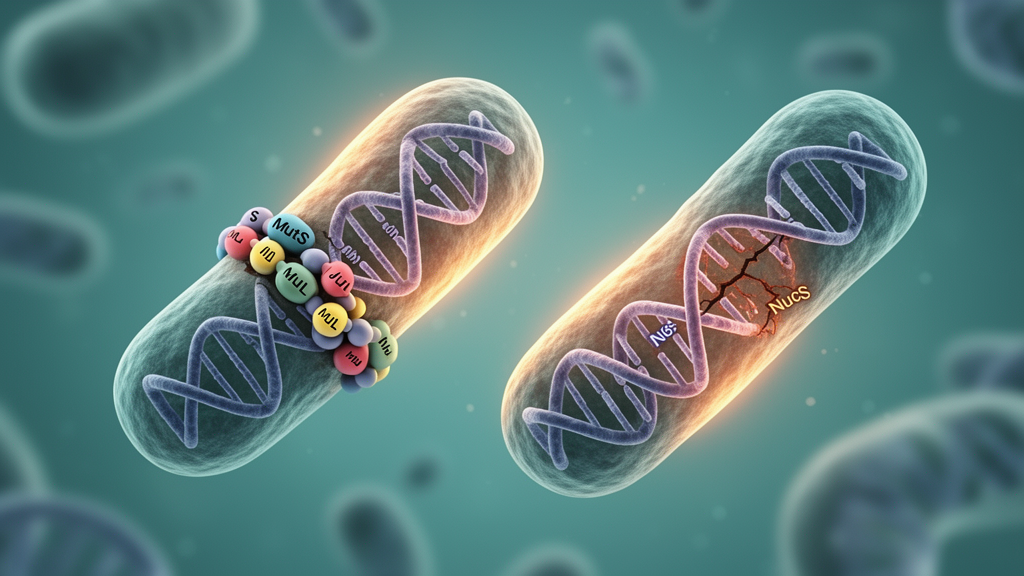
DNA mismatch repair is one of the most fundamental guardians of the genome, and prokaryotes deploy it in two strikingly different ways. Most bacteria and archaea rely on the canonical MutS-MutL system, a two-protein machine that recognizes mispaired bases and recruits the machinery to fix them. A smaller set of lineages, including many actinobacteria and certain archaea, instead use EndoMS/NucS, an endonuclease-based pathway that cuts at mismatches through a different mechanism. Since a 2017 phylogenomic survey reported that these two systems are largely mutually exclusive across prokaryotic life, researchers have wondered whether expanded genome databases would overturn that picture or reinforce it.
A new open-access study in BMC Genomics has now revisited the question at unprecedented scale, screening the annotations of 23,435 NCBI reference genomes, comprising 22,606 bacterial and 829 archaeal assemblies. The work, conducted by independent researcher Kiarash Sadeghian Esfahani, goes beyond a simple gene-counting exercise. Its central contribution is an architecture-aware audit that asks not just whether a genome carries a label mentioning NucS, but whether the encoded protein actually contains the complete two-domain structure needed to function as a genuine NucS enzyme.
The technical logic of the study hinges on protein domain architecture. A complete NucS protein must carry both an N-terminal NucS_N domain, captured by the Pfam profile PF21003, and a C-terminal NucS_C domain, captured by PF01939, on the same polypeptide. A canonical MutS protein must match five defined MutS profile hidden Markov models on a single protein, and must not carry a same-protein PF01713 domain, which would suggest a small MutS-related protein rather than the canonical mismatch repair form. MutL, the partner protein, requires the PF01119 and PF08676 profiles together. By applying these profile criteria with Pfam profile HMMs, the study converts fuzzy annotation wording into precise structural verdicts.
The initial annotation screen produced a tantalizing result: 1,145 genomes appeared to harbor both NucS and canonical MutS-MutL, a pattern that, if real, would challenge the 2017 mutual-exclusivity finding. But when the stricter multidomain criteria were applied, only 470 of those genomes passed all three tests. Of these, 421 were Halobacteria, 48 were Deinococcota, and a single assembly, from Lysobacter korlensis, was flagged as highly contaminated and therefore unreliable. The coexistence of both repair systems, it turns out, remains concentrated in exactly the lineages identified nearly a decade ago, with no new coexistence lineage emerging from the expanded dataset.
The most revealing part of the analysis concerns what loose annotation language actually means. Across 6,270 unique NucS candidate proteins, 5,189 carried both the N-terminal and C-terminal profiles, while 111 carried only NucS_N, 901 carried only NucS_C, and 69 matched neither profile. In other words, roughly one in five candidate proteins fell short of the complete two-domain architecture, even though they had been picked up by annotation-based screening.
The discrepancy becomes even starker in the tier of genomes annotated with the generic phrase NucS domain-containing. That tier contained 682 genomes, of which 680 were testable, yielding 717 unique candidate proteins. Among these, 685 were NucS_C-only, eight were NucS_N-only, five carried both profiles, and 19 carried neither. At the genome level, 663 of the 680 testable generic-tier genomes, or 97.50 percent, contained at least one NucS-associated domain, but only five contained a same-protein two-domain NucS candidate. A generic annotation is therefore usually valid at the domain level, yet it is a poor proxy for a complete, potentially functional NucS protein.
By contrast, explicit nucS gene annotations proved far more trustworthy. Genomes with explicit nucS annotations showed 99.63 percent concordance with the two-domain profile requirement, meaning that when annotators commit to naming the gene, the underlying protein almost always carries the full architecture. Canonical MutS and MutL annotation-positive genomes met the strong profile criteria in 96.78 percent and 97.14 percent of cases, respectively. The lesson for comparative genomics is that annotation specificity matters: broad domain-containing labels and precise gene names carry very different evidentiary weight.
To quantify how rarely the two repair systems truly coexist, the study computed the Jaccard overlap between genomes harboring two-domain NucS candidates and genomes meeting the strong MutS-MutL criteria. The result was just 2.18 percent, a figure that underscores how mutually exclusive the two pathways remain across the contemporary reference collection. The Halobacteria, with 421 validated coexistence genomes, and Deinococcus-Thermus, with 48, stand as the enduring exceptions to a rule that now holds across more than twenty-three thousand assemblies.
The author is careful to frame the scope of these conclusions. Because genomes lacking relevant annotations were not exhaustively searched with profile HMMs, the reported counts represent validated positives from an annotation-first workflow rather than exhaustive prevalence estimates or gene-loss reconstructions. Some true NucS or MutS-MutL genes may lurk in poorly annotated genomes that the screen never reached. This distinction matters for anyone hoping to use the numbers as a census of mismatch repair diversity, but it does not undermine the central finding about lineage concentration.
For the field of prokaryotic genomics, the study arrives at a moment when automated annotation pipelines and large language models are increasingly used to infer gene function at scale. The demonstration that a generic domain-containing label can be 97 percent likely to indicate some NucS-associated domain yet only rarely indicate a complete two-domain protein is a cautionary tale for downstream analyses. Whether the goal is reconstructing the evolution of DNA repair pathways, predicting genome stability phenotypes, or curating protein family databases, the message is clear: verify the full multidomain architecture before trusting the label. As reference genome collections continue to grow, architecture-aware validation of this kind may become a standard step in turning annotation databases into reliable biological knowledge.
Subject of Research: Comparative genomics of NucS and MutS-MutL DNA mismatch repair systems across prokaryotic reference genomes
Article Title: Annotation-aware multidomain validation of NucS and MutS-MutL across 23,435 prokaryotic reference genomes
Article References: Annotation-aware multidomain validation of NucS and MutS-MutL across 23,435 prokaryotic reference genomes. (n.d.). https://doi.org/10.1186/s12864-026-13470-8
Image Credits: AI Generated
DOI: 10.1186/s12864-026-13470-8
Keywords: DNA mismatch repair, NucS, EndoMS, MutS, MutL, comparative genomics, Pfam, profile HMM, RefSeq, protein domain architecture, archaea, bacteria
News Source: Juliet Wilcox. (October 15, 2026). Genome Survey Confirms NucS and MutS-MutL Repair Systems Rarely Share the Same Microbe. Scienmag.