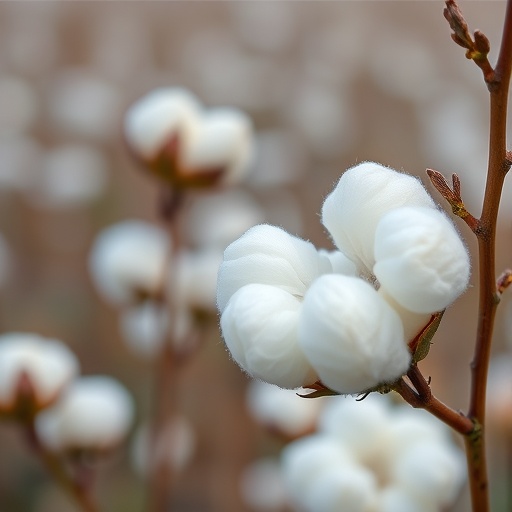
Every year, the textile industry drenches billions of kilograms of cotton in synthetic dyes, a process that consumes enormous volumes of water and leaves behind some of the most stubborn effluent in global manufacturing. Naturally colored cotton, which builds brown and green pigment directly into its fibers, has long been promoted as a cleaner alternative, but weak fibers, a muted palette and murky genetics have kept it at the margins of commercial agriculture. That picture has now become considerably sharper. In a study published in BMC Biology, researchers at the Institute of Cotton Research of the Chinese Academy of Agricultural Sciences report a genome-wide dissection of fiber color and whiteness in upland cotton (Gossypium hirsutum), pinpointing two major chromosomal hubs on chromosomes A07 and D11 that jointly decide whether a cotton boll spins out snow-white lint or deep brown fiber. The work, led by co-first authors Shiguftah Khalid and Zhenzhen Wang under corresponding authors Shoupu He and Xiongming Du, folds genome-wide association studies, quantitative trait locus mapping, transcriptome profiling and classical segregation genetics into one integrated framework.
Naturally colored cotton is not a new idea. Cultivars producing brown and green lint have been grown for generations, and their pigmentation flows largely through the flavonoid biosynthesis pathway, the same metabolic assembly line that colors fruits, leaves and seed coats across the plant kingdom. Yet breeding progress has been slow. The available color range is narrow, pigmentation shifts with the environment, and colored fibers are generally shorter and weaker than those of elite white cultivars, a penalty that has kept naturally colored cotton commercially unattractive. Recurrent crossing and strategic hybridization have produced improved colored lines, but success hinges on activating the structural genes of the flavonoid route — GhC4H, GhCHS, GhCHI, GhF3H, GhDFR, GhANR and Gh4CL2 — which are themselves orchestrated by MYB–bHLH–WD40 transcriptional complexes. Earlier work had tied brown fiber to dominant nuclear loci, including Lc1 on chromosome 7 and Lc2 on chromosome 6, and had identified GhTT2-3A, an R2R3-MYB transcription factor, as a pivotal activator of brown pigment formation. What remained missing was a unified account of how pigment production, pigment dilution and fiber quality are coordinated across the genome — the question the Chinese team set out to answer at whole-genome scale.
The investigation began with phenotyping on an unusually fine scale. The researchers evaluated two natural panels of upland cotton — 373 white-fiber accessions and an expanded set of 403 accessions that added 28 brown and two green genotypes — over two years at three contrasting sites in Henan, Xinjiang and Hainan provinces. At maturity, 27 color-related parameters, including total color difference (ΔE, reported as EE), Hunter’s whiteness (WH), brightness indices and reflectance coefficients, were measured with a high-precision colorimeter, and the values were corrected for environmental noise using best linear unbiased predictions. Every accession was then subjected to whole-genome resequencing; high-quality reads were aligned to the CRI-TM-1 reference genome, and single nucleotide polymorphisms were filtered for minor allele frequency, missing data and segregation distortion. Genome-wide association scans, run with a mixed linear model in the EMMAX software to control for population structure and kinship, swept the genome for variants explaining variation in each colorimetric trait, applying a stringent significance threshold of −log10(P) = 6.
In the white-fiber panel, one region rose above everything else: a 400-kilobase window on chromosome D11, spanning 24.3 to 24.7 megabases, that associated strongly with both EE and WH. Linkage disequilibrium analysis revealed three major haplotypes in the interval with sharply divergent effects — D11-Hap-1 tracked with elevated whiteness, while D11-Hap-3 carried higher total color difference scores, signaling fibers that drift away from pure white. Transcriptomic data then narrowed the field to three candidate genes whose expression differs across haplotype groups: Gh_D11G208100, encoding a protein carrying the little-understood DUF1685 domain; Gh_D11G207100, a membrane-anchored kinase-related protein known as MAKR1; and Gh_D11G207600, a DTX51-type detoxification transporter belonging to the multidrug and toxin extrusion (MATE) family, whose members are known to move flavonoid pigments across membranes. The expression timing was telling. Pigment biosynthesis genes fire early in fiber development, at five to ten days post-anthesis, whereas the D11 candidates peak between ten and twenty-five days post-anthesis — precisely the window in which pigments are deposited, sequestered or excluded from the maturing fiber wall. The concordance of association signals, haplotype effects and transcriptomic variation marks this interval as a genuine hotspot for white-fiber quality.
The broader 403-accession panel, which included pigmented fibers, supplied the other half of the story. Here the strongest association signal landed on chromosome A07, at 20.4 to 22.3 megabases, with a secondary, independent peak on D11. The A07 interval is densely packed with transcriptional regulators of the flavonoid pathway: TT2, an R2R3-MYB factor that anchors the MYB–bHLH–WD40 (MBW) complex driving proanthocyanidin biosynthesis; the bHLH factor bHLH82; and two anthocyanin-regulatory C1 proteins, Gh_A07G019900 and Gh_A07G020000, all of which were strongly up-regulated in brown-fiber genotypes. A ferritin-like regulator, ftnA, joined the activated module, while Gh_A07G019400, a YLMG2-family gene expressed at higher levels in white fibers, emerged as a plausible negative regulator of pigment deposition. When the team mapped the same traits in a biparental F2 population of 437 individuals derived from a cross between the brown line Zhong-128 and the white line Liao-96, a quantitative trait locus on A07 overlapped the association interval almost exactly, fusing the population-level and family-level evidence into a single coherent signal.
The numbers attached to that A07 locus are striking. Peak logarithm-of-odds scores exceeded 150, and the interval explained more than 63 percent of the phenotypic variance in total color difference and over 54 percent of the variance in Hunter’s whiteness, with additive effects on the two traits pulling in opposite directions. The same region also showed linkage to fiber length and fiber strength, hinting that pigmentation and quality are genetically entangled. On chromosome D11, by contrast, the detected QTLs were modest, collectively accounting for roughly five to eight percent of variance, but the team interpreted their effects as those of a dilution or whitening modifier rather than a primary pigment switch. Promoter analysis reinforced the connection between the two chromosomes: candidate genes at both loci are enriched for MYB and bHLH binding motifs, the cis-regulatory elements through which MBW complexes exert their control, implying that A07 and D11 participate in a shared transcriptional network rather than acting in isolation.
Classical genetics then supplied the architectural rules. The team generated three additional F2 populations, each pairing a white parent with a brown parent carrying a contrasting A07 haplotype, and scored fiber color in 185, 160 and 169 progeny. Segregation ratios fit a three-gene model without significant deviation in any cross (chi-squared values of 2.01, 0.51 and 1.01; three degrees of freedom; P > 0.05), matching the expected 3:18:27:16 ratio across four phenotypic classes. In this model, the Lb locus, tied to the A07 region, acts as a gatekeeper: recessive lblb plants produce white fiber regardless of all other alleles, while a single dominant Lb allele merely permits pigmentation. Two dominant dilution loci, W1 and W2 — best explained by the D11 region — then set the intensity. Plants carrying both dilution genes are white or near-white; losing one yields light brown; losing both, in the presence of Lb, produces brown and dark brown fiber. Notably, dark-brown extremes appeared in only one cross despite shared A07 haplotypes, marking extreme pigmentation as a threshold outcome shaped by genetic background rather than a fixed Mendelian class.
Protein-level evidence then connected the two hubs physically. Using a GAL4-based yeast two-hybrid system, the researchers fused TT2-A07 to the DNA-binding domain as bait and tested it against candidate proteins fused to the activation domain. All co-transformants survived on double-dropout medium, confirming that both plasmids were maintained, and three combinations activated reporters on stringent selective media: TT2-A07 interacted with the DUF1685 protein Gh_D11G208100, with MAKR1, and with the bHLH82 protein known to cooperate with MYB and WD40 partners. The DTX51 transporter Gh_D11G207600 failed to interact, consistent with the idea that it functions downstream as a transport step in a regulatory cascade rather than as a direct binding partner. The results were identical across three independent replicates and suggest that the whiteness machinery on D11 plugs into the pigment-activation complex on A07, although the authors caution that co-localization or bimolecular fluorescence complementation experiments in the plant itself will be required to confirm the functional consequences of these interactions.
The study also quantified a trade-off that has haunted colored-cotton breeding for decades. Across the diversity panel, Hunter’s whiteness correlated positively with fiber length and strength, while total color difference correlated negatively — darker lint tended to be shorter and weaker. The major A07 QTL co-localized with QTLs for fiber length and strength, and fine mapping placed the pigment regulator GhTT2 in the same linkage-disequilibrium block as MRI1, a quality-related candidate gene, suggesting that tight linkage of distinct genes, rather than strict pleiotropy of a single locus, drags quality down along with color. Haplotype stratification sharpened the picture: A07-Hap-2 accessions were consistently darker with weaker fibers, whereas Hap-4 accessions combined whiteness with superior length, uniformity and lint percentage. Crucially, the trade-off is not an iron law. Several brown genotypes, most notably the high-quality line ZGH0758, achieved length and strength comparable to white cultivars, demonstrating that favorable allele combinations can partially sever the link between pigmentation and structural performance.
Transcriptome sequencing across fiber development explained how that compensation works. In brown genotypes, phenylpropanoid and flavonoid biosynthesis surged during early elongation, five to ten days post-anthesis, drawing on pyruvate and phenylalanine metabolism for precursor supply; by fifteen to twenty days, enrichment shifted toward hormone signaling, proteasome activity and ABC transporters that stabilize and shuttle pigment metabolites. White fibers ran the opposite program, suppressing secondary metabolism while ramping up ribosomal proteins such as RPS30A and RPL34, an apparent reallocation of resources toward the translational machinery that builds cell-wall material and drives elongation. ZGH0758 was distinctive in running both programs at once, sustaining pigment output and translational capacity simultaneously — a recipe the authors propose as a breeding template. With candidate genes now in hand at both loci, the team argues that marker-assisted selection can pyramid favorable A07 haplotypes with whiteness-enhancing D11 alleles, and tune regulators such as TT2, TT16 and their bHLH partners, to deliver naturally colored cotton that no longer forces growers and manufacturers to choose between color and quality.
Subject of Research: Genetic basis of fiber color and whiteness regulation in upland cotton (Gossypium hirsutum)
Subject of Research: Biology
Article Title: Genome-wide integrative dissection of genetic basis of fiber color and whiteness regulation in upland cotton (Gossypium hirsutum)
Article References: Khalid, S., Wang, Z., Mahmood, T., Geng, X., Li, H., Zhang, X., He, S., & Du, X. (2026). Genome-wide integrative dissection of genetic basis of fiber color and whiteness regulation in upland cotton (Gossypium hirsutum). BMC Biology, 24(1), Article 183. https://doi.org/10.1186/s12915-026-02662-z
Image Credits: AI Generated
DOI: 10.1186/s12915-026-02662-z
Keywords: colored cotton, fiber quality, genome-wide association study, flavonoid pathway, inheritance patterns, QTL mapping, Gossypium hirsutum, fiber pigmentation, proanthocyanidin biosynthesis, transcriptome profiling
Cite Scienmag News
APA
MLA
Chicago
Juliet Wilcox. (August 30, 2026). Genome study reveals genetic basis of cotton fiber color and whiteness. Scienmag. https://scienmag.com/genome-study-reveals-genetic-basis-of-cotton-fiber-color-and-whiteness/
Juliet Wilcox. “Genome study reveals genetic basis of cotton fiber color and whiteness.” Scienmag, 30 August 2026, https://scienmag.com/genome-study-reveals-genetic-basis-of-cotton-fiber-color-and-whiteness/. Accessed 30 August 2026.
Juliet Wilcox. “Genome study reveals genetic basis of cotton fiber color and whiteness.” Scienmag. August 30, 2026. https://scienmag.com/genome-study-reveals-genetic-basis-of-cotton-fiber-color-and-whiteness/
Copy citation
Download RIS
Tags: chromosomal regions impacting cotton fiber pigmentationchromosomal regions influencing cotton fiber whitenesscotton breeding for natural colorcotton fiber color and qualitycotton fiber color and whiteness genetic basiscotton fiber color geneticscotton fiber color regulation mechanismscotton fiber pigmentation geneticscotton fiber pigmentation inheritancecotton fiber whiteness genetic basiscotton genome dissection for fiber traitsenvironmentally friendly cotton cultivationgenetic improvement of cotton for sustainable dyeinggenetically driven cotton fiber colorationgenome-wide association studies in cottonnaturally colored cotton breedingquantitative trait locus mapping in cottonsustainable cotton productiontranscriptome profiling in cotton fiber developmenttranscriptome profiling of cotton fibers