PULLMAN, Wash. — A new genetic test can identify dogs at risk of a potentially deadly disorder resulting in excessive bleeding and bruising in the hours and days following surgical procedures.
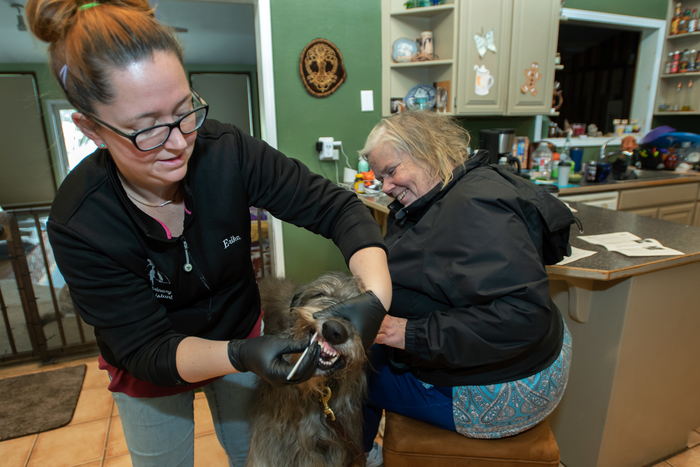
Credit: Ted S. Warren, Washington State University College of Veterinary Medicine
PULLMAN, Wash. — A new genetic test can identify dogs at risk of a potentially deadly disorder resulting in excessive bleeding and bruising in the hours and days following surgical procedures.
A team led by Washington State University researchers developed the DEPOHGEN (TM) test following a study in which they examined Scottish deerhounds and identified a gene associated with the condition known as delayed postoperative hemorrhage or DEPOH. Animals with a mutation in the DEPOH gene are significantly more likely to experience the condition. The study was published in the Journal of Veterinary Internal Medicine.
“Dogs with the DEPOH mutation have a much higher risk than other dogs of developing this after undergoing surgery,” said Dr. Michael Court, the study’s corresponding author. “The DEPOHGEN test will allow us to prevent delayed postoperative hemorrhage by administering antifibrinolytic drugs to dogs that test positive for the gene before any surgery.”
Delayed postoperative hemorrhage was first recorded in greyhounds, but it has also been noted in other sighthound breeds, like Scottish deerhounds and Irish wolfhounds. Following the identification of the DEPOH gene, the team examined samples from WSU’s pet DNA bank and discovered the mutation in additional sighthounds, like Italian greyhounds and salukis, as well as in some other popular breeds, such as golden retrievers and border collies.
Court, a veterinarian and professor of pharmacology and genomics in WSU’s College of Veterinary Medicine and Program in Individualized Medicine, said delayed postoperative hemorrhage typically occurs one to four days after major surgery when blood clots begin to break down too soon in a process called hyperfibrinolysis. The severity can range from minor bruising to life-threatening hemorrhaging.
“Clotting factors stop the bleeding when you’ve had surgery, but you don’t want that blood clot to hang around forever. Normally, the body breaks down that clot as the tissue heals, usually over days to weeks, not just one or two days as it does in dogs with the mutant gene,” Court said.
Although delayed postoperative hemorrhaging can be prevented by administering drugs before surgery, indiscriminate treatment can be costly and lead to adverse reactions to the medications.
The new test, which is available through WSU, will make it possible to detect the gene in pets prior to non-emergency surgeries and give preventative treatment when warranted. Court is also hopeful the test will eventually be included in common health panels used to evaluate puppies and dogs for many conditions.
Court began looking into the condition after being approached by the Scottish Deerhound Club of America and Dr. John Dillberger, who serves as the club’s health and genetics commission chair. The club provided partial funding, DNA samples and patient records for the study.
Court recruited Holly Neibergs, a professor in WSU’s College of Agricultural, Human, and Natural Resource Sciences and expert in animal genomics, to assist with the study.
The researchers evaluated 269 Scottish deerhounds and used genome-wide association analysis to identify a single region on chromosome 9 that contained 40 candidate genes. Further screening of the candidate genes was performed and only the DEPOH gene was identified as being directly linked to the pathophysiology of the disorder.
Both Dillberger, who has owned Scottish deerhounds for more than three decades, and Court said the study and the resulting test is a great example of how a collaborative project between an academic institution and dog breed organization can make a positive impact for pets and their owners. A patent application has been submitted on the DEPOHGEN (TM) test by WSU with Court, Dillberger and the Scottish Deerhound Club of America listed as coinventors.
“Now pet owners can test their dog at any time in its life to understand whether it is at risk,” Dillberger said. “And if it is, before planning any scheduled or elective surgery, they can make sure the surgeon is aware of it and prepare accordingly. This will help save the lives of pets.”
Journal
Journal of Veterinary Internal Medicine
DOI
10.1111/jvim.16643
Article Publication Date
13-Feb-2023