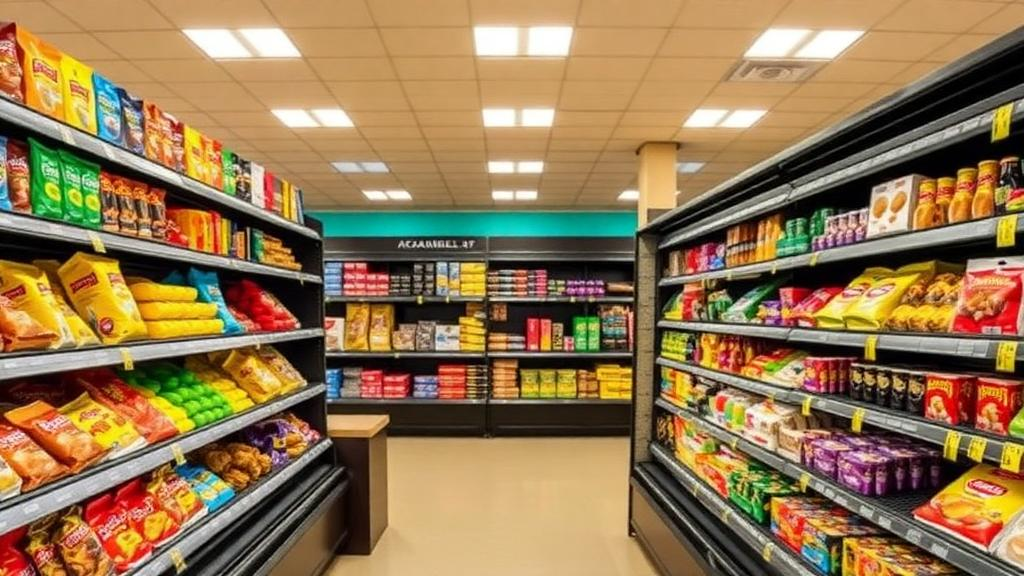
When a shopper stands in line at a supermarket, the products within arm’s reach are not there by accident. Retailers place candy bars, sugary drinks, and salty snacks at the checkout precisely because hungry, impatient customers make impulsive purchases. For decades, this small strip of retail real estate has been a reliable engine for selling sugar and salt. Now, for the first time, researchers have rigorous evidence that a city can rewrite those rules—and that the design of the rules matters enormously for how much they accomplish.
In January 2024, the city of Perris, California, became only the third jurisdiction in the world to enforce a mandatory healthy checkout policy, following Berkeley, California, and England. Under Perris’s healthy checkout ordinance, or HCO, food and beverages displayed within six feet of a register must meet defined nutrition standards. A team led by Yuru Huang and Jennifer Falbe of the University of California, Davis, seized on the rollout as a natural experiment, publishing their evaluation in PLOS Medicine. Their findings offer both an encouraging proof of concept and a cautionary lesson about policy boundaries.
The researchers collected data at two time points: June 2023, before the ordinance took effect, and June 2024, six months after implementation. They audited all 13 Perris stores subject to the ordinance and compared them with 51 matched stores in three nearby cities that had no such policy. In total, the team recorded 65,271 product facings—each facing being a single product displayed toward consumers from which they can select. This facing-level granularity is what gives the study its power, because it captures the actual visual environment a shopper encounters rather than a coarse inventory list.
The analytical approach was a difference-in-differences design, a workhorse of policy evaluation. By measuring the change over time in Perris and subtracting the change over the same period in comparison cities, the method attempts to isolate the effect of the ordinance itself from broader trends in the retail food environment—seasonal promotions, corporate merchandising shifts, or regional dietary fashions. The comparison stores were matched to the Perris stores to make the counterfactual as plausible as possible: what would have happened at Perris checkouts without the law?
The headline result is striking. Among all product facings located within six feet of registers, compliance with the ordinance’s nutrition standards rose from 50 percent to 67 percent. Relative to comparison cities, that represents a 37 percent increase in compliance, with a prevalence ratio of 1.37 and a 95 percent confidence interval of 1.12 to 1.68, a statistically significant effect. In other words, the policy did not merely nudge retailers; it substantially transformed what shoppers see in the most impulsive purchasing zone of the store.
Drilling down into food and beverage facings specifically, the picture becomes even more interesting. Compliance in the six-foot zone jumped from 36 percent to 55 percent, a 52 percent relative increase compared with control cities. Beverages drove much of the change: compliant beverages rose 141 percent in relative terms, climbing from just 6 percent to 18 percent of beverage facings. One hundred percent fruit juice, a category that qualifies under the standards, showed a 200 percent relative increase, from 0.7 percent to 1.7 percent of facings. Retailers, it seems, found it easier to swap in compliant drinks than to abandon their most profitable confectionery lines.
That last observation points to the study’s most sobering finding. While healthier options proliferated near the registers, there were no significant reductions in any specific noncompliant category—candy, sugar-sweetened beverages, salty snacks, or other sweets all held their ground within the six-foot zone. The policy, in effect, added healthy products to the checkout rather than evicting unhealthy ones. From a public health standpoint, this matters. If a candy bar remains at the register but is now flanked by juice boxes, the impulse-buying architecture of the checkout is diluted but not dismantled. Whether that dilution changes what people actually buy is a question this study, which measured the retail environment rather than purchases or diets, cannot yet answer.
The scope of the ordinance also shaped its reach. Perris’s policy applies only to products within six feet of the register, whereas Berkeley’s ordinance and England’s regulations cover the entire checkout area. The researchers found that increases in compliance were not statistically significant beyond the six-foot boundary, and across the entire checkout the effect was smaller—a prevalence ratio of 1.31, still significant but attenuated. This spatial gradient is exactly what one would expect if retailers complied with the letter of the law rather than its spirit: they cleaned up the regulated zone and left the rest of the checkout largely untouched. The comparison across jurisdictions suggests that broader policy scope could capture more of the checkout, though direct head-to-head evaluations remain limited.
The study is not without limitations, and the authors are candid about them. The difference-in-differences approach assumes that, absent the policy, trends in Perris and the comparison cities would have evolved in parallel—an assumption the researchers could not verify. If Perris stores were already on a different trajectory before the ordinance, some of the observed improvement could reflect that divergence rather than the policy itself. The six-month follow-up window is also short; it remains to be seen whether compliance holds over years, whether retailers find loopholes, and whether the changed environment translates into measurable shifts in purchasing behavior and dietary intake, the ultimate targets of such policies.
Even with those caveats, the evaluation arrives at a pivotal moment. Checkout policies are among the few food environment interventions that target a specific, well-understood behavioral trigger rather than relying on consumer education or voluntary industry pledges, which have a mixed record. Perris’s experience demonstrates that mandatory standards can be enforced in ordinary retail settings and that retailers will respond, particularly in the beverage category where compliant substitutes are readily available. But the persistence of candy and sugary snacks at the register, and the sharp falloff in compliance beyond the regulated radius, suggest that jurisdictions crafting their own ordinances should define the policy scope broadly and set nutrition standards that leave fewer profitable loopholes. As more cities and countries weigh similar rules, Perris offers a rare piece of hard evidence: healthy checkout laws work where they reach—and their reach is a design choice.
Subject of Research: Evaluation of a mandatory healthy checkout food policy on the retail food environment in Perris, California
Article Title: The retail food environment following a mandatory healthy checkout policy: A natural experimental evaluation
Article References: The retail food environment following a mandatory healthy checkout policy: A natural experimental evaluation. (n.d.). https://doi.org/10.1371/journal.pmed.1004814
Image Credits: AI Generated
DOI: 10.1371/journal.pmed.1004814
Keywords: healthy checkout policy, retail food environment, Perris California, natural experiment, difference-in-differences, nutrition standards, food policy, public health, sugar-sweetened beverages, impulse purchasing, PLOS Medicine, ordinance compliance
News Source: Ophelia Keating. (October 10, 2026). Checkout Rules That Work: California City’s Healthy Register Policy Reshapes Snack Aisles. Scienmag.