Transport system of essential materials in brain cells disrupted in certain genetic developmental disorders.
University of Maryland School of Medicine (UMSOM) researchers identified a new gene that may be linked to certain neurodevelopmental disorders and intellectual disabilities. The researchers believe that finding genes involved in certain types of developmental disorders, provide an important first step in determining the cause of these disorders and ultimately in developing potential therapies for treating them. The paper was recently published in the American Journal of Human Genetics.
About 3 percent of the world’s population has intellectual disability. Up to half the cases are due to genetics, however, because many thousands of genes contribute to brain development, it has been difficult to identify the specific cause for each patient.
Once the researchers identified the gene, they worked with collaborators to give clinical diagnoses to 10 other families around the world, who had relatives with this condition. The researchers also used zebrafish to show the gene’s role in development and survival, demonstrating its importance in helping the brain’s neurons function properly.
“Our goal is to find as many of these genes required for brain function and take this knowledge back to patients and families to provide a clinically relevant genetic diagnosis,” says Saima Riazuddin, PhD, MPH, MBA, Professor of Otorhinolaryngology-Head & Neck Surgery and Biochemistry & Molecular Biology at UMSOM.
Dr. Riazuddin and her team collaborate regularly with several scientists in Pakistan studying a group of 350 families geographically isolated, which as a result has led to inbreeding resulting in genetic disorders such as neurodevelopmental disorder and intellectual disability.
The team focused on one particular family with two brothers and an uncle with symptoms of intellectual disability, delayed speech and other developmental milestones and epilepsy. Other members of the family with similar symptoms had since passed in childhood or early adulthood. Dr. Riazuddin and her team identified the gene AP1G1 as the culprit.
Then through collaboration with 27 other institutions, her team was able to identify ten other families with the variations in the same gene that led to growth retardation and intellectual disability. These families lived in Italy, Germany, the Netherlands, Poland, and the United States.
To determine the gene’s role in development, the researchers engineered zebrafish without Ap1g1. These zebrafish embryos all began to die off by the fourth day. When the researchers added back mutated versions of the genes, like those found in the families with neurodevelopment disorder and intellectual disability, they observed a spectrum of symptoms with some zebrafish embryos dying off, some with major structural defects, and others with only minor tail deformities.
The gene AP1G1 contains the blueprints to make the protein Adaptor Protein 1 gamma 1 (AP1γ1). This protein is one of five pieces that makes up the Adaptor Protein Complex, which builds transport vesicles to move materials around cells.
“Think of these transport vesicles as little vehicles like trucks that have to load, transport, and unload their cargo around the cells (e.g. neurons) to provide the necessary supplies for the cell to function,” says Dr. Riazuddin.
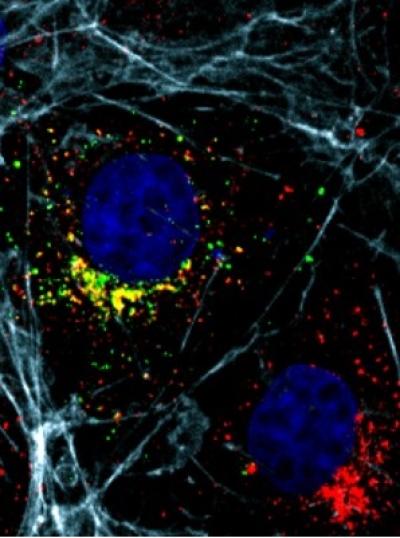
Dr. Riazuddin’s team made normal and mutant versions of AP1G1 which they put in mammalian cells with cargo molecules labeled in red. The cells with the mutant versions of AP1G1 had vesicles that were delayed in delivering their cargo or did not make their deliveries at all.
“Improving clinical diagnosis of these developmental disorders may eventually provide new targets for therapies, in order to one day be able to treat these conditions allowing more people to live independently,” says E. Albert Reece, MD, PhD, MBA, Executive Vice President for Medical Affairs, UM Baltimore, and the John Z. and Akiko K. Bowers Distinguished Professor and Dean, University of Maryland School of Medicine.
###
This studied was funded by National Institute of Neurological Disorders and Stroke (R01NS107428), the EU FP7 Large-Scale Integrating Project Genetic and Epigenetic Networks in Cognitive Dysfunction (241995), Higher Education Commission of Pakistan (NRPU project 10700), and a Fondazione del Monte grant (ID ROL: FDM/4021).
The researchers have no conflicts of interest to declare.
Media Contact
Vanessa McMains
[email protected]
Related Journal Article
http://dx.