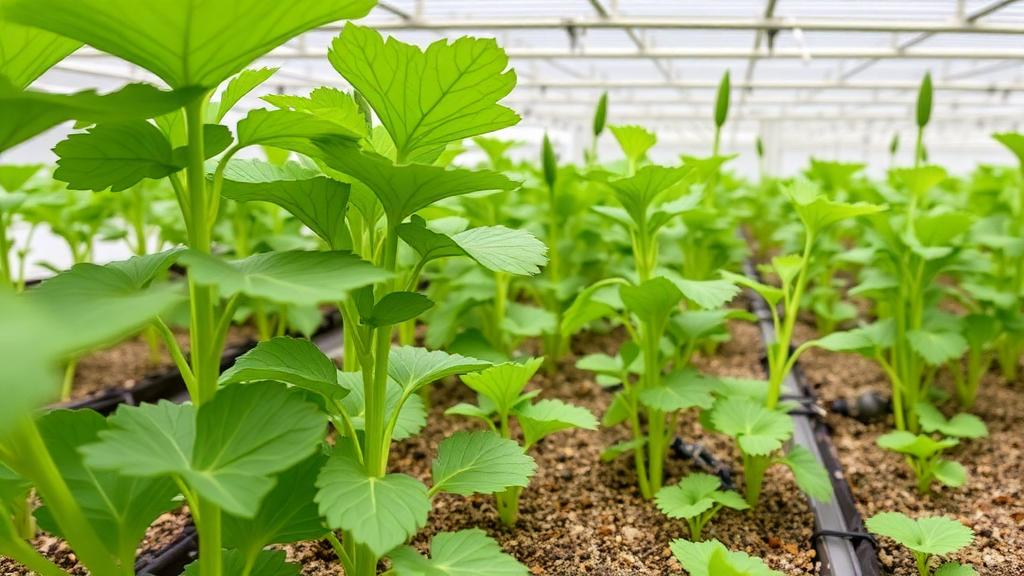
In the arid and semi-arid tropics, few forage legumes are as valuable to smallholder farmers as Leucaena tarramba, a fast-growing shrub prized as livestock feed. Yet like so many tropical crops, its productivity hinges on water, and as droughts grow longer and less predictable, breeders are racing to find plants that can keep growing when the rain stops. A new study published in BMC Plant Biology offers a detailed look at how Indonesian researchers are using gamma radiation to create genetic diversity in this legume and then sorting through the resulting mutants with a deceptively simple tool: a hydroponic tank spiked with a chemical that mimics drought.
The research, led by Purnama Isti Khaerani of the Research Center for Genetic Engineering at Indonesia’s National Research and Innovation Agency (BRIN) together with colleagues at Hasanuddin University and partner institutions, tackles a persistent bottleneck in mutation breeding. Irradiating seeds with cobalt-60 gamma rays at doses ranging from 50 to 1000 gray generates thousands of candidate plants, but only a fraction carry useful traits. The team first established the median lethal dose, the radiation level that kills half the seedlings, at 820 gray based on survival 21 days after planting. From the first generation of irradiated plants, they advanced material derived from 0, 250, 500, and 750 gray into the second generation, the M2, where recessive mutations typically begin to reveal themselves.
Screening for drought tolerance in soil is notoriously messy. Water moves unevenly through soil profiles, evaporation varies from pot to pot, and root architecture interacts with substrate in ways that swamp the signal breeders are trying to detect. The Indonesian team sidestepped this problem by growing the M2 seedlings in a deep-water culture hydroponic system and adding polyethylene glycol 6000 to the nutrient solution at concentrations of 10 and 20 percent. PEG is a large, inert polymer that plants cannot absorb; instead, it lowers the water potential of the solution, forcing roots to work harder to take up water. In effect, it reproduces the osmotic component of soil drought with a precision that field trials cannot match, and it does so reproducibly across hundreds of seedlings at once.
The experimental design was a split-plot arrangement, with PEG concentration as the main plot and irradiation dose as the subplot, allowing the researchers to disentangle the effects of stress severity from those of the mutagenic treatment. Seedlings were exposed to the osmotic stress for 42 days after planting in the hydroponic system, and then transferred to a greenhouse for post-hydroponic evaluations at 60 and 90 days after planting. This two-phase approach matters because a plant that survives an artificial osmotic challenge in a tank is not necessarily one that will thrive in a paddock; the later greenhouse measurements served as an early check on whether hydroponic performance carries over into more realistic growing conditions.
The results showed a clear interaction between stress level and radiation dose across several morpho-physiological traits. Under moderate stress of 10 percent PEG, mutants derived from 250 and 500 gray maintained several growth-related traits better than the wild type and showed adaptive physiological responses. At 20 percent PEG, the picture darkened for all entries: growth and physiological performance declined more sharply, reflecting the severity of the osmotic challenge. The researchers quantified that severity using a stress intensity metric, which rose from 0.68 under 10 percent PEG to 0.85 under 20 percent PEG, confirming that the higher concentration imposed a substantially harsher selection environment.
To rank the mutants objectively, the team applied two classic selection indices. The stress tolerance index, or STI, rewards genotypes that yield well both under stress and without it, while the stress susceptibility index, or SSI, penalizes those that lose the most performance when water becomes scarce. Under 10 percent PEG, the STI of the 750 gray group climbed to 0.41 from 0.23 in the wild type, while its SSI fell from 1.10 in the wild type to 0.90. The same directional pattern appeared under 20 percent PEG, though with lower STI values overall. Crucially, both the 500 and 750 gray groups posted SSI values below 1 under both stress levels, a statistical signature of lower relative susceptibility than the unirradiated controls and the 250 gray group. In plain terms, the heavier radiation doses appear to have generated a pool of mutants in which drought-resilient individuals are more common.
Individual dry-weight measurements revealed considerable variation among M2 mutants from the 250, 500, and 750 gray lineages, and a principal component analysis built on the full suite of morpho-physiological traits captured 89.5 percent of the total variation in a single two-dimensional view. That analysis cleanly separated entries that maintained their performance under stress from those that collapsed, and it flagged a short list of promising candidates under 10 percent PEG, including mutants labeled 250Gy_2P1, 250Gy_3P1, 250Gy_4P1, and the series 500Gy_1P1 through 500Gy_4P1. These are putative mutants, a deliberately cautious term: they show the phenotype the breeders want, but confirming that the trait is genetically fixed rather than a fluke of the growing environment requires progeny testing and, eventually, molecular validation.
The heritability estimates in the study add an important note of realism. Broad-sense heritability, the proportion of observed variation attributable to genetic differences, ranged from 0.24 to 0.60 during the hydroponic phase and from 0.11 to 0.80 during the post-hydroponic greenhouse evaluations at 60 and 90 days. The lower end of those ranges, particularly the 0.11 figure, signals that some measured traits are heavily influenced by environment and would make unreliable selection targets on their own. This is precisely why the authors frame their hydroponic PEG platform as a preliminary screening framework rather than a definitive test: it is designed to narrow thousands of candidates down to a manageable number that can then be subjected to multi-generation and multi-location trials.
The broader significance of the work lies in the pairing of two technologies that are individually old but jointly underused. Mutation breeding with gamma rays has produced improved crop varieties for decades, from rice to barley, because it generates novel allelic variation without the regulatory complexity of transgenic methods. Hydroponic PEG screening, meanwhile, gives breeders a fast, cheap, and controllable way to impose drought stress at scale. Combining them, and wrapping the whole effort in quantitative indices and multivariate statistics, turns what could be a fishing expedition into a structured pipeline. For a forage crop like L. tarramba, which supports livestock systems across dry tropical regions where improved varieties are scarce, even modest gains in drought tolerance could translate into more reliable fodder supplies.
There remain clear caveats. PEG-induced osmotic stress captures only part of what drought means in the field; it does not reproduce the soil physical constraints, the progressive drying cycles, or the atmospheric vapor pressure deficits that real droughts impose. The authors themselves emphasize that the promising M2 lines identified here, including the 250 and 500 gray derivatives that held their growth under moderate stress, must now move into progeny testing and molecular characterization to confirm that the tolerance traits are heritable and to locate the underlying mutations. But as a first filter, the study demonstrates that a tank of PEG-laced nutrient solution, a cobalt-60 source, and a well-chosen set of indices can rapidly surface candidate plants worth a breeder’s attention. In a warming world where forage crops face increasingly erratic rainfall, that kind of accelerated triage may become one of the most valuable tools in the plant breeder’s kit.
Subject of Research: Screening gamma-induced Leucaena tarramba mutants for drought tolerance using PEG-simulated osmotic stress in hydroponics
Article Title: Screening gamma-induced Leucaena tarramba mutants for drought tolerance under PEG-simulated osmotic stress in hydroponics
Article References: Khaerani, P. I., Hastilestari, B. R., Musa, Y., Utamy, R. F., Cai, G., Álvarez-Holguín, A., Indriatama, W. M., Husni, A., Wakano, F., Ashar, J. R., & Anshori, M. F. (2026). Screening gamma-induced Leucaena tarramba mutants for drought tolerance under PEG-simulated osmotic stress in hydroponics. BMC Plant Biology. https://doi.org/10.1186/s12870-026-10008-8
Image Credits: AI Generated
DOI: 10.1186/s12870-026-10008-8
Keywords: Leucaena tarramba, drought tolerance, gamma irradiation, mutation breeding, polyethylene glycol, hydroponics, osmotic stress, M2 mutants, stress tolerance index, heritability, principal component analysis, forage legume
News Source: Alan Morgan. (October 4, 2026). Gamma Rays and Fake Drought: Mutant Legumes Face a Hydroponic Stress Test. Scienmag.