Conversion efficiency improved by more than 60%
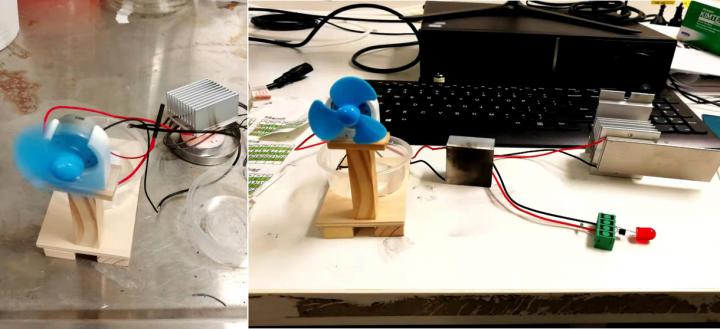
Credit: FLEET
A new University of Wollongong study overcomes a major challenge of thermoelectric materials, which can convert heat into electricity and vice versa, improving conversion efficiency by more than 60%.
Current and potential future applications range from low-maintenance, solid-state refrigeration to compact, zero-carbon power generation, which could include small, personal devices powered by the body’s own heat.
“The decoupling of electronic (electron-based) and thermal (phonon-based) transport will be a game-changer in this industry,” says the UOW’s Prof Xiaolin Wang.
Thermoelectric applications and challenges
Bismuth telluride-based materials (Bi2Te3, Sb2Te3 and their alloys) are the most successful commercially-available thermoelectric materials, with current and future applications falling into two categories: converting electricity into heat, and vice versa:
- Converting electricity into heat: reliable, low-maintenance solid-state refrigeration (heat pump) with no moving parts, no noise, and no vibration.
- Converting heat into electricity including fossil-free power generation from a wide range of heat sources or powering micro-devices ‘for free’, using ambient or body temperature.
Heat ‘harvesting’ takes advantage of the free, plentiful heat sources provided by body heat, automobiles, everyday living, and industrial process. Without the need for batteries or a power supply, thermoelectric materials could be used to power intelligent sensors in remote, inaccessible locations.
An ongoing challenge of thermoelectric materials is the balance of electrical and thermal properties: In most cases, an improvement in a material’s electrical properties (higher electrical conductivity) means a worsening of thermal properties (higher thermal conductivity), and vice versa.
“The key is to decouple thermal transport and electrical transport”, says lead author, PhD student Guangsai Yang.
Better efficiency through decoupling
The team added a small amount of amorphous nano-boron particles to bismuth telluride-based thermoelectric materials, using nano-defect engineering and structural design.
Amorphous nano boron particles were introduced using the spark plasma sintering (SPS) method.
“This reduces the thermal conductivity of the material, and at the same time increases its electron transmission”, explains corresponding author Prof Xiaolin Wang.
“The secret of thermoelectric materials engineering is manipulating the phonon and electron transport,” explains Professor Wang.
Because electrons both carry heat and conduct electricity, material engineering based on electron transport alone is prone to the perennial tradeoff between thermal and electrical properties.
Phonons, on the other hand, only carry heat. Therefore, blocking phonon transport reduces thermal conductivity induced by lattice vibrations, without affecting electronic properties.
“The key to improving thermoelectric efficiency is to minimize the heat flow via phonon blocking, and maximize electron flow via (electron transmitting),” says Guangsai Yang. “This is the origin of the record-high thermoelectric efficiency in our materials.”
The result is record-high conversion efficiency of 11.3%, which is 60% better than commercially-available materials prepared by the zone melting method.
As well as being the most successful commercially-available thermoelectric materials, bismuth telluride-based materials are also typical topological insulators.
The study
Ultra-High Thermoelectric Performance in Bulk BiSbTe/Amorphous Boron Composites with Nano-Defect Architectures was published in Advanced Energy Materials in September 2020, and selected as the cover story for the November edition. DOI 10.1002/aenm.202000757
As well as support from the Australian Research Council (Future Fellowship, Centre of Excellence and Linkage Infrastructure Equipment and Facilities programs) funding was received from the China Scholarship Council and National Natural Science Foundation of China.
Experimentation facilities included the University of Wollongong Electron Microscopy Centre, with technical support from the Australian Centre for Microscopy and Microanalysis (ACMM) at the University of Sydney.
Novel material studies at FLEET
The properties of novel and atomically-thin materials are studied at FLEET, an Australian Research Council Centre of Excellence, within the Centre’s Enabling technology A.
The Centre for Future Low-Energy Electronics Technologies (FLEET) is a collaboration of over a hundred researchers, seeking to develop ultra-low energy electronics to face the challenge of energy use in computation, which already consumes 8% of global electricity, and is doubling each decade.
Project leader and co-author Prof Xiaolin Wang leads FLEET’s University of Wollongong node, as well as leading the Enabling Technology team developing the novel and atomically thin materials underpinning FLEET’s search for ultra-low energy electronics, managing synthesis and characterisation of novel 2D materials at the University of Wollongong
Media Contact
Errol Hunt
[email protected]
Original Source
http://www.
Related Journal Article
http://dx.