The long-held belief that the Milky Way, the galaxy containing Earth and the solar system, is relatively static has been ruptured by fresh cosmic insight
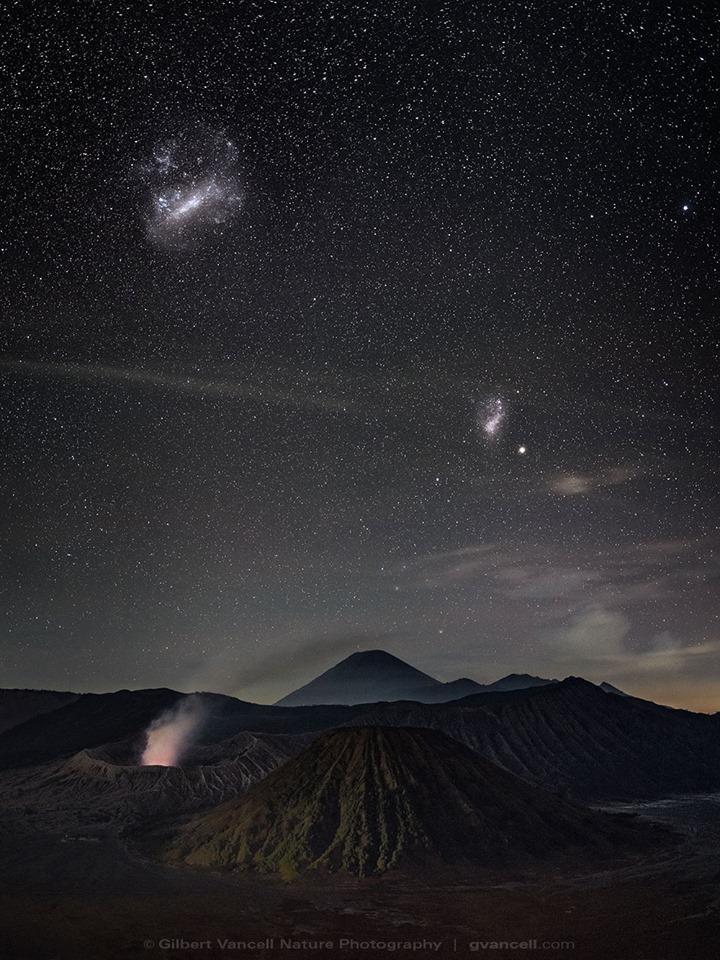
Credit: Gilbert Vancell- gvancell.com
The spiral-shaped disc of stars and planets is being pulled, twisted and deformed with extreme violence by the gravitational force of a smaller galaxy – the Large Magellanic Cloud (LMC).
Scientists believe the LMC crossed the Milky Way’s boundary around 700 million years ago – recent by cosmological standards – and due to its large dark matter content it strongly upset our galaxy’s fabric and motion as it fell in.
The effects are still being witnessed today and should force a revision of how our galaxy evolved, astronomers say.
The LMC, now a satellite galaxy of the Milky Way, is visible as a faint cloud in the southern hemisphere’s night skies – as observed by its namesake, the 16th century Portuguese explorer Ferdinand Magellan.
Previous research has revealed that the LMC, like the Milky Way, is surrounded by a halo of dark matter – elusive particles which surround galaxies and do not absorb or emit light but have dramatic gravitational effects on the movement of stars and gas in the universe.
Using a sophisticated statistical model that calculated the speed of the Milky Way’s most distant stars, the University of Edinburgh team discovered how the LMC warped our galaxy’s motion. The study, published in Nature Astronomy, was funded by UK Science and Technology Facilities Council (STFC).
The researchers found that the enormous attraction of the LMC’s dark matter halo is pulling and twisting the Milky Way disc at 32 km/s or 115,200 kilometers per hour towards the constellation Pegasus.
To their surprise they also found that the Milky Way was not moving towards the LMC’s current location, as previously thought, but towards a point in its past trajectory.
They believe this is because the LMC, powered by its massive gravitational force, is moving away from the Milky Way at the even faster speed of 370 km/s, around 1.3 million kilometres per hour.
Astronomers say it is as if the Milky Way is trying hard to hit a fast moving target, but not aiming very well.
This discovery will help scientists develop new modelling techniques that capture the strong dynamic interplay between the two galaxies.
Astronomers now intend to find out the direction from which the LMC first fell in to the Milky Way and the exact time it happened. This will reveal the amount and distribution of dark matter in the Milky Way and the LMC with unprecedented detail.
Dr Michael Petersen, lead author and Postdoctoral Research Associate, School of Physics and Astronomy, said:
“Our findings beg for a new generation of Milky Way models, to describe the evolution of our galaxy.
“We were able to show that stars at incredibly large distances, up to 300,000 light-years away, retain a memory of the Milky Way structure before the LMC fell in, and form a backdrop against which we measured the stellar disc flying through space, pulled by the gravitational force of the LMC.”
Professor Jorge Peñarrubia, Personal Chair of Gravitational Dynamics, School of Physics and Astronomy, said:
“This discovery definitely breaks the spell that our galaxy is in some sort of equilibrium state. Actually, the recent infall of the LMC is causing violent perturbations onto the Milky Way.
“Understanding these may give us an unparalleled view on the distribution of dark matter in both galaxies.”
###
The study received support from Martin Weinberg for usage of the EXP code.
For further information please contact: Rhona Crawford, Press and PR Office, 0131 650 2246, [email protected]
Media Contact
Rhona Crawford
[email protected]
Related Journal Article
http://dx.