• HOME
  • NEWS
  • EXPLORE
    • CAREER
      • Companies
      • Jobs
    • EVENTS
    • iGEM
      • News
      • Team
    • PHOTOS
    • VIDEO
    • WIKI
  • BLOG
  • COMMUNITY
    • FACEBOOK
    • INSTAGRAM
    • TWITTER
Monday, May 18, 2026
BIOENGINEER.ORG
No Result
View All Result
  • Login
  • HOME
  • NEWS
  • EXPLORE
    • CAREER
      • Companies
      • Jobs
        • Lecturer
        • PhD Studentship
        • Postdoc
        • Research Assistant
    • EVENTS
    • iGEM
      • News
      • Team
    • PHOTOS
    • VIDEO
    • WIKI
  • BLOG
  • COMMUNITY
    • FACEBOOK
    • INSTAGRAM
    • TWITTER
  • HOME
  • NEWS
  • EXPLORE
    • CAREER
      • Companies
      • Jobs
        • Lecturer
        • PhD Studentship
        • Postdoc
        • Research Assistant
    • EVENTS
    • iGEM
      • News
      • Team
    • PHOTOS
    • VIDEO
    • WIKI
  • BLOG
  • COMMUNITY
    • FACEBOOK
    • INSTAGRAM
    • TWITTER
No Result
View All Result
Bioengineer.org
No Result
View All Result
Home NEWS Science News

Fused-ring electron acceptor with 3D exciton and charge transport

Bioengineer by Bioengineer
April 28, 2020
in Science News
Reading Time: 2 mins read
0
IMAGE
Share on FacebookShare on TwitterShare on LinkedinShare on RedditShare on Telegram

IMAGE

Credit: Zhan Xiaowei

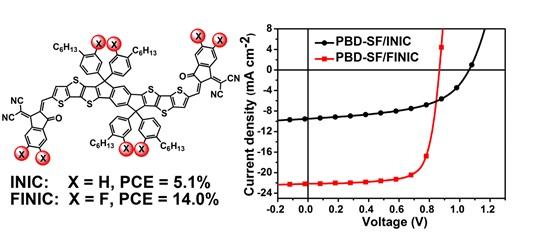
Recently, Professor Zhan Xiaowei’s group from the College of Engineering at Peking University made new progress in non-fullerene acceptors for organic solar cells (OSCs). They developed a new fluorinated fused-ring electron acceptor (FREA) with 3D stacking and exciton and charge transport (Adv. Mater., DOI: 10.1002/adma.202000645).

In 2015, the Zhan group pioneered the concept of FREA and invented the landmark molecule ITIC (Adv. Mater., 2015, 27, 1170-1174, cited 1590 times). In 2017, they firstly introduced fluorinated 2-(3-oxo-2,3-dihydroinden-1-ylidene) -malononitrile, 1FIC and 2FIC, in FREAs (J. Am. Chem. Soc., 2017, 139, 1336-1343, cited 547 times; Adv. Mater., 2017, 29, 1700144, cited 549 times). Now, all the best non-fullerene acceptors are based on 1FIC/2FIC.

Most recently, they proposed a new design strategy to construct FREAs via fluorination of both end-groups and side-chains. Close 3D stacking network is formed due to 3D non-covalent interactions caused by F atoms on both end-groups and side-chains, which is beneficial to efficient 3D exciton and charge transport. The OSCs based on FINIC with fluorinated end-groups and side-chains show an efficiency of 14.0%, much higher than that of the nonfluorinated INIC-based cells (5.1%).

The research work was supported by the National Nature Science Foundation of China and Basic Research Promotion Project of Peking University.

###

Media Contact
Huang Weijian
[email protected]

Original Source

http://newsen.pku.edu.cn/news_events/news/research/9699.htm

Related Journal Article

http://dx.doi.org/10.1002/adma.202000645

Tags: Electrical Engineering/ElectronicsResearch/DevelopmentTechnology/Engineering/Computer Science
Share12Tweet8Share2ShareShareShare2

Related Posts

Improving Infant Data Collection for NICU Equity

May 18, 2026
Neuroscience, Socioeconomic Status, and Preterm Birth Insights — Technology and Engineering

Neuroscience, Socioeconomic Status, and Preterm Birth Insights

May 18, 2026

Supramolecular Dye Polymers Boost Aggregation Photocatalysis

May 18, 2026

Maternal Age and Pregnancy Heart Risks Explored

May 18, 2026
Please login to join discussion

POPULAR NEWS

  • Research Indicates Potential Connection Between Prenatal Medication Exposure and Elevated Autism Risk

    844 shares
    Share 338 Tweet 211
  • New Study Reveals Plants Can Detect the Sound of Rain

    731 shares
    Share 292 Tweet 182
  • Salmonella Haem Blocks Macrophages, Boosts Infection

    62 shares
    Share 25 Tweet 16
  • Breastmilk Balances E. coli and Beneficial Bacteria in Infant Gut Microbiomes

    58 shares
    Share 23 Tweet 15

About

We bring you the latest biotechnology news from best research centers and universities around the world. Check our website.

Follow us

Recent News

Improving Infant Data Collection for NICU Equity

Neuroscience, Socioeconomic Status, and Preterm Birth Insights

Supramolecular Dye Polymers Boost Aggregation Photocatalysis

Subscribe to Blog via Email

Enter your email address to subscribe to this blog and receive notifications of new posts by email.

Join 82 other subscribers
  • Contact Us

Bioengineer.org © Copyright 2023 All Rights Reserved.

Welcome Back!

Login to your account below

Forgotten Password?

Retrieve your password

Please enter your username or email address to reset your password.

Log In
No Result
View All Result
  • Homepages
    • Home Page 1
    • Home Page 2
  • News
  • National
  • Business
  • Health
  • Lifestyle
  • Science

Bioengineer.org © Copyright 2023 All Rights Reserved.