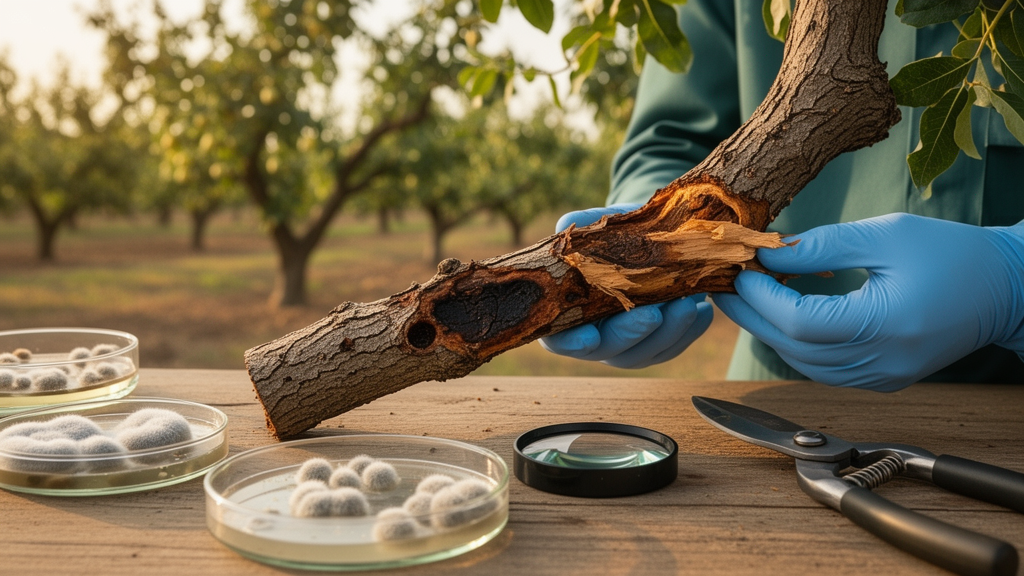
A large-scale survey of walnut orchards in Central Anatolia has documented how widespread and diverse the fungal disease complex behind cankers, twig dieback, and fruit rot is in the region. Researchers examined 30,501 trees across 265 orchards in eight Turkish provinces and found that 87.9 percent of orchards contained at least one symptomatic tree, with a pooled overall incidence of symptomatic trees of 16.0 percent. The study, published in BMC Plant Biology, investigated the prevalence, species composition, symptom associations, pathogenicity, and temperature-dependent growth of Botryosphaeriaceae fungi affecting walnut across the region.
The survey covered Aksaray, Kayseri, Kırıkkale, Kırşehir, Nevşehir, Niğde, Sivas, and Yozgat. Both the proportion of orchards with at least one symptomatic tree and the incidence of symptomatic trees varied significantly among provinces, indicating a spatially heterogeneous disease landscape. From trees showing perennial canker, twig dieback, or fruit rot symptoms, the researchers collected 1,283 tissue samples, from which 666 Botryosphaeriaceae isolates were obtained, corresponding to 51.9 percent of sampled tissues.
Molecular and morphological characterization identified five species: Diplodia seriata accounted for 37.4 percent of isolates, Neofusicoccum parvum for 29.0 percent, Botryosphaeria dothidea for 17.4 percent, Lasiodiplodia theobromae for 8.6 percent, and Lasiodiplodia pseudotheobromae for 7.7 percent. To confirm species boundaries, the team performed multilocus phylogenetic analyses of 56 representative isolates using three DNA loci: the internal transcribed spacer region (ITS), the beta-tubulin gene (TUB2), and the translation elongation factor 1-alpha gene (TEF1-α). These analyses supported the five species-level groups identified in the collection, providing a taxonomic framework for the isolates recovered from Central Anatolian walnuts.
Isolate-level species composition was significantly associated with both symptom type and province. That means the particular mix of fungal species recovered differed depending on whether the sampled tissue came from a canker, dieback, or fruit rot symptom, and also depending on which province the orchard was located in. The study design documents these associations rather than proving causal roles for each species in each symptom.
Pathogenicity was tested using 15 multilocus-confirmed isolates, three per species, inoculated onto both detached and attached walnut branches. All five species caused disease in these tests. The highest pathogenicity was generally observed in isolates of L. theobromae and L. pseudotheobromae, while the lowest was recorded in D. seriata isolates. The researchers also examined how mycelial growth responded to temperature, and species differences emerged: L. pseudotheobromae reached its highest growth at 30 degrees Celsius, and both L. theobromae and L. pseudotheobromae maintained higher growth at 35 degrees Celsius compared with the other species tested. The authors conclude that the Botryosphaeriaceae disease complex in Central Anatolian walnut orchards is widespread and heterogeneous, with spatial variation in isolate composition, and that the high pathogenicity of the tested Lasiodiplodia isolates and their comparatively strong in vitro growth at the upper end of the tested temperature range warrant further investigation.
Subject of Research: Botryosphaeriaceae species associated with canker, twig dieback, and fruit rot of walnut in Central Anatolia, Türkiye
Article Title: Species composition, distribution, and pathogenicity of Botryosphaeriaceae species associated with canker, twig dieback, and fruit rot of walnut in Central Anatolia, Türkiye
Article References: Eser, Y. K., & Endes, A. (2026). Species composition, distribution, and pathogenicity of Botryosphaeriaceae species associated with canker, twig dieback, and fruit rot of walnut in Central Anatolia, Türkiye. BMC Plant Biology. https://doi.org/10.1186/s12870-026-10197-2
Image Credits: AI Generated
DOI: 10.1186/s12870-026-10197-2
Keywords: walnut, Botryosphaeriaceae, Lasiodiplodia, Diplodia seriata, Neofusicoccum parvum, canker, twig dieback, fruit rot, Central Anatolia, plant pathology, phylogenetics, pathogenicity
News Source: Roger Howard. (October 24, 2026). Fungal Pathogens Behind Walnut Cankers Mapped Across Central Anatolia. Scienmag.