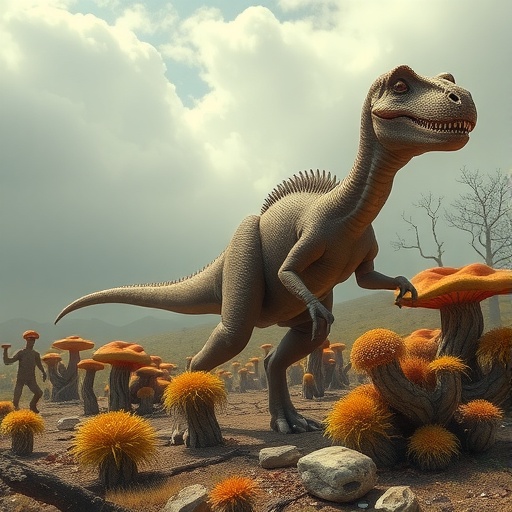
New groundbreaking research from the Johns Hopkins Bloomberg School of Public Health has unveiled compelling evidence of extensive fungal proliferation in North America both preceding and following the catastrophic asteroid impact that is widely believed to have precipitated the extinction of the dinosaurs 66 million years ago. These findings, revealed through meticulous analysis of microfossils extracted from geological strata within Colorado’s Denver Basin, represent a pivotal advancement in our understanding of biotic responses to mass extinction events and suggest that fungal blooms following environmental catastrophes may be more globally pervasive than previously understood.
The study elucidates a distinct surge in fungal microfossil presence immediately subsequent to the Cretaceous–Paleogene (K–Pg) boundary, corroborating earlier isolated findings from New Zealand rock deposits. This global fungal spike aligns temporally with the asteroid impact that terminated the Cretaceous period. Through quantitative comparison distinguishing fungal remains from plant-derived microstructures, researchers confirmed that fungal biomass experienced an unprecedented expansion in response to the extensive ecological disruption caused by the impact. This fungal overgrowth likely thrived on the abundant detritus from widespread flora and fauna mortality.
What distinguishes this research is its revelation of an antecedent fungal bloom occurring tens of thousands of years before the asteroid collision. This prior fungal expansion coincides with a period of intense volcanic activity in the Deccan Traps region of what is now western India, a phenomenon historically implicated in global climate perturbations and biosphere stress preceding the K–Pg extinction. The volcanic episode’s climatic effects, notably a decline in regional temperatures at the Denver site, appear to have catalyzed ecosystem disturbances substantial enough to stimulate fungal proliferation well before the asteroid’s apocalyptic impact.
The biological implications of these findings are profound. Fungi, as saprotrophic organisms, often exploit ecological niches created by mass die-offs, thriving on decaying organic matter when ecosystems destabilize. This adaptive trait positions them as crucial agents in post-catastrophe ecological succession. By mapping the temporal fungal abundance bursts, researchers have provided a novel proxy for gauging ecosystem collapse and recovery phases in prehistoric times, lending support to the emergent discipline of “disaster microbiology,” which investigates microbial dynamics during planetary-scale upheavals.
Intriguingly, the study also identifies a third fungal growth phase occurring approximately 10,000 years post-impact, during the early Paleocene epoch. This phase, lasting roughly 2,000 years, suggests a sustained period of environmental perturbation extending beyond the immediate aftermath of the asteroid strike. The persistence of fungal dominance long after the extinction event implies prolonged ecological instability, likely influenced by combined factors of disrupted climate, altered vegetation patterns, and lingering environmental stressors.
The research team, led by professor Arturo Casadevall and his colleague Rosanna Baker, leveraged advanced paleomicrobiological techniques to meticulously quantify fungal microfossils against a backdrop of plant-derived spores and pollen. This approach enabled precise temporal resolution of fungal activity peaks within sedimentary sequences. Their interdisciplinary collaboration with paleontologist Tyler Lyson, who provided critical access to diverse fossil-bearing rock samples, was instrumental in synthesizing geological, paleontological, and microbiological evidence into a coherent narrative of ecosystem transition across the K–Pg boundary.
This pioneering work also provides empirical underpinning to a long-standing hypothesis that fungal overgrowth after the Cretaceous extinction event contributed to shaping the evolutionary trajectory of surviving species. Mammals, possessing comparatively higher and more resilient body temperatures that confer fungal resistance, may have gained a significant survival advantage in the post-extinction biosphere dominated by fungal proliferation. This selective pressure arguably facilitated mammalian adaptive radiation and eventual dominance of terrestrial vertebrate fauna in subsequent geological epochs.
Moreover, the study includes comparative analysis of fungal microfossil abundance from North Dakota paleontological sites, which did not exhibit pronounced fungal blooms concurrent with the asteroid event. The absence in these samples is tentatively attributed to local lithological differences affecting microfossil preservation rather than indicating a true regional biological absence. Nonetheless, the North Dakota data corroborated findings of earlier and later fungal surges, reinforcing temporal patterns of fungal response to environmental crises.
Collectively, these findings reshape the narrative of the K–Pg extinction by highlighting complex, multi-phased ecological disruptions rather than a singular cataclysmic event. The identification of global fungal surges anthropogenically expands our understanding of mass extinction aftermaths, emphasizing the intricate interplay between abiotic stressors such as volcanism and bolide impacts, and biotic responses manifested through microbial community dynamics. This holistic perspective invites further exploration into microbial roles in Earth’s resiliency and recovery mechanisms following mass extinctions.
Published in the prestigious Proceedings of the National Academy of Sciences on May 12, the study exemplifies the potent synergy of microbiology, paleontology, and geochemistry in decoding Earth’s deep-time biological crises. It paves the way for future inquiries into fungal fossils as sensitive bioindicators for ancient environmental upheavals and evolutionary pressures. The innovative methodological framework established here promises to enrich paleobiological research across temporal and spatial scales.
Dr. Casadevall and Ms. Baker’s research, supported in part by the National Institutes of Health, invites us to reconsider how microbial life forms have historically modulated planetary ecosystems during periods of profound change. In redefining fungi not merely as decomposers but as ecological protagonists in extinction and recovery narratives, this work heralds a paradigm shift in understanding Earth’s biotic resilience.
Subject of Research: Fungal proliferation associated with mass extinction events in the Cretaceous–Paleogene boundary.
Article Title: Fungal Proliferation Before and After the Cretaceous–Paleogene Mass Extinction Event in North America.
News Publication Date: May 12, 2024.
Web References: https://www.pnas.org/doi/10.1073/pnas.2536899123
References: Casadevall A., Baker R.P. (2024). Fungal Proliferation Before and After the Cretaceous–Paleogene Mass Extinction Event in North America. Proceedings of the National Academy of Sciences.
Keywords: fungi, fungal bloom, Cretaceous–Paleogene extinction, asteroid impact, Deccan Traps volcanism, disaster microbiology, microfossils, mass extinction, paleontology, ecosystem upheaval, mammalian evolution.
Tags: asteroid impact fungal proliferationbiotic response to extinction eventsCretaceous mass extinction fungal boomdinosaur extinction fungal evidencefungal biomass expansion after asteroidfungal microfossils Denver Basinfungal overgrowth on ecological disruptionfungal proliferation in Cretaceous periodfungal response to mass extinctionglobal fungal blooms post-catastropheK–Pg boundary fungal spikepre-impact fungal bloom evidence