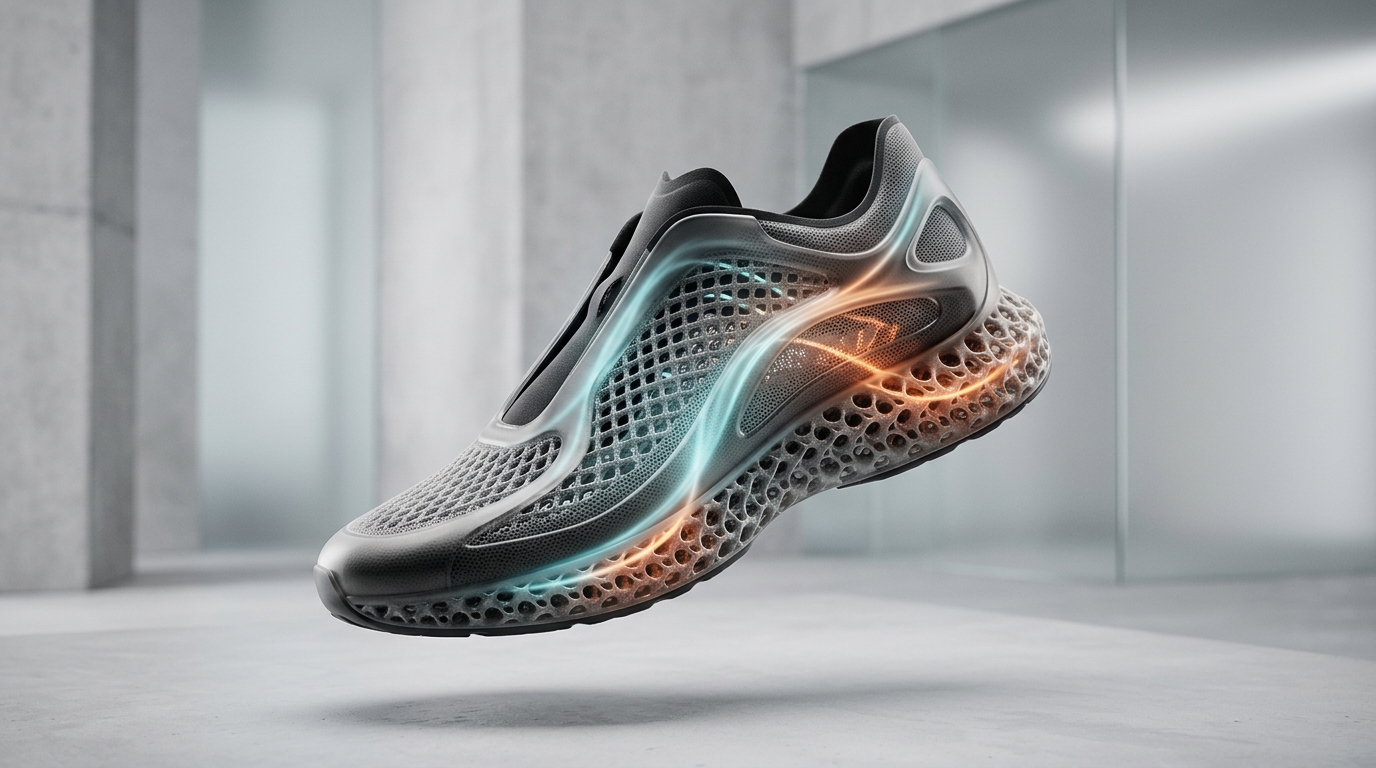
Researchers have built complete shoes on a 3D printer using a lightweight, microfoamed thermoplastic polyurethane filament and then measured how the finished footwear performs under compression, impact and walking loads. The study, published in the journal Fashion and Textiles, evaluated the entire printed shoe as a single wearable structure rather than testing isolated midsoles, insoles or uppers, an approach the authors describe as an integrated material–process–structure–performance framework for fully 3D printed footwear.
Imjoo Jung and Sunhee Lee of Dong-A University fabricated shoes with a dual-nozzle fused deposition modeling printer using three body-and-support material combinations: lightweight PLA printed with PLA support, TPU printed with lightweight PLA support, and lightweight TPU printed with PLA support. The support structures were removed before testing, so the final samples are named for the shoe-body material alone. The shoe model, an open-source gyroid design with dimensions of 245.00 × 95.85 × 93.88 millimeters, was sliced with a 20 percent infill density and a zigzag pattern, and tree-type supports were used with placement set to touch the buildplate.
Before printing, the team characterized four filaments: conventional PLA, lightweight PLA, conventional TPU and lightweight TPU. Rheological testing showed that the loss factor, tan δ, rose with temperature for all materials, but the lightweight variants maintained comparatively lower values, indicating better shape retention under heat. PLA exceeded tan δ values of 17 at elevated temperatures, while TPU showed higher tan δ than lightweight TPU above 180 degrees Celsius. Differential scanning calorimetry revealed that the dense filaments each had a single melting peak, at 148.69 degrees Celsius for PLA and 226.42 degrees Celsius for TPU, whereas the lightweight foaming filaments showed dual melting peaks, at 152.16 and 193.34 degrees Celsius for lightweight PLA and at 159.70 and 194.37 degrees Celsius for lightweight TPU. The dual peaks were associated with endothermic absorption related to microparticles generated during the foaming process, and the lightweight TPU displayed a much lower enthalpy of 3.47 joules per gram compared with 11.52 joules per gram for dense TPU.
Print orientation proved to be a decisive process parameter. The researchers sliced the shoe model at 15-degree intervals from 0 to 90 degrees and found the maximum printable size varied from 322.40 millimeters at 0 degrees to 350.11 millimeters at 45 degrees and 297.18 millimeters at 90 degrees. The 45-degree orientation allowed the largest printable dimension within the build volume and produced diagonally stacked layers across the shoe body, an arrangement the authors suggest may distribute bending deformation across multiple layers rather than concentrating it along a single horizontal plane. The trade-off was a relatively long printing time and greater support-material consumption, which the team accepted as a practical compromise between printable size and fabrication feasibility.
After printing, the mechanical differences between the three shoe types were stark. The lightweight PLA shoe required roughly 45 hours to print and weighed 192.78 grams on average, but it behaved as a rigid, brittle structure in compression, with a steep rise in stress after about 13 percent strain, an initial modulus of 4440.59 megapascals and a maximum strain of only 25.91 percent. The TPU shoe, at 142.04 grams, and the lightweight TPU shoe, at 133.38 grams, developed stiffness much later, with strain-softening appearing around 50 and 60 percent strain respectively. The lightweight TPU shoe recorded the largest maximum strain at 82.98 percent and the greatest compressive toughness at 5.80 joules, and its porous morphology, with an average pore size of approximately 50 micrometers, enabled wall buckling and energy dissipation that did not occur in the dense, non-porous TPU structure.
Impact attenuation testing followed ASTM F1976, with 5-joule drop impacts applied 30 times to the heel region of each sample. The lightweight PLA shoe exhibited the highest peak load, at 688.82 newtons on the final drop, and its load–displacement curves showed irregular and unstable fluctuations, indicating inefficient energy dissipation and a substantial portion of the impact force transferred directly toward the foot. The TPU shoe showed the lowest peak load at 449.69 newtons and the largest displacement at 9.74 millimeters, a combination the authors interpret as high shock absorption through large deformation. The lightweight TPU shoe fell between the two, with a peak load of 477.24 newtons and displacement of 8.85 millimeters, and both flexible shoes showed progressive load reduction across four rebound peaks, confirming effective attenuation of impact energy through repeated deformation and recovery.
A pilot plantar pressure evaluation with two female participants then tested barefoot, socks, TPU shoe and lightweight TPU shoe conditions. The lightweight PLA shoe was excluded because its high stiffness limited foot insertion and walking deformation during a preliminary wearability screening. Measurements across 10 foot zones showed that body-weight-normalized peak pressure generally decreased in the metatarsal and heel regions when participants wore the printed shoes. For subject 1, pressure in the M2 zone fell from 3.14 kilopascals per kilogram barefoot to 1.72 with the TPU shoe and 2.10 with the lightweight TPU shoe, and the midfoot heel zone dropped from 3.11 to 1.78 and 1.93 respectively. For subject 2, the M1 zone decreased from 2.05 barefoot to 1.61 and 1.54, and the lateral heel fell from 2.00 to 1.19 and 1.25.
Contact area expanded even more consistently. Both shoe conditions increased plantar contact area compared with barefoot and socks, and the lightweight TPU shoe produced the broadest contact area in most regions, particularly in the midfoot and heel zones. For subject 1, contact area in the midfoot, midfoot heel and lateral heel zones increased from a range of 17.29 to 21.93 percent barefoot to 22.59 to 25.13 percent with the lightweight TPU shoe, and for subject 2 the range rose from 12.63 to 15.47 percent to 21.02 to 25.04 percent. The authors attribute this to the shoe’s lightweight foamed morphology, low initial modulus and high deformability, which allowed the structure to deform under body loading while maintaining sufficient recovery, spreading plantar loading over a wider surface rather than concentrating it in localized metatarsal and heel regions.
The study’s limitations are clearly stated. The plantar pressure evaluation was a pilot study with only two female participants who both wore the same 245-millimeter shoe model despite having different foot sizes, so the observed pressure-distribution patterns are preliminary and subject-specific and cannot be generalized to a broader population. No conventional or commercial footwear was included as a control, meaning the observed reductions in plantar pressure cannot be interpreted as evidence of superior performance compared with commercial shoes. The build-orientation analysis was limited to slicing feasibility and printable size, and long-term durability, bending fatigue, abrasion resistance, outsole traction and subjective comfort were not evaluated. The authors call for future studies with larger and more diverse participant populations, participant-specific shoe sizing, commercial footwear controls and systematic durability testing to validate the plantar pressure redistribution behavior they observed.
Subject of Research: Fully 3D printed shoes fabricated with lightweight microfoamed TPU filament and evaluated for mechanical performance and plantar pressure
Article Title: Integrated characterization of fully 3D printed shoes using lightweight microfoamed TPU
Article References: Jung, I., & Lee, S. (2026). Integrated characterization of fully 3D printed shoes using lightweight microfoamed TPU. Fashion and Textiles, 13(1), Article 46. https://doi.org/10.1186/s40691-026-00492-9
Image Credits: AI Generated
DOI: 10.1186/s40691-026-00492-9
Keywords: 3D printing, additive manufacturing, fused deposition modeling, thermoplastic polyurethane, lightweight TPU, microfoamed filament, footwear, plantar pressure, impact attenuation, compressive properties, polylactic acid, dual-nozzle printing
News Source: Denise Maddox. (November 4, 2026). Fully 3D printed shoes made with microfoamed TPU show lighter build and lower peak pressures. Scienmag.