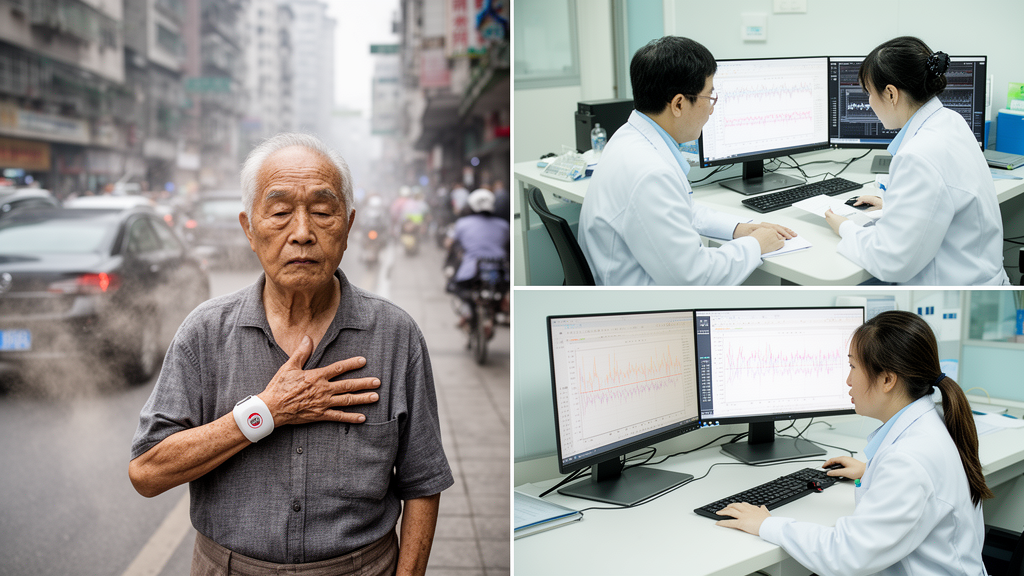
Short-term exposure to fine particulate matter and coarse particulate matter was associated with higher odds of angina onset in a time-stratified case-crossover study of 16,476 recorded cases in Fujian Province, China, from 2021 to 2023. The study focused on the onset of angina pectoris, a common clinical manifestation of ischemic heart disease that is associated with substantial symptom burden and healthcare use. Researchers examined whether recent changes in particulate-matter concentrations were associated with the occurrence of angina and assessed the associations separately for total angina, unstable angina and other forms of the condition.
The population was limited to cases recorded in Fujian Province during the three-year study period. Individual-level concentrations of PM2.5 and PM2.5–10 were estimated using satellite-derived data at a spatial resolution of 1 km × 1 km. The investigators used a time-stratified case-crossover design to estimate associations between short-term particulate-matter exposure and angina onset.
They also conducted subgroup analyses by sex, age and season. These analyses were designed to determine whether the estimated associations differed among selected population groups and periods of the year. For PM2.5, each interquartile range increase of 10.4 micrograms per cubic metre at lag 3 was associated with 6.44% higher odds of total angina pectoris.
The estimate had a 95% confidence interval of 3.22% to 9.76%. The corresponding association was 5.74% higher odds for unstable angina, with a 95% confidence interval of 1.53% to 10.13%. For other forms of angina pectoris, each interquartile range increase was associated with 9.39% higher odds, with a 95% confidence interval of 1.39% to 18.01%.
PM2.5–10 was associated with higher odds of angina across the same outcomes, but the reported estimate covered lag 0–3 rather than lag 3 alone. Each interquartile range increase of 6.9 micrograms per cubic metre over that period was associated with 5.53% higher odds of total angina pectoris. The 95% confidence interval was 2.41% to 8.75%.
For unstable angina, the estimate was 5.45% higher odds, with a 95% confidence interval of 1.15% to 9.93%. Other forms of angina pectoris showed a 9.51% association with higher odds, with a 95% confidence interval of 1.85% to 17.74%. The investigators observed linear exposure–response relationships for both pollutants.
The numerical similarity between the two particulate measures did not make their estimates directly interchangeable: the PM2.5 findings concerned lag 3, whereas the PM2.5–10 findings concerned the broader lag 0–3 window. Effect estimates tended to be higher among males and older individuals. However, differences between these subgroups were not statistically significant, so the study did not establish that either group had a definitively stronger association between particulate matter and angina onset.
The confidence intervals also showed substantial uncertainty for the other forms of angina, particularly in the PM2.5 analysis, where the interval extended from a 1.39% increase to an 18.01% increase in odds. Taken together, the results support an association between short-term PM2.5 and PM2.5–10 exposure and increased odds of angina onset in the studied population. The pattern was consistent across total angina, unstable angina and other forms of angina pectoris.
As an observational case-crossover study, however, the analysis reports exposure–outcome associations rather than demonstrating that particulate matter directly caused the recorded episodes. The findings apply to the cases and exposure contrasts studied in Fujian Province during 2021–2023 and do not establish the effects of long-term exposure or whether the same association applies to populations outside this setting.
Subject of Research: Short-term particulate-matter exposure and angina onset in Fujian Province
Article Title: Ambient particulate matter and angina pectoris onset: a case-crossover study
Article References: Li, X., Li, J., Zhang, Y., Yin, Y., Chen, T., Yang, K., Wei, J., Ni, Y., Jin, Z., Zhong, W., & Du, X. (2026). Ambient particulate matter and angina pectoris onset: a case-crossover study. BMC Public Health. https://doi.org/10.1186/s12889-026-30003-w
Image Credits: AI Generated
DOI: 10.1186/s12889-026-30003-w
Keywords: air pollution, PM2.5, PM2.5–10, angina pectoris, unstable angina, case-crossover study, environmental epidemiology, Fujian Province, Ambient, particulate, matter, angina
News Source: Russell Cooper. (October 22, 2026). Fujian case-crossover study links short-term particulate matter to angina. Scienmag.