• HOME
  • NEWS
  • EXPLORE
    • CAREER
      • Companies
      • Jobs
    • EVENTS
    • iGEM
      • News
      • Team
    • PHOTOS
    • VIDEO
    • WIKI
  • BLOG
  • COMMUNITY
    • FACEBOOK
    • INSTAGRAM
    • TWITTER
Wednesday, July 8, 2026
BIOENGINEER.ORG
No Result
View All Result
  • Login
  • HOME
  • NEWS
  • EXPLORE
    • CAREER
      • Companies
      • Jobs
        • Lecturer
        • PhD Studentship
        • Postdoc
        • Research Assistant
    • EVENTS
    • iGEM
      • News
      • Team
    • PHOTOS
    • VIDEO
    • WIKI
  • BLOG
  • COMMUNITY
    • FACEBOOK
    • INSTAGRAM
    • TWITTER
  • HOME
  • NEWS
  • EXPLORE
    • CAREER
      • Companies
      • Jobs
        • Lecturer
        • PhD Studentship
        • Postdoc
        • Research Assistant
    • EVENTS
    • iGEM
      • News
      • Team
    • PHOTOS
    • VIDEO
    • WIKI
  • BLOG
  • COMMUNITY
    • FACEBOOK
    • INSTAGRAM
    • TWITTER
No Result
View All Result
Bioengineer.org
No Result
View All Result
Home NEWS Science News Biology

FSU researchers find diverse communities comprise bacterial mats threatening coral reefs

Bioengineer by Bioengineer
October 15, 2020
in Biology
Reading Time: 2 mins read
0
IMAGE
Share on FacebookShare on TwitterShare on LinkedinShare on RedditShare on Telegram

IMAGE

Credit: Courtesy of Ethan Cissell

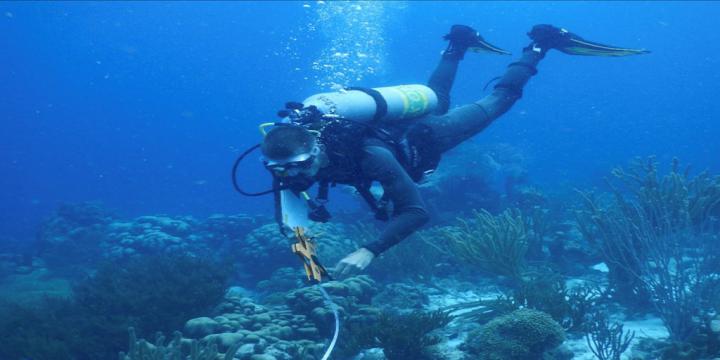
TALLAHASSEE, Fla. — Researchers are learning more about the brightly colored bacterial mats threatening the ecological health of coral reefs worldwide. In new research released this month, a Florida State University team revealed that these mats are more complex than scientists previously knew, opening the door for many questions about how to best protect reef ecosystems in the future.

FSU Assistant Professor of Biological Science Sophie McCoy and doctoral student Ethan Cissell published their findings in the journal Science of the Total Environment.

“By targeting the full biological diversity of these mat communities on reefs, and by studying the transcriptome, which gives us information about which biochemical processes are being used by those organisms, we’re opening the door to a more complete understanding of the entire ecological role of mats,” McCoy said.

Though these cyanobacterial mats have been examined in the past, scientists focused on characterizing the cyanobacteria. Cissell and McCoy found that cyanobacteria only made up about 47.57% of the mats. Their analysis showed that mats also contained a type of algae called diatoms, fungi, a single cell organism called archaea, viruses and other forms of bacteria.

“We know from other well-characterized systems that cyanobacteria, even in bloom-forming scenarios, associate with a diversity of other microorganisms that make significant and unique contributions to the overall dynamics and ecophysiology of these cyanobacteria-dominated consortia,” Cissell said. “We set out to determine if similar associations are found in proliferating cyanobacterial mats on coral reefs.”

Cyanobacterial mats have posed a huge problem for coral reef health. Coral reef bacteria have always played an important role in these ecological communities, but the growth — largely attributed to local and global climate stressors — has threatened to totally snuff out the life of precious corals.

Previously, the bacteria covered about 1% of reefs, but that has grown to 20 to 30% in some places.

Researchers said this greater understanding of the communities comprising the mats leads to more questions about how the mats form and grow.

“What this means is that the mechanisms controlling mat bloom dynamics on coral reefs are likely more complex than previously thought,” Cissell said. “These data we present provide important baselines for future mechanistic-based exploration of the processes driving the growth, persistence, and decline of benthic cyanobacterial mats.”

McCoy and Cissell conducted 29 diving expeditions in Bonaire, an island municipality of the Netherlands off the coast of Venezuela, for the project. They are currently conducting genetic sequencing on mat samples to get a better understanding of daily patterns of the communities comprising the mat. They are also examining samples taken from a dying mat to better understand compositional and functional shifts associated with mat death.

###

Their work was supported by the National Science Foundation and the Phycological Society of America.

Media Contact
Kathleen Haughney
[email protected]

Original Source

https://news.fsu.edu/news/science-technology/2020/10/15/fsu-researchers-find-diverse-communities-comprise-bacterial-mats-threatening-coral-reefs/

Tags: Climate ChangeEarth ScienceEcology/Environment
Share12Tweet8Share2ShareShareShare2

Related Posts

Here are a few rewritten headlines for a science magazine post, each with a slightly different tone: Intriguing & poetic: How do organs sculpt themselves? Sea stars hold the secret Direct & research-focused: Sea stars reveal the hidden rules of organ formation Metaphorical & inviting: Tiny architects beneath the waves: What sea stars teach us about building organs Short & punchy: Star-shaped clues to how our organs take shape Question-led: Could a sea star show us how organs form? Elegant & feature-style: The body’s blueprint, glimpsed in a sea star’s arm

July 6, 2026
Bacteria evolve faster with unconventional gene copies — Biology

Bacteria evolve faster with unconventional gene copies

July 6, 2026

Neighbours rewire soil feedback via root microbiome shifts

July 6, 2026

Evolution-Inspired Biosensors Revolutionize Lipid Tracking in Real Time

July 2, 2026
Please login to join discussion

POPULAR NEWS

  • Detection of EDCs in Breast Milk and Infant Urine Up to Six Months Highlights Early Exposure Risks

    77 shares
    Share 31 Tweet 19
  • New Drug Candidate Developed at McMaster Shows Potential for Treating Brain Cancer

    58 shares
    Share 23 Tweet 15
  • KTU Researchers Explore Ultrasound’s Role in Enhancing Blood Flow Beyond Diagnostics

    53 shares
    Share 21 Tweet 13
  • 高齢者の骨粗鬆症治療の持続性比較

    51 shares
    Share 20 Tweet 13

About

We bring you the latest biotechnology news from best research centers and universities around the world. Check our website.

Follow us

Recent News

Encellin’s diabetes implant shows non-fibrotic engraftment in phase 1

Return exactly one rewritten English science news headline for the original title below. Maximum 12 words. Output plain text only. Do not use HTML, Markdown, quotes, labels, explanations, bullets, numbering, or multiple options. Original title: MIT engineers whip up a more breathable hydrogel

Flame retardant BDE-209 targets molecularly linked to ulcerative colitis

Subscribe to Blog via Email

Enter your email address to subscribe to this blog and receive notifications of new posts by email.

Join 83 other subscribers
  • Contact Us

Bioengineer.org © Copyright 2023 All Rights Reserved.

Welcome Back!

Login to your account below

Forgotten Password?

Retrieve your password

Please enter your username or email address to reset your password.

Log In
No Result
View All Result
  • Homepages
    • Home Page 1
    • Home Page 2
  • News
  • National
  • Business
  • Health
  • Lifestyle
  • Science

Bioengineer.org © Copyright 2023 All Rights Reserved.