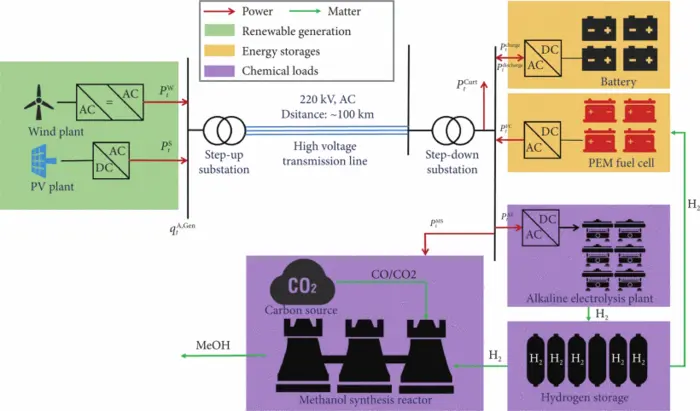
Methanol is a crucial chemical feedstock and a potential green fuel, particularly for the shipping industry. Currently, its production predominantly relies on fossil feedstocks, leading to high greenhouse gas emissions. With the global push towards decarbonization, there is an urgent need to explore cleaner alternatives like renewable e-methanol. Based on these challenges, there is a need for in-depth research to develop sustainable methanol production methods.
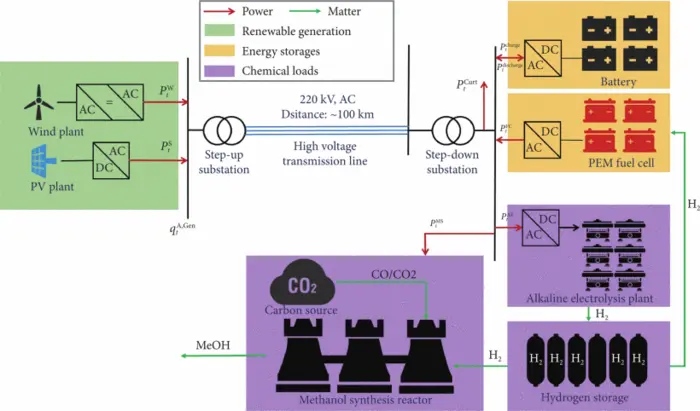
Credit: iEnergy, Tsinghua University Press
Methanol is a crucial chemical feedstock and a potential green fuel, particularly for the shipping industry. Currently, its production predominantly relies on fossil feedstocks, leading to high greenhouse gas emissions. With the global push towards decarbonization, there is an urgent need to explore cleaner alternatives like renewable e-methanol. Based on these challenges, there is a need for in-depth research to develop sustainable methanol production methods.
A team of researchers from Tsinghua University, the Tsinghua-Sichuan Energy Internet Research Institute, and the Methanol Institute conducted a study (DOI: 10.23919/IEN.2024.0013), published in June 2024 in iEnergy. The study investigates the feasibility of producing renewable e-methanol using different carbon sources, including bio-carbon, direct air capture (DAC), fossil fuel carbon capture (FFCC), and fossil sources. By comparing the lifecycle greenhouse gas emissions and production costs of these e-methanols, the research aims to identify the most promising pathways for commercializing green methanol.
The study evaluates the lifecycle greenhouse gas emissions and production costs of four types of renewable e-methanol, each using different carbon sources: bio-carbon, DAC, FFCC, and fossil sources. The findings reveal that renewable e-methanol significantly reduces greenhouse gas emissions, with bio-carbon and DAC methods showing negative emissions. However, the production costs of renewable e-methanol (ranging from 4167 to 10250 CNY per tonne) are currently 2-4 times higher than conventional methanol. Key factors influencing cost-effectiveness include the availability of green carbon sources and the e-hydrogen cost depending on power generation and chemical process flexibility. The study suggests that the declining e-hydrogen costs and appropriate carbon taxes, could pave the way for blue methanol to initially compete with fossil fuels in the shipping industry. As the industry advances, green renewable methanol is poised to further enhance its competitiveness, ultimately replacing diesel and heavy fuel oil and driving substantial emission reductions.
Dr. Jin Lin, a lead researcher at Tsinghua University, stated, “Our findings underscore the potential of renewable e-methanol to serve as a sustainable fuel alternative. By addressing the cost and availability of e-hydrogen and green carbon, we can pave the way for its commercial adoption and contribute to global decarbonization efforts.”
Renewable e-methanol has promising applications in the shipping industry, where it can replace diesel and heavy fuel oil, reducing carbon emissions significantly. Future research and policy efforts should focus on lowering e-hydrogen costs and enhancing the supply of green carbon sources. The successful commercialization of renewable e-methanol could play a critical role in achieving global sustainability goals.
This work was supported by the National Natural Science Foundation of China (U22A20220) and the China Postdoctoral Science Foundation (2023M741887).
About iEnergy
iEnergy (Published by Tsinghua University Press), has multiple meanings, intelligent energy, innovation for energy, internet of energy, and electrical energy due to “i” is the symbol of current. iEnergy, publishing quarterly, is a cross disciplinary journal aimed at disseminating frontiers of technologies and solutions of power and energy. The journal publishes original research on exploring all aspects of power and energy, including any kind of technologies and applications from power generation, transmission, distribution, to conversion, utilization, and storage. iEnergy provides a platform for delivering cutting-edge advancements of sciences and technologies for the future-generation power and energy systems.
About SciOpen
SciOpen is an open access resource of scientific and technical content published by Tsinghua University Press and its publishing partners. SciOpen provides end-to-end services across manuscript submission, peer review, content hosting, analytics, identity management, and expert advice to ensure each journal’s development. By digitalizing the publishing process, SciOpen widens the reach, deepens the impact, and accelerates the exchange of ideas.
Journal
iEnergy
DOI
10.23919/IEN.2024.0013
Article Title
Feasibility study of renewable e-methanol production: A substitution pathway from blue to green
Article Publication Date
30-Jun-2024