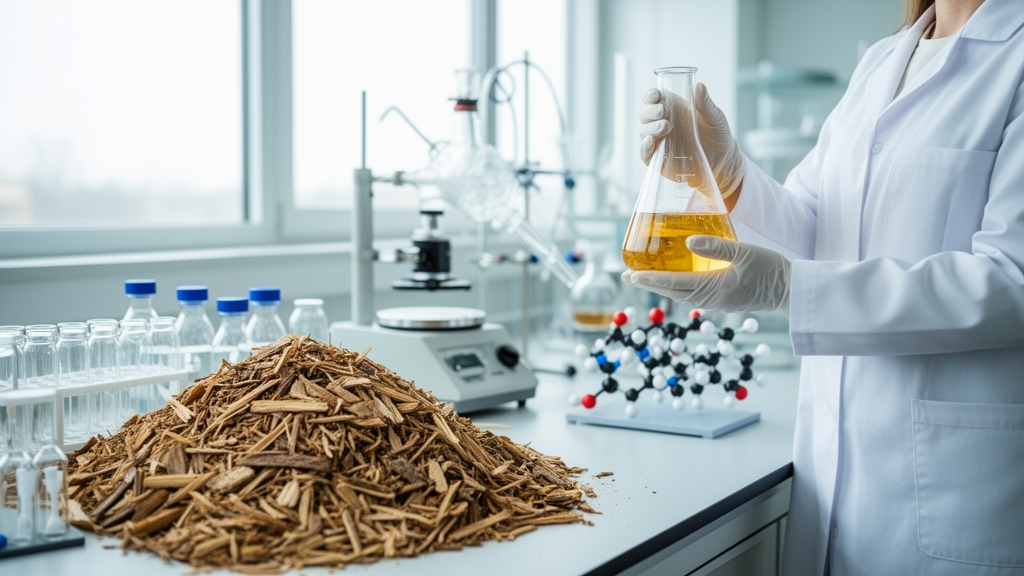
For more than a century, the molecules that underpin modern life—pharmaceuticals, plastics, pesticides, solvents, and fuels—have been built almost exclusively from petroleum. That dependence has come at a steep environmental price, from rising carbon dioxide emissions to persistent wastewater and hazardous effluents. Now, a comprehensive review published in Frontiers in Environmental Engineering argues that the chemical industry stands at a genuine inflection point, one where plant matter, agricultural leftovers, and even municipal waste could replace crude oil as the raw material of organic synthesis. The review, led by Sushmita Bhatia and Ram Singh of Delhi Technological University together with Shruti Rai Bhardwaj of India’s Ministry of Environment, Forest and Climate Change, maps out how biomass valorization—the conversion of biological material into valuable chemicals—has matured from a niche green-chemistry curiosity into a credible industrial strategy.
The core argument rests on a simple chemical observation: biomass is fundamentally different from petroleum. Where crude oil consists of hydrocarbons that must be laboriously functionalized with oxygen atoms before they can become useful products, biomass is already oxygen-rich. Carbohydrates, lignin, lipids, and proteins arrive pre-oxidized, meaning chemists can often skip energy-intensive oxidation steps entirely. Biomass is also, in principle, carbon-neutral, since the carbon dioxide released when its products are burned or degraded was recently captured from the atmosphere by photosynthesis. The review notes that scenario projections suggest at least 30 percent of bulk chemicals could be derived from renewable feedstocks by 2050, a target that would have seemed fanciful a generation ago.
The authors divide the available feedstock landscape into three broad categories. Lignocellulosic biomass—the structural material of plant cell walls—is by far the most abundant, composed of roughly 40 to 60 percent cellulose, 20 to 40 percent hemicellulose, and 10 to 25 percent lignin. Because it is non-edible, it avoids the food-versus-fuel dilemma that has plagued first-generation biofuels. Carbohydrate-based biomass, including simple sugars, starches, and polysaccharides, offers higher reactivity and faster conversion into value-added chemicals. Waste-derived biomass—rice husks, bagasse, corn stover, food scraps, forestry residues, and animal waste—provides the cheapest and most circular option, transforming material that would otherwise rot in landfills into chemical feedstock. The catch, the authors caution, is heterogeneity: waste streams vary in composition from batch to batch and carry impurities that complicate processing.
At the heart of the biomass economy sit so-called platform molecules—versatile intermediates from which a vast array of products can be built. Furfural, produced by acid-catalyzed dehydration of the pentose sugars in hemicellulose, has been manufactured commercially since 1921, with global production of roughly 200,000 tons annually using inexpensive hydrochloric or sulfuric acid. Its more modern cousin, 5-(hydroxymethyl)furfural, or HMF, can be made from both glucose and fructose and serves as a gateway to levulinic acid, 2,5-furandicarboxylic acid, and the biofuel dimethylfuran. Interestingly, the review highlights 5-(chloromethyl)furfural (CMF) as a rising star: it is more stable and less hydrophilic than HMF in acidic environments, making it a strong contender to become the primary furan-based biorefinery product.
Other platform molecules carry equally impressive credentials. Levulinic acid, recognized by the US National Renewable Energy Laboratory as a top value-added chemical from biomass, bears both a carboxylic acid and a ketone, allowing it to react with a wide range of functional groups. Glycerol, first isolated in 1779 by Carl Wilhelm Scheele during his studies of olive oil saponification, is now churned out in enormous quantities as a byproduct of biodiesel production and can be converted into propylene glycol, epichlorohydrin, and other industrial staples. Succinic acid, one of twelve platform chemicals identified by the US Department of Energy, is produced by engineered bacteria such as Actinobacillus succinogenes that fix carbon dioxide through the reductive branch of the citric acid cycle, and it feeds into biodegradable polymers like polybutylene succinate that rival PET in properties.
Perhaps the most striking section of the review concerns the synthesis of active pharmaceutical ingredients and nitrogen heterocycles from biomass-derived starting materials. In one 2024 study highlighted by the authors, researchers converted guaiacol ethylene glycol acetal—obtained from softwood lignin by acid-catalyzed depolymerization—into homovanillyl alcohol using a ruthenium-on-alumina catalyst in water at 90 degrees Celsius, achieving a 92 percent yield. A hydrogen-borrowing reaction with primary amines then delivered dopamine analogues, which were cyclized via Pictet-Spengler reactions in a deep eutectic solvent to yield tetrahydroisoquinoline derivatives in yields ranging from 35 to 99 percent. In another example, levulinic acid and nitrobenzene were transformed into N-pyrrolidones at room temperature under 1 megapascal of hydrogen using a platinum catalyst on niobium pentoxide, delivering the product in 96 percent yield—a reaction that would have been unthinkable with conventional petrochemical substrates just a few years ago.
The review also catalogues a wave of greener activation methods that are reshaping how these transformations are carried out. Microwave-assisted synthesis has enabled the production of quinolines and pyridines from biomass-derived lactic acid in just one hour at 120 degrees Celsius, using iron chloride and potassium persulfate as catalysts. Photocatalysis has emerged as a particularly elegant option: silver nanoparticles supported on graphitic carbon nitride can oxidize furfural to furoic acid under visible light, sidestepping the harsh conditions and poor selectivity of traditional thermal and Cannizzaro-type methods. And in perhaps the most minimalist approach of all, grindstone chemistry—solvent-free, catalyst-free mechanochemistry—has been used to synthesize hydrazinylthiazole derivatives from furfural in under five minutes, with yields exceeding 92 percent, simply by grinding the reagents together.
The authors are candid about the obstacles standing between laboratory success and industrial reality. Most biomass valorization studies remain confined to small-scale experiments, and efficiency varies dramatically across feedstock types because cellulose, hemicellulose, lignin, and mineral content differ from source to source. Sulfur compounds, alkali metals, and lignin-derived contaminants can poison catalysts, shortening their lifespan and inflating processing costs. Pretreatment—the energy-intensive step of breaking down raw biomass—adds complexity that is rarely factored into performance assessments, and the lack of standardized procedures makes it difficult to compare results across laboratories. Scalability remains the single biggest hurdle: yields and selectivities reported under pristine laboratory conditions frequently fail to translate to industrial reactors.
Water management adds another layer of complexity. Although biomass valorization generates far less harmful waste than petrochemical processing, many conversion routes still produce aqueous streams containing organic acids, residual sugars, and degradation products. The review emphasizes that integrating wastewater treatment strategies into biorefinery design is essential, and it notes an intriguing circular twist: effluents from biomass processing are often rich in nitrogen and phosphorus, meaning they can potentially be repurposed as fertilizer nutrients without pre-treatment, closing the loop between chemical production and agriculture.
Looking forward, the authors call for low-cost catalytic systems, improved pretreatment technologies, and integration with continuous-flow operations and waste management infrastructure. The trajectory, however, is unmistakable. What began as an effort to squeeze a few extra chemicals from crop residues has evolved into a systematic program for rebuilding organic synthesis on renewable foundations—from furfural-derived isoindolinones found in real drug molecules to biohydrocarbons that can substitute directly for gasoline, diesel, and jet fuel. If the challenges of feedstock variability and scale-up can be overcome, the review suggests, the petroleum era of organic chemistry may not end with a bang, but with a quiet, grinding, sun-powered transformation of the world’s waste into its next generation of medicines and materials.
Subject of Research: Biomass valorization for sustainable synthesis of small organic molecules and platform chemicals
Article Title: Small organic molecules through biomass valorization: sustainable routes and applications
Article References: Bhatia, S., Bhardwaj, S. R., & Singh, R. (2026). Small organic molecules through biomass valorization: sustainable routes and applications. Frontiers in Environmental Engineering, 5, Article 1867033. https://doi.org/10.3389/fenve.2026.1867033
Image Credits: AI Generated
DOI: 10.3389/fenve.2026.1867033
Keywords: biomass valorization, platform chemicals, furfural, levulinic acid, green chemistry, catalysis, lignocellulose, circular economy, photocatalysis, pharmaceuticals, biorefinery, sustainable chemistry
News Source: Bethany Barker. (October 16, 2026). From Crop Waste to Medicine: How Biomass Is Rewriting the Rules of Organic Chemistry. Scienmag.