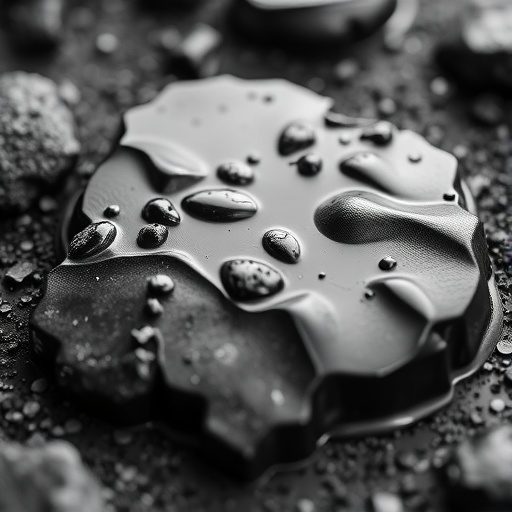
In a breakthrough that could reshape the future of sustainable materials and energy production, researchers at the University of Pittsburgh’s Swanson School of Engineering have unveiled a revolutionary method of producing high-quality graphite at significantly lower temperatures than those traditionally required. The pivotal discovery emerged unexpectedly in the laboratory of Professor Götz Veser, where ethane was pumped through molten metal heated to under 1,000 degrees Celsius. Contrary to expectations, the carbon byproduct that surfaced was not the usual mundane residue but a fluffy, high-grade graphite, a material that has become a cornerstone in advanced battery technologies.
Graphite, often hailed as “black gold,” particularly in contexts involving automotive and high-tech sectors, is indispensable for lithium-ion batteries that power electric vehicles and modern electronics. Currently, the industrial synthesis of such graphite is a notoriously energy-heavy process necessitating temperatures approaching 3,000 degrees Celsius. Moreover, the global supply chain is heavily dependent on China, which accounts for some 95 percent of battery-grade graphite production. This dependency presents significant challenges in energy efficiency, sustainability, and geopolitical autonomy.
The Pittsburgh team, led by Professor Veser and former PhD candidate Aime Laurent Twizerimana, along with Assistant Professor Mohammad Masnadi and PhD student Nader Sawtarie, recognized the urgent need for an energy-efficient and domestically viable alternative. Their research harnessed an underexplored catalytic method involving molten metals, a concept that traces its roots back nearly a century but remained largely unexploited in this context. Unlike conventional solid catalysts, molten metal catalysts offer a unique physical characteristic: their extreme density causes carbon to separate and float atop the molten medium, simplifying collection and preventing reactor clogging.
The process began as an effort to develop greener pathways for ethylene production by “cracking” ethane, a major component of natural gas abundant in Western Pennsylvania. Ethane cracking conventionally involves steam reforming, a technique plagued by continuous formation of carbon deposits that necessitate frequent shutdowns for maintenance. However, the molten metal catalysis technique demonstrated a cleaner and more efficient alternative, reducing energy input while producing valuable byproducts.
As Twizerimana delved deeper into his doctoral research, he noticed a curious variation in carbon morphology when different metals were employed. Some metals yielded a fluffy, distinct carbon arrangement rather than the dense deposits typically associated with ethane cracking. This observation spurred further analysis by Sawtarie, whose expertise in two-dimensional metals and graphene characterization was instrumental. Their collaboration revealed that this fluffy substance was, in fact, high-value graphite, matching or exceeding quality standards for battery applications.
This discovery not only offers a lower-temperature route for graphite synthesis but simultaneously generates hydrogen as a co-product. Hydrogen, widely recognized as a clean energy vector, complements the sustainability credentials of this novel process by providing an additional revenue stream and reducing reliance on fossil-fuel-based hydrogen production methods.
Revolutionizing a process that typically demands prolonged batch operations at scorching temperatures—often taking up to three weeks—this new method offers a continuous, scalable approach that could dramatically reduce carbon emissions and costs. While small-scale graphite production in the United States exists, it remains economically uncompetitive compared to Chinese imports. The Pittsburgh innovation aims to close this gap by delivering domestic, scalable, and cost-effective graphite synthesis.
Supported by the University of Pittsburgh’s Big Idea Center, which provides vital mentorship and resources for entrepreneurial ventures, the research team transitioned their laboratory success into a startup named Graphonos Materials. The startup’s disruptive technology captured the imagination of investors and judges alike, securing a $20,000 Aramco Innovator Prize at the prestigious Rice Business Plan Competition—an event often dubbed the “Super Bowl” of entrepreneurial pitch contests.
Beyond financial endorsements, these achievements underscore the market’s clear appetite for sustainable, low-cost graphite and the critical role such materials play in the clean energy transition. The team is currently advancing toward developing a fully integrated bench-scale system capable of producing kilograms of graphite per day. This milestone is a crucial stepping stone toward pilot-scale demonstrations and eventual commercialization, aligning with global efforts to localize critical materials supply chains and innovate energy-efficient manufacturing.
If realized at scale, the process promises dual environmental and economic benefits by transforming Western Pennsylvania’s ethane reserves into essential raw materials that undergird electric vehicles, renewable energy storage, and advanced electronics. It embodies a strategic pivot from traditional fossil fuel processing to value-added chemical production within a circular economy framework, contributing meaningfully to energy transition narratives.
As the demand for lithium-ion batteries accelerates worldwide, fueled by electrification policies and consumer preferences, the importance of sustainable graphite synthesis cannot be overstated. The Pittsburgh innovation leverages unique catalytic chemistry and materials science to disrupt entrenched production paradigms marked by extreme energy consumption and geopolitical bottlenecks.
Ultimately, this development is emblematic of how interdisciplinary research—melding chemical engineering, materials science, and entrepreneurship—can yield tangible solutions to pressing global challenges. By capturing the potential of molten metal catalysis, the Graphonos Materials team paves the way for greener, domestic production pathways that harmonize economic competitiveness with environmental stewardship.
Subject of Research:
Advanced molten metal catalytic process for low-temperature synthesis of battery-grade graphite and hydrogen co-production.
Article Title:
University of Pittsburgh Researchers Innovate Low-Temperature Molten Metal Catalysis to Produce Sustainable Battery-Grade Graphite
News Publication Date:
April 2024
Web References:
University of Pittsburgh Swanson School of Engineering Faculty Pages
Rice Business Plan Competition Official Website
Aramco Ventures News Releases
Keywords:
Chemical engineering
Molten metal catalysis
Graphite production
Battery materials
Ethane cracking
Sustainable manufacturing
Hydrogen co-production
Lithium-ion batteries
Energy transition
Clean energy technologies
Chemical reactors
Circular economy
Tags: advanced materials for energy storagealternative graphite sourceselectric vehicle battery technologyenergy-efficient graphite manufacturinggeopolitical impact of graphitegraphite supply chain challengeshigh-quality battery-grade graphitelithium-ion battery materialslow-temperature graphite synthesisreducing graphite production emissionssustainable graphite productionUniversity of Pittsburgh engineering research