Researchers in Chile have designed an indoor air purification prototype which uses microorganisms to capture and degrade pollutants, with efficiencies above 90%.
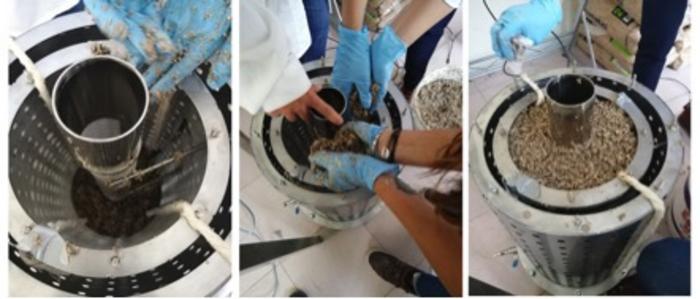
Credit: Alberto Vergara-Fernández
Researchers in Chile have designed an indoor air purification prototype which uses microorganisms to capture and degrade pollutants, with efficiencies above 90%.
In the study, published in SCI’s Journal of Chemical Technology and Biotechnology, the scientists demonstrated that the system could operate for 8 months without any loss in efficiency.
As the demand for better insulation and energy efficiency in buildings increases, a lack of air flow has resulted in worsening indoor air quality, posing a risk to human health and the environment. Biofiltration systems, which pass air through a thin film containing immobilised bacteria and fungi, offer a potentially low-cost and effective solution.
Alberto Vergara-Fernández, Founder of Green Technologies Research Group at Universidad de los Andes in Chile and corresponding author of the study explained the rationale behind the research.
‘The first motivation was the search for a treatment system that was easy to install and did not depend on new pipes and installations for its use. In addition, it can be applied in different confined environments, from domestic to industrial under the same principle.’
The study focused on the removal of two pollutants of particular concern in indoor spaces, namely volatile organic compounds (VOCs) which can originate from building materials and household products such as paint; and polycyclic aromatic hydrocarbons (PAHs) from wood-burning.
Current methods for the removal of these pollutants are largely limited to adsorption techniques, which use an activated carbon filter to capture the impurities. However, Vergara-Fernández explains a key issue with these systems – pollutants will accumulate on the activated carbon and form a new waste requiring disposal.
Explaining the advantages of the new prototype system, he said, ‘The main difference is related to the destruction capacity of the contaminants rather than the transfer of them to another phase, from which they must also be eliminated. Given the degradation of the contaminants and not just adsorption, the lifetime of the support is much longer, maintaining its high removal efficiency.’
The researchers used the fungus Fusarium solani and the bacterium Rhodococcus erythropolis to grow an initial microbial population for the system. After 8 months of continuous performance, further species were captured from the air, demonstrating the potential of the prototype for retaining airborne bacteria and fungi.
Vergara-Fernández explained how the high specialisation of the microbial flora developed in the bioreactor contributed to the efficiency of the purification system. ‘One of the main findings was the possibility of developing a highly specialised microbial consortium, which allows obtaining high elimination capacities in very short periods of operation time, maintaining good elimination capacities.’
Whilst there have been a number of previous studies using biological methods for the treatment of indoor pollutants under laboratory conditions, no commercial systems have been deployed on a large scale, possibly influenced by the large sizes required to achieve an acceptable removal efficiency.
Vergara-Fernández and the team hope that they can continue to develop their research to address this problem.
He explained, ‘The main challenges and limitations of the biopurification system, on which we are currently working, is the reduction in the dimensions of the equipment that makes up the system. We are developing a hybrid system that combines physical-chemical and biological technology, with the aim of reducing the inlet flows to the biological system’.
Journal
Journal of Chemical Technology and Biotechnology
DOI
10.1002/jctb.7533
Subject of Research
Cells
Article Title
A radial-flow device for the biopurification of a model VOC- and wood-smoke- contaminated confined space
COI Statement
The authors declare that they have no conflict of interest.