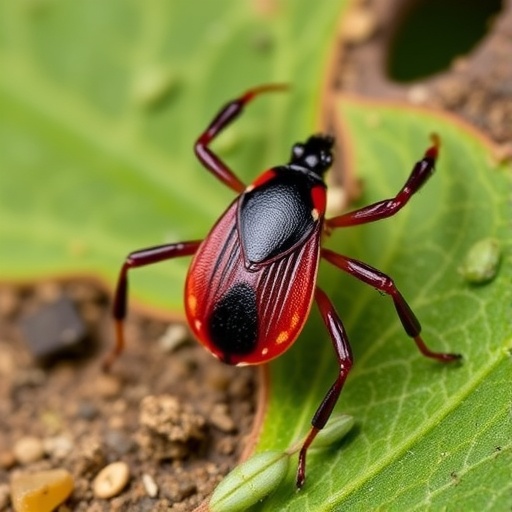
The Asian longhorned tick, Haemaphysalis longicornis, has long posed a puzzle to evolutionary biologists and public health officials alike. Unlike most animals, some populations of this disease-vector tick reproduce entirely without males, a phenomenon known as parthenogenesis, while closely related strains of the same species reproduce in the conventional sexual manner. Now, a team of researchers has assembled reference-quality genomes of both reproductive forms, providing the most detailed genomic portrait yet of how a major disease vector abandoned sex—and what that might mean for controlling the ticks that spread serious pathogens to humans and livestock.
The study, published in Nature Ecology & Evolution, reports haplotype-resolved, reference-quality genome assemblies of the parthenogenetic strain of H. longicornis alongside two reference-quality genomes of bisexual strains. This level of genomic resolution matters enormously for this particular species because the parthenogenetic strain is triploid, carrying three sets of chromosomes rather than the usual diploid pair. Untangling three haplotypes within a single genome requires exceptionally long sequencing reads and sophisticated computational assembly, and the resulting assemblies allow researchers to compare, base by base, how the genomes of sexual and asexual ticks have diverged.
The comparative analysis delivered a striking first finding: despite the radical difference in reproductive mode, the genomes are remarkably similar in structure. The researchers observed high collinearity between the parthenogenetic and bisexual genomes, meaning that genes remain in largely the same order and orientation across the chromosomes of both strains. Moreover, the three haplotypes of the triploid parthenogenetic strain maintain a stable chromosomal architecture among themselves. This suggests that the transition to asexual reproduction did not involve a wholesale restructuring of the tick genome, no dramatic chromosomal upheaval, no massive rearrangement of the genetic blueprint. Instead, the shift to parthenogenesis appears to have been a subtler affair, written in changes to gene families and their regulation rather than in the gross architecture of the chromosomes.
Where the differences emerged was in the content of the genes themselves. The parthenogenetic genome showed a major expansion in cell cycle-related gene families, a category that includes the inhibitor of apoptosis protein, or IAP, family. These genes regulate some of the most fundamental processes in biology: the pace of cell division, the survival of cells that would otherwise die, and the coordination of the mitotic machinery that copies and segregates chromosomes during cell division. For an animal that must produce eggs and drive their development without fertilization, an expanded toolkit for managing the cell cycle makes intuitive sense. Parthenogenesis demands that an unfertilized egg be coaxed through the same developmental program that, in sexual species, is normally triggered by the genetic contribution of sperm. Genes that control apoptosis and mitosis are prime candidates for roles in such a reprogrammed developmental pathway.
At the same time, the parthenogenetic genome showed contractions in other gene families. This pattern of simultaneous expansion and contraction is consistent with a broader theme in the evolutionary biology of asexual organisms: lineages that abandon sex often shed genes whose functions are tied to sexual reproduction, while selectively amplifying genes that support self-sufficient reproduction. The balancing act between these opposing forces—genome streamlining in some regions, proliferation in others—appears to be written into the chromosomes of this tick.
To understand how these genomic differences are distributed across natural populations, the team carried out population resequencing of 179 individual ticks. The analysis revealed two genetically distinct subpopulations, corresponding to the parthenogenetic and bisexual forms. Among the chromosomes, one stood out: chromosome 7 harbored high genetic differentiation between the two subpopulations, and within it the researchers identified several candidate genes probably associated with parthenogenesis. The concentration of differentiation signals on a single chromosome raises intriguing possibilities about how the asexual lineage arose. Rather than a diffuse, genome-wide drift away from the sexual form, the genetic basis of parthenogenesis may be anchored in a relatively defined genomic region, making chromosome 7 a priority target for future functional studies.
The functional experiments at the heart of the study focused on one gene in particular: BIRC5, a member of the IAP gene family. Also known in other organisms as survivin, BIRC5 is a well-characterized regulator of cell division and cell survival, and its expansion in the parthenogenetic genome made it a natural suspect. The researchers used gene knockdown techniques to silence BIRC5 in ticks of both strains and then measured the effects on oviposition, the laying of eggs. The results were revealing in both directions. Knockdown suppressed oviposition in both the parthenogenetic and bisexual strains, confirming that the gene plays an essential role in egg production regardless of reproductive mode. But the parthenogenetic strain showed milder adverse effects than its sexual counterpart, probably because it mounts a stronger transcriptional response when the gene is compromised. In other words, the parthenogenetic tick’s expanded IAP repertoire appears to give it a buffer, a redundancy that allows it to withstand partial loss of function in a way the bisexual strain cannot.
This finding carries implications beyond basic evolutionary biology. H. longicornis is an aggressive and versatile vector, capable of transmitting agents of theileriosis in cattle and human pathogens such as Borrelia and tick-borne viruses, and it has been spreading into new territories in recent years, including North America. Parthenogenetic populations have a reproductive advantage: every individual can produce offspring, allowing populations to grow twice as fast, in principle, as equivalent bisexual populations. A single engorged female introduced to a new environment can, in theory, found an entire population without ever encountering a male. This reproductive shortcut is one reason the species has become such a successful invader and such a persistent threat to livestock industries.
Understanding the genetic machinery that makes asexual reproduction possible could open new avenues for control. If genes such as BIRC5 and its IAP relatives are essential to egg production in both strains, they represent potential molecular targets for interventions aimed at disrupting tick reproduction. Interfering with such pathways—whether through targeted pesticides, RNA-based control methods, or other emerging technologies—could suppress populations before they become established. The milder effects of BIRC5 knockdown in the parthenogenetic strain also serve as a caution: control strategies designed against one reproductive form may need tuning to work against the other, and the transcriptional flexibility of the parthenogenetic strain could complicate efforts to disable its reproduction.
The study also contributes to one of the longest-running debates in evolutionary theory: why sex exists at all. Sex is costly. It requires finding mates, produces only half as many offspring per female as asexual reproduction, and shuffles apart genetic combinations that may already work well. Yet sex dominates the tree of life, and asexual lineages tend to be evolutionarily short-lived. The exceptions to this rule, including the parthenogenetic strains of H. longicornis, are therefore scientifically precious. By showing that the asexual strain retains the chromosomal architecture of its sexual relatives, while modifying its complement of cell cycle genes, the study suggests that successful parthenogenesis may depend less on escaping the drawbacks of asexuality and more on fine-tuning the molecular machinery of development. Polyploidy—the possession of three chromosome sets here—may itself contribute to the durability of the asexual lineage, providing the genetic redundancy that buffers deleterious mutations and supports novel regulatory responses.
The researchers’ haplotype-resolved assemblies of a triploid animal genome also set a technical benchmark. Resolving the three haplotypes of the parthenogenetic strain separately, and confirming their stable architecture, demonstrates how modern long-read sequencing can disentangle genomes that would have been hopelessly collapsed into a single ambiguous sequence only a few years ago. Such assemblies will be essential for future work on other polyploid and asexual species, which include numerous crop pests, disease vectors, and ecologically important invertebrates.
What remains to be discovered is the full cast of genes behind parthenogenesis. Chromosome 7’s candidate genes await functional validation, and the expanded cell cycle families undoubtedly contain other members that contribute to autonomous egg development. The transcriptional resilience observed in the parthenogenetic strain hints at regulatory networks that have been rewired to support a life without fertilization. As ticks continue to expand their range in a warming world, and as the diseases they carry spread with them, deciphering the genomic basis of their remarkable reproductive flexibility is not merely an academic exercise. It is a step toward anticipating—and perhaps interrupting—the spread of one of the world’s most consequential arthropod disease vectors.
Subject of Research: Genomic and evolutionary basis of parthenogenesis in the disease-vector tick species Haemaphysalis longicornis
Subject of Research: Biology
Article Title: Genomic and evolutionary basis of parthenogenesis in a disease-vector tick species
Article References: Lyu, Q., Sheng, K., Zhou, H., Ji, J., Wang, M., Wang, F., Guo, M., Cai, K., Hu, B., Nie, K., Zhang, R., Yue, S., Li, X., Li, C., Zhou, X., Holmes, E. C., Chen, J., Zhang, L., & Shi, W. (2026). Genomic and evolutionary basis of parthenogenesis in a disease-vector tick species. Nature Ecology & Evolution, 10(9), 1758-1773. https://doi.org/10.1038/s41559-026-03137-8
Image Credits: AI Generated
DOI: 10.1038/s41559-026-03137-8
Keywords: parthenogenesis, Haemaphysalis longicornis, Asian longhorned tick, triploid genome, haplotype-resolved assembly, inhibitor of apoptosis proteins, BIRC5, oviposition, chromosome 7, disease vector, cell cycle genes, population genomics
Cite Scienmag News
APA
MLA
Chicago
Juliet Wilcox. (September 4, 2026). How a disease-spreading tick reproduces without males. Scienmag. https://scienmag.com/how-a-disease-spreading-tick-reproduces-without-males/
Juliet Wilcox. “How a disease-spreading tick reproduces without males.” Scienmag, 4 September 2026, https://scienmag.com/how-a-disease-spreading-tick-reproduces-without-males/. Accessed 4 September 2026.
Juliet Wilcox. “How a disease-spreading tick reproduces without males.” Scienmag. September 4, 2026. https://scienmag.com/how-a-disease-spreading-tick-reproduces-without-males/
Copy citation
Download RIS
Tags: evolutionary adaptation in ticksevolutionary biology of parthenogenesisgenome assembly of Haemaphysalis longicornisgenomic comparison of reproductive modesgenomic insights into tick reproductionimplications for tick control strategiesimplications for tick-borne disease controllong-read sequencing in genome researchparthenogenesis in Asian longhorned tickparthenogenesis in disease-carrying ticksparthenogenetic Asian longhorned tick genomepathogen spread by ticksreference-quality tick genomessexual vs asexual tick reproductiontick chromosome structure analysistick disease vector genomicstick genome assembly methodstick genome sequencing techniquestick reproductive modes comparisontick-borne disease transmissiontriploid parthenogenetic tick genometriploid tick genome