WASHINGTON, Feb. 20, 2024 — The freshness of animal meat is an essential property determining its quality and safety. With advanced technology capable of preserving food for extended periods of time, meat can be shipped around the globe and consumed long after an animal dies. As global meat consumption rates increase, so too does the demand for effective measures for its age.
Credit: Ngo Thi Hong Le
WASHINGTON, Feb. 20, 2024 — The freshness of animal meat is an essential property determining its quality and safety. With advanced technology capable of preserving food for extended periods of time, meat can be shipped around the globe and consumed long after an animal dies. As global meat consumption rates increase, so too does the demand for effective measures for its age.
Despite the technological advances keeping meat fresh for as long as possible, certain aging processes are unavoidable. Adenosine triphosphate (ATP) is a molecule produced by breathing and responsible for providing energy to cells. When an animal stops breathing, ATP synthesis also stops, and the existing molecules decompose into acid, diminishing first flavor and then safety. Hypoxanthine (HXA) and xanthine are intermediate steps in this transition. Assessing their prevalence in meat indicates its freshness.
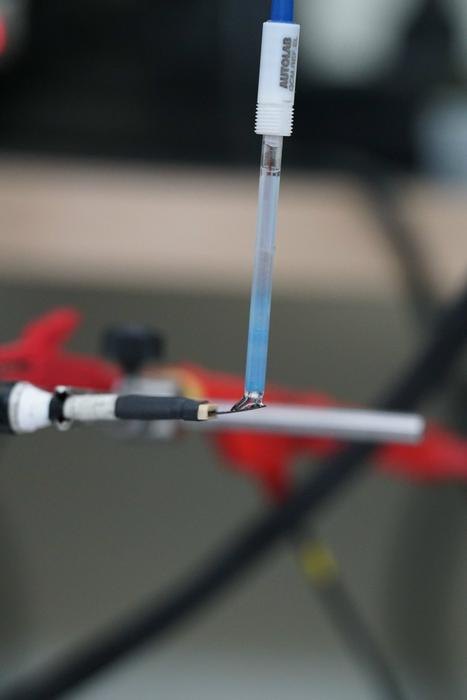
In AIP Advances, from AIP Publishing, researchers from the Vietnam Academy of Science and Technology, VNU University of Science, Hanoi University of Science and Technology, and the Russian Academy of Sciences developed a biosensor using graphene electrodes modified by zinc oxide nanoparticles to measure HXA. The team demonstrated the sensor’s efficacy on pork meat.
While many HXA sensing methods currently exist, they can be costly and time-consuming and require specialists.
“In comparison to modern food-testing methods, like high-performance liquid chromatography, gas chromatography, mass spectrometry, atomic and molecular spectroscopy, and nuclear magnetic resonance spectroscopy, biosensors like our sensor offer superior advantages in time, portability, high sensitivity, and selectivity,” said author Ngo Thi Hong Le.
The sensor is produced using a polyimide film, which is converted into porous graphene using a pulsed laser. The added zinc oxide nanoparticles attract the HXA molecules to the electrode surface. When HXA interacts with the electrode, it oxidizes and transfers its electrons, spiking the electrode’s voltage. The linear relationship between HXA and voltage increase enables easy determination of HXA content.
To assess the sensor’s ability, the researchers tested solutions with known quantities of HXA. After the outstanding performance, the researchers measured the biosensor’s practicality using pork tenderloins purchased from a supermarket. The sensor performed with over 98% accuracy, favorable detection range, and low detection limit.
“In Vietnam, pork is the most consumed meat,” said Le. “Therefore, pork quality monitoring is one of the important requirements in the food industry in our country, which is why we prioritized it.”
More than just pork, any meat product can be evaluated by this biosensor.
###
The article “Nonenzymatic electrochemical sensor based on ZnO nanoparticles/porous graphene for the detection of hypoxanthine in pork meat” is authored by Ngo Thi Hong Le, Nguyen Xuan Viet, Nguyen Van Anh, Ta Ngoc Bach, Phung Thi Thu, Nguyen Thi Ngoc, Do Hung Manh, Vu Hong Ky, Vu Dinh Lam, Victor Kodelov, Svetlana Von Gratowski, Nguyen Hai Binh, and Trinh Xuan Anh. It will appear in AIP Advances on Feb. 20, 2024 (DOI: 10.1063/5.0190293). After that date, it can be accessed at https://doi.org/10.1063/5.0190293.
ABOUT THE JOURNAL
AIP Advances is an open access journal publishing in all areas of physical sciences—applied, theoretical, and experimental. The inclusive scope of AIP Advances makes it an essential outlet for scientists across the physical sciences. See https://aip.scitation.org/journal/adv.
###
Journal
AIP Advances
DOI
10.1063/5.0190293
Article Title
Nonenzymatic electrochemical sensor based on ZnO nanoparticles/porous graphene for the detection of hypoxanthine in pork meat
Article Publication Date
20-Feb-2024