We are all closely associated with microorganisms. The most common example is the human gut, where bacteria are necessary for digestion and health or can be responsible for illness. The plant microbiome is similar. Depending on the microorganisms in and on it, a plant might be healthy and produce or it might die.
Scientists are heavily investigating the plant microbiome, primarily focusing on bacteria and fungi and characterizing which microorganisms are beneficial. Despite this effort, it is very difficult to estimate the community of these microorganisms, as it is dependent on the plant itself and on the environment in which it grows.
Another factor that characterizes the community of beneficial microorganisms are protists, which feed on bacteria and fungi and are difficult to culture. “It is important to understand that bacteria and fungi are not acting autonomously,” explained plant pathologist Kenneth Dumack. “Their composition and abundance depends on the interplay with their predators, the protists.”
Because protists are so difficult to culture, they are rarely included in experiments. As a result, scientists still have a lot to learn about how protists affect plant health, growth, and production.
To start building this knowledge, Dumack and colleagues at the University of Cologne and Heinrich Heine University, both involved in the Cluster of Excellence on Plant Sciences (CEPLAS), have provided a freely available culture collection of protists to researchers all over the world.
“Now everybody can assess and use these cultures for their research,” Dumack said. “We hope the research community accepts this offer and are looking forward to many experiments and their results. Hopefully this will be a major gain for the whole scientific community.”
This culture collection may help to sustainably increase plant yields or help scientists understand sustainable ways to improve plant health. For more information or to access this collection, read “A Call for Research: A Resource of Core Microbial Symbionts of the Arabidopsis thaliana Microbiome Ready and Awaiting Experimental Exploration” published in the open access Phytobiomes Journal. The research was funded through the German Excellence Strategy by the German Research Foundation.
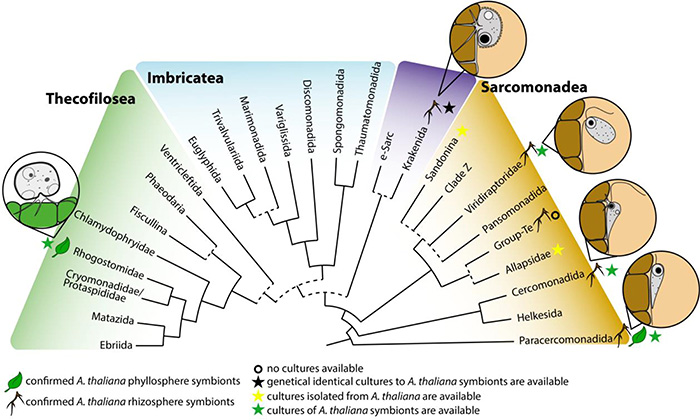
Credit: Kenneth Dumack, Melanie Sapp, Tiemo von Steimker, Anna Tatjana Mänz, Laura Ellen Rose, and Michael Bonkowski
We are all closely associated with microorganisms. The most common example is the human gut, where bacteria are necessary for digestion and health or can be responsible for illness. The plant microbiome is similar. Depending on the microorganisms in and on it, a plant might be healthy and produce or it might die.
Scientists are heavily investigating the plant microbiome, primarily focusing on bacteria and fungi and characterizing which microorganisms are beneficial. Despite this effort, it is very difficult to estimate the community of these microorganisms, as it is dependent on the plant itself and on the environment in which it grows.
Another factor that characterizes the community of beneficial microorganisms are protists, which feed on bacteria and fungi and are difficult to culture. “It is important to understand that bacteria and fungi are not acting autonomously,” explained plant pathologist Kenneth Dumack. “Their composition and abundance depends on the interplay with their predators, the protists.”
Because protists are so difficult to culture, they are rarely included in experiments. As a result, scientists still have a lot to learn about how protists affect plant health, growth, and production.
To start building this knowledge, Dumack and colleagues at the University of Cologne and Heinrich Heine University, both involved in the Cluster of Excellence on Plant Sciences (CEPLAS), have provided a freely available culture collection of protists to researchers all over the world.
“Now everybody can assess and use these cultures for their research,” Dumack said. “We hope the research community accepts this offer and are looking forward to many experiments and their results. Hopefully this will be a major gain for the whole scientific community.”
This culture collection may help to sustainably increase plant yields or help scientists understand sustainable ways to improve plant health. For more information or to access this collection, read “A Call for Research: A Resource of Core Microbial Symbionts of the Arabidopsis thaliana Microbiome Ready and Awaiting Experimental Exploration” published in the open access Phytobiomes Journal. The research was funded through the German Excellence Strategy by the German Research Foundation.
Journal
Phytobiomes Journal
DOI
10.1094/PBIOMES-11-20-0080-A
Method of Research
Experimental study
Subject of Research
Not applicable
Article Title
A Call for Research: A Resource of Core Microbial Symbionts of the Arabidopsis thaliana Microbiome Ready and Awaiting Experimental Exploration
Article Publication Date
1-Dec-2021