• HOME
  • NEWS
  • EXPLORE
    • CAREER
      • Companies
      • Jobs
    • EVENTS
    • iGEM
      • News
      • Team
    • PHOTOS
    • VIDEO
    • WIKI
  • BLOG
  • COMMUNITY
    • FACEBOOK
    • INSTAGRAM
    • TWITTER
Wednesday, August 12, 2026
BIOENGINEER.ORG
No Result
View All Result
  • Login
  • HOME
  • NEWS
  • EXPLORE
    • CAREER
      • Companies
      • Jobs
        • Lecturer
        • PhD Studentship
        • Postdoc
        • Research Assistant
    • EVENTS
    • iGEM
      • News
      • Team
    • PHOTOS
    • VIDEO
    • WIKI
  • BLOG
  • COMMUNITY
    • FACEBOOK
    • INSTAGRAM
    • TWITTER
  • HOME
  • NEWS
  • EXPLORE
    • CAREER
      • Companies
      • Jobs
        • Lecturer
        • PhD Studentship
        • Postdoc
        • Research Assistant
    • EVENTS
    • iGEM
      • News
      • Team
    • PHOTOS
    • VIDEO
    • WIKI
  • BLOG
  • COMMUNITY
    • FACEBOOK
    • INSTAGRAM
    • TWITTER
No Result
View All Result
Bioengineer.org
No Result
View All Result
Home NEWS Science News Biology

Fossils reveal diversity of animal life roaming Europe 2 million years ago

Bioengineer by Bioengineer
August 24, 2020
in Biology
Reading Time: 2 mins read
0
IMAGE
Share on FacebookShare on TwitterShare on LinkedinShare on RedditShare on Telegram

Revival of research at significant paleontological site in Eastern Europe includes focus on when humans migrated to Eurasia from Africa
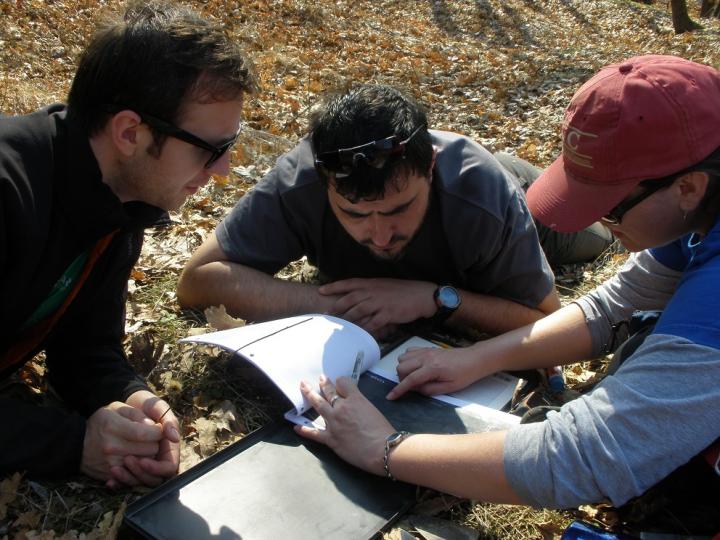
IMAGE

Credit: University of Arkansas

A re-analysis of fossils from one of Europe’s most significant paleontological sites reveals a wide diversity of animal species, including a large terrestrial monkey, short-necked giraffe, rhinos and saber-toothed cats.

These and other species roamed the open grasslands of Eastern Europe during the early Pleistocene, approximately 2 million years ago. Ultimately, the researchers hope the fossils will provide clues about how and when early humans migrated to Eurasia from Africa. Reconstructions of past environments like this also could help researchers better understand future climate change.

“My colleagues and I are excited to draw attention back to the fossil site of Gr?unceanu and the fossil potential of the Olte? River Valley of Romania,” said Claire Terhune, associate professor of anthropology at the University of Arkansas. “It’s such a diverse faunal community. We found multiple animals that hadn’t been clearly identified in the area before, and many that are no longer found in Europe at all. Of course, we think these findings alone are interesting, but they also have important implications for early humans moving into the continent at that time.”

About 124 miles west of the Romanian capital of Bucharest, the Olte? River Valley, including the the important site of Gr?unceanu, is one of Eastern Europe’s richest fossil deposits. Many Olte? Valley fossil sites, including Gr?unceanu, were discovered in the 1960s after landslides caused in part by deforestation due to increased agricultural activity in the area.

Archeologists and paleontologists from the Emil Racovi?? Institute of Speleology in Bucharest excavated the sites soon after they were discovered. Fossils were recovered and stored at the institute, and scholarly publications about the sites flourished in the 1970s and 1980s. But interest in these fossils and sites waned over the past 20 to 30 years, in part because many records of the excavations and fossils were lost.

Since 2012, the international team, including Terhune and researchers from Romania, the United States, Sweden and France, has focused on this important fossil region. Their work has included extensive identification of fossils at the institute and additional field work.

In addition to the species mentioned above, the researchers identified fossil remains of animals similar to modern-day moose, bison, deer, horse, ostrich, pig and many others. They also identified a fossil species of pangolin, which were thought to have existed in Europe during the early Pleistocene but had not been solidly confirmed until now. Today, pangolins, which look like the combination of an armadillo and anteater and are among the most trafficked animals in the world, are found only in Asia and Africa.

###

The researchers’ work was published in Quaternary International.

Media Contact
Claire Terhune
[email protected]

Original Source

https://researchfrontiers.uark.edu/auto-fossils-reveal-diversity-of-animal-life-roaming-europe-2-million-years-ago/

Related Journal Article

http://dx.doi.org/10.1016/j.quaint.2020.06.020

Tags: ArchaeologyEvolutionPaleontology
Share13Tweet8Share2ShareShareShare2

Related Posts

First 3D Map Reveals Mouse Ovary Counts Its Own Eggs

First 3D Map Reveals Mouse Ovary Counts Its Own Eggs

August 12, 2026
Entropy theory offers new view of critical illness beyond organ dysfunction

Entropy theory offers new view of critical illness beyond organ dysfunction

August 12, 2026

NUS researchers engineer color-sensing yeast in scientific breakthrough

August 12, 2026

Immune Cell Differences Predict Skin Cancer Treatment Outcomes

August 12, 2026
Please login to join discussion

POPULAR NEWS

  • Physiologic signatures during extubation readiness trials in neonates over 35 weeks

    29 shares
    Share 12 Tweet 7
  • Small Brønsted bases activate GTP hydrolysis in KRAS-Q61 mutants

    29 shares
    Share 12 Tweet 7
  • Scientists Discover and Design Potent Cell-Surface Display Elements

    29 shares
    Share 12 Tweet 7
  • Ripple Oscillations Link Neurons Across Regions to Support Distributed Working Memory

    29 shares
    Share 12 Tweet 7

About

We bring you the latest biotechnology news from best research centers and universities around the world. Check our website.

Follow us

Recent News

Physiologic signatures during extubation readiness trials in neonates over 35 weeks

Small Brønsted bases activate GTP hydrolysis in KRAS-Q61 mutants

Scientists Discover and Design Potent Cell-Surface Display Elements

Subscribe to Blog via Email

Enter your email address to subscribe to this blog and receive notifications of new posts by email.

Join 86 other subscribers
  • Contact Us

Bioengineer.org © Copyright 2023 All Rights Reserved.

Welcome Back!

Login to your account below

Forgotten Password?

Retrieve your password

Please enter your username or email address to reset your password.

Log In
No Result
View All Result
  • Homepages
    • Home Page 1
    • Home Page 2
  • News
  • National
  • Business
  • Health
  • Lifestyle
  • Science

Bioengineer.org © Copyright 2023 All Rights Reserved.