• HOME
  • NEWS
  • EXPLORE
    • CAREER
      • Companies
      • Jobs
    • EVENTS
    • iGEM
      • News
      • Team
    • PHOTOS
    • VIDEO
    • WIKI
  • BLOG
  • COMMUNITY
    • FACEBOOK
    • INSTAGRAM
    • TWITTER
Monday, May 11, 2026
BIOENGINEER.ORG
No Result
View All Result
  • Login
  • HOME
  • NEWS
  • EXPLORE
    • CAREER
      • Companies
      • Jobs
        • Lecturer
        • PhD Studentship
        • Postdoc
        • Research Assistant
    • EVENTS
    • iGEM
      • News
      • Team
    • PHOTOS
    • VIDEO
    • WIKI
  • BLOG
  • COMMUNITY
    • FACEBOOK
    • INSTAGRAM
    • TWITTER
  • HOME
  • NEWS
  • EXPLORE
    • CAREER
      • Companies
      • Jobs
        • Lecturer
        • PhD Studentship
        • Postdoc
        • Research Assistant
    • EVENTS
    • iGEM
      • News
      • Team
    • PHOTOS
    • VIDEO
    • WIKI
  • BLOG
  • COMMUNITY
    • FACEBOOK
    • INSTAGRAM
    • TWITTER
No Result
View All Result
Bioengineer.org
No Result
View All Result
Home NEWS Science News Biology

Fossilized insect from 100 million years ago is oldest record of primitive bee with pollen

Bioengineer by Bioengineer
February 12, 2020
in Biology
Reading Time: 2 mins read
0
IMAGE
Share on FacebookShare on TwitterShare on LinkedinShare on RedditShare on Telegram

IMAGE

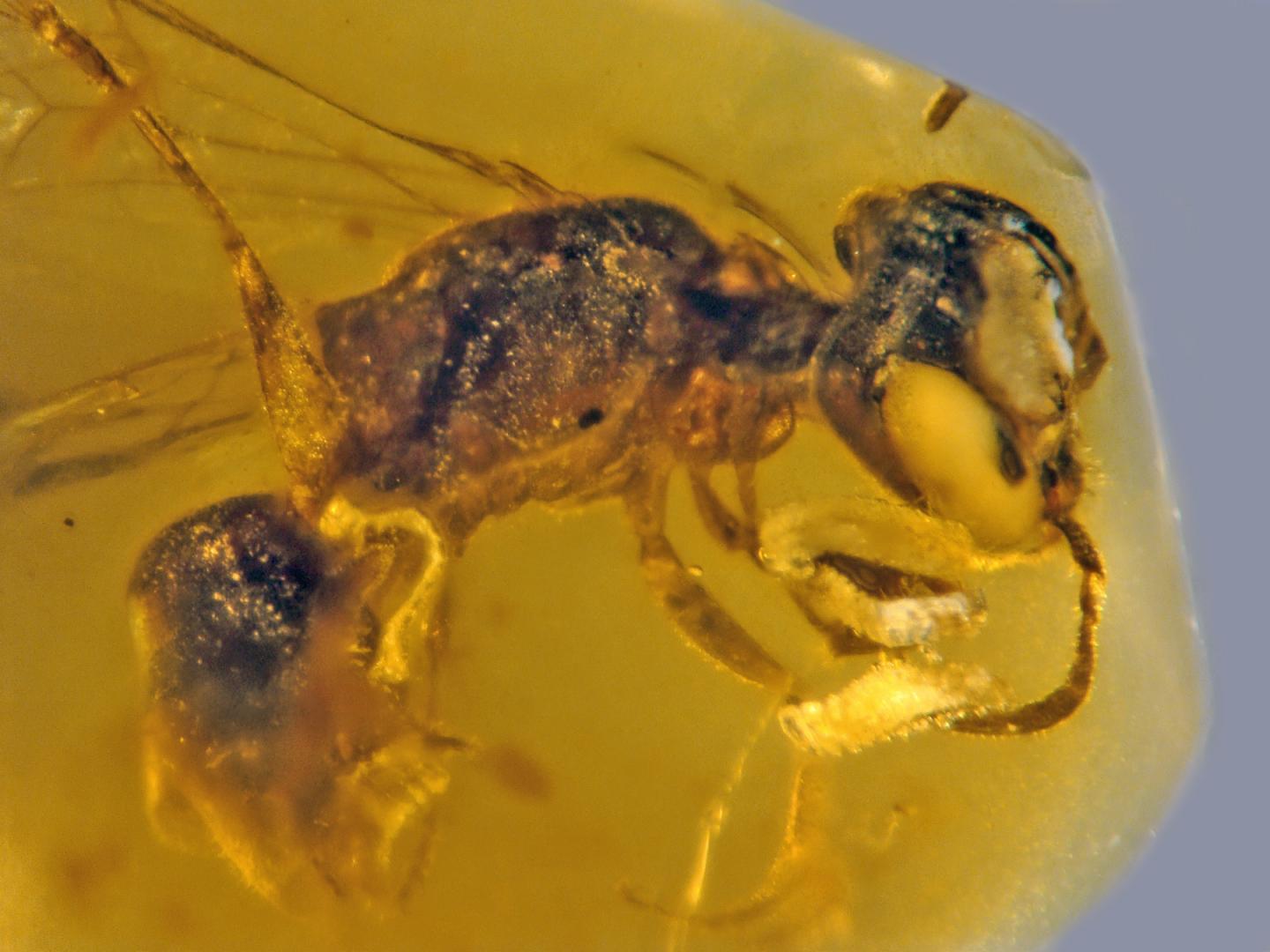
Credit: Image provided by George Poinar Jr., OSU College of Science.


CORVALLIS, Ore. – Beetle parasites clinging to a primitive bee 100 million years ago may have caused the flight error that, while deadly for the insect, is a boon for science today.

The female bee, which became stuck in tree resin and thus preserved in amber, has been identified by Oregon State University researcher George Poinar Jr. as a new family, genus and species.

The mid-Cretaceous fossil from Myanmar provides the first record of a primitive bee with pollen and also the first record of the beetle parasites, which continue to show up on modern bees today.

The findings, published in BioOne Complete, shed new light on the early days of bees, a key component in evolutionary history and the diversification of flowering plants.

Insect pollinators aid the reproduction of flowering plants around the globe and are also ecologically critical as promoters of biodiversity. Bees are the standard bearer because they’re usually present in the greatest numbers and because they’re the only pollinator group that feeds exclusively on nectar and pollen throughout their life cycle.

Bees evolved from apoid wasps, which are carnivores. Not much is known, however, about the changes wasps underwent as they made that dietary transition.

Poinar, professor emeritus in the OSU College of Science and an international expert in using plant and animal life forms preserved in amber to learn more about the biology and ecology of the distant past, classified the new find as Discoscapa apicula, in the family Discoscapidae.

The fossilized bee shares traits with modern bees – including plumose hairs, a rounded pronotal lobe, and a pair of spurs on the hind tibia – and also those of apoid wasps, such as very low-placed antennal sockets and certain wing-vein features.

“Something unique about the new family that’s not found on any extant or extinct lineage of apoid wasps or bees is a bifurcated scape,” Poinar said, referring to a two-segment antennae base. “The fossil record of bees is pretty vast, but most are from the last 65 million years and look a lot like modern bees. Fossils like the one in this study can tell us about the changes certain wasp lineages underwent as they became palynivores – pollen eaters.”

Numerous pollen grains on Discoscapa apicula show the bee had recently been to one or more flowers.

“Additional evidence that the fossil bee had visited flowers are the 21 beetle triungulins – larvae – in the same piece of amber that were hitching a ride back to the bee’s nest to dine on bee larvae and their provisions, food left by the female,” Poinar said. “It is certainly possible that the large number of triungulins caused the bee to accidently fly into the resin.”

###

Media Contact
George Poinar Jr.
[email protected]

Original Source

https://beav.es/4Jg

Related Journal Article

http://dx.doi.org/10.18476/pale.v13.a1

Tags: BiologyEcology/EnvironmentEntomologyEvolutionPlant Sciences
Share12Tweet8Share2ShareShareShare2

Related Posts

Transforming Jellyfish Bycatch into a Valuable Collagen Source for Cosmetics and Biotechnology — Biology

Transforming Jellyfish Bycatch into a Valuable Collagen Source for Cosmetics and Biotechnology

May 11, 2026
Ancient Plant Populations Reveal Fresh Insights into Climate Resilience — Biology

Ancient Plant Populations Reveal Fresh Insights into Climate Resilience

May 8, 2026

Rare Brain Disorders in Children Linked to Mutations in Lesser-Known Protein Complex

May 8, 2026

From Odd Insect to Underwater Predator: The Remarkable Evolution of a Bloodthirsty Fruit Fly

May 8, 2026
Please login to join discussion

POPULAR NEWS

  • Research Indicates Potential Connection Between Prenatal Medication Exposure and Elevated Autism Risk

    840 shares
    Share 336 Tweet 210
  • New Study Reveals Plants Can Detect the Sound of Rain

    728 shares
    Share 290 Tweet 182
  • Salmonella Haem Blocks Macrophages, Boosts Infection

    62 shares
    Share 25 Tweet 16
  • Breastmilk Balances E. coli and Beneficial Bacteria in Infant Gut Microbiomes

    57 shares
    Share 23 Tweet 14

About

We bring you the latest biotechnology news from best research centers and universities around the world. Check our website.

Follow us

Recent News

Light-Driven CoOOH/TiO2/CoNi-LDH Boosts Protection, Sterilization

New JACIE IEC Certification Pathway Expands Opportunities for Centers Beyond Transplant

Medicaid’s Role in Combating Climate Change Impacts

Subscribe to Blog via Email

Enter your email address to subscribe to this blog and receive notifications of new posts by email.

Join 82 other subscribers
  • Contact Us

Bioengineer.org © Copyright 2023 All Rights Reserved.

Welcome Back!

Login to your account below

Forgotten Password?

Retrieve your password

Please enter your username or email address to reset your password.

Log In
No Result
View All Result
  • Homepages
    • Home Page 1
    • Home Page 2
  • News
  • National
  • Business
  • Health
  • Lifestyle
  • Science

Bioengineer.org © Copyright 2023 All Rights Reserved.