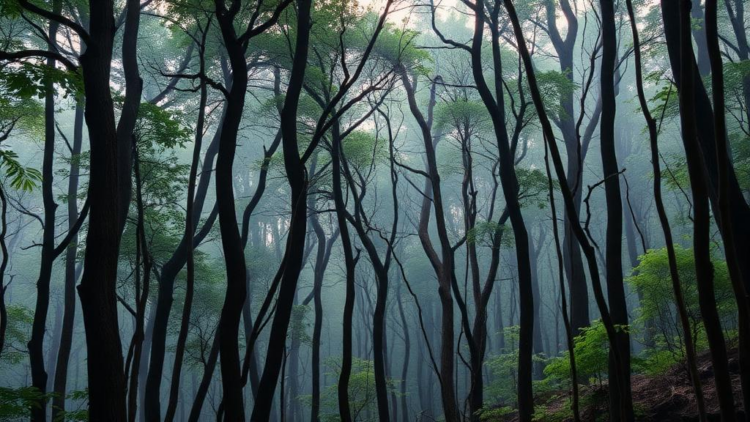
High in the temperate Himalaya, between roughly 2750 and 3300 meters above sea level, the forest canopy changes in a series of abrupt ecological handovers: maple forests give way to birch–rhododendron stands, which in turn yield to pure rhododendron forest as elevation increases. Beneath these canopies lies a layer of herbaceous plants that is easy to overlook but ecologically decisive, contributing a disproportionate share of the biodiversity, nutrient cycling, and forage resources of mountain forests. A new study published in Plant Biosystems by Rajendra Kumar Joshi and Satish Chandra Garkoti of Jawaharlal Nehru University and the University of Delhi shows that this understory world is not static. Its biomass, diversity, and species composition pulse with the seasons, and the character of that pulse depends on which forest type the plants find themselves in. The work offers one of the most detailed seasonal portraits yet of herbaceous communities across elevational forest transitions in the central Himalaya.
The researchers sampled herbaceous vegetation monthly from May to November, spanning the pre-monsoon, rainy, and post-monsoon periods that structure the growing season in the region. Sampling relied on replicated one-by-one-meter quadrats, a standard but labor-intensive approach that demands repeated visits across rugged terrain. By returning month after month to the same forest types, the team could separate the effects of season from the effects of forest identity, a distinction that single-snapshot surveys routinely miss. Their statistical framework combined one-way and two-way analyses of variance to test for differences among forest types and seasons, with community structure characterized through species diversity indices, Importance Value Index scores, Bray–Curtis similarity, and hierarchical clustering.
The headline result is that both forest type and season leave strong, statistically significant fingerprints on herbaceous biomass. Biomass differed markedly among the three forest types, with maple forest supporting the highest mean standing crop at 185.3 grams per square meter, followed by birch–rhododendron forest at 162.7 grams per square meter and rhododendron forest at 128.4 grams per square meter. Seasonal variation was even more pronounced, with biomass peaking during the rainy season, when monsoon moisture transforms the forest floor into a brief but intense flush of growth. Crucially, the analysis revealed a significant interaction between forest type and season, meaning the seasonal trajectory of biomass was not simply shifted up or down in different forests but followed genuinely different patterns depending on canopy composition.
That interaction matters because it points to the canopy as an active filter rather than a passive backdrop. Maple, birch, and rhododendron canopies differ in density, leaf phenology, and the quality and quantity of light they transmit to the ground, and these differences cascade downward to shape which herbs can persist and how vigorously they grow. Earlier work by the same research group and others has shown that tree canopy composition influences soil properties, microbial biomass, and light attenuation in Himalayan forests, and the new findings extend that logic to the seasonal dynamics of the herb layer itself. In effect, each forest transition along the elevational gradient resets the understory clock, changing not only how much biomass accumulates but when it accumulates.
Diversity told a complementary story. The surveys recorded a total of 72 herbaceous species belonging to 34 families and 18 orders, a respectable tally for a temperate understory and a reminder of how much botanical richness is packed into the narrow band of elevation the study covered. Species richness differed significantly across both seasons and forest types, again peaking during the rainy season. The birch–rhododendron forest emerged as the diversity hotspot of the gradient, recording the greatest Shannon diversity index value of 3.58 alongside the lowest dominance, measured by a Simpson-type concentration index of just 0.07. Low dominance combined with high evenness indicates a community in which no single species monopolizes resources, a configuration often associated with greater resilience and more niches packed into the same space.
Each forest type also had its own ecological VIPs. The Importance Value Index, a composite measure that combines relative density, frequency, and dominance, identified Strobilanthes pentastemonoides var. dalhousieana as the most ecologically important herb in the maple forest, Aconitum heterophyllum in the birch–rhododendron forest, and Primula denticulata in the rhododendron forest. The identity of these dominants is more than a botanical footnote. Aconitum heterophyllum, for instance, is a highly valued and heavily harvested medicinal plant of the Himalaya, and understanding the forest contexts in which it achieves greatest ecological weight has direct implications for conservation planning. The fact that different species dominate in adjacent forest types underscores how quickly conservation priorities can shift across short elevational distances.
The multivariate analyses added a compositional dimension to the picture. Bray–Curtis similarity calculations followed by hierarchical clustering showed that the maple and birch–rhododendron forests share a greater degree of floristic affinity with each other, while the rhododendron forest formed a distinct assemblage of its own. This pattern suggests that the transition from maple to birch–rhododendron forest is relatively gradual in floristic terms, whereas the shift into pure rhododendron forest represents a sharper compositional break. Ecotones, the transitional zones where one community gives way to another, are increasingly recognized as biodiversity reservoirs and as sensitive early-warning systems for climate-driven range shifts, and the study’s findings reinforce the case for treating these Himalayan transition zones as conservation targets in their own right.
The seasonal dimension of the study carries particular weight in an era of climate change. Herbaceous plants, with their short generation times and limited ability to buffer environmental variation, are known from global syntheses to respond more strongly to climate anomalies than longer-lived woody species. In the Himalaya, where warming is proceeding faster than the global average and monsoon patterns are projected to become more erratic, the timing and magnitude of the understory’s rainy-season peak could shift in ways that ripple through the entire forest ecosystem. Changes in herb biomass affect soil erosion control, nutrient return through litterfall, and the food base for insects, birds, and mammals. A compressed or delayed growing season in the herb layer would be felt long before any visible change in the trees themselves.
The authors emphasize that their findings highlight the importance of maintaining forest continuity and transitional habitats for conserving understory biodiversity in temperate Himalayan ecosystems. That message has practical urgency. Himalayan temperate forests face pressure from livestock grazing, fuelwood extraction, medicinal plant harvesting, and land-use change, and fragmentation that severs the elevational continuum of forest types could eliminate precisely the transitional habitats where much of the understory’s diversity is concentrated. Because the study demonstrates that biomass and diversity patterns are jointly governed by forest identity and season, management interventions such as canopy thinning or plantation species selection will inevitably reshape the understory as well, whether or not that outcome is intended.
Methodologically, the study also illustrates the value of patience in mountain ecology. Monthly sampling across an elevational gradient for seven months is a demanding protocol, yet it is exactly this temporal resolution that allowed the researchers to detect the forest-by-season interactions that define the system. Single-season surveys, which remain common in the region’s literature, would have captured fragments of these patterns but missed their structure. As remote sensing and automated monitoring expand across the Himalaya, ground-truthed datasets of this kind become even more valuable, anchoring broad-scale models in ecological reality. For now, the study stands as a clear demonstration that the green carpet beneath the Himalayan canopy lives by its own calendar, one written jointly by the monsoon and by the trees standing above it, and that protecting it means protecting both the rhythm and the places where it plays out.
Subject of Research: Seasonal dynamics of herbaceous biomass and diversity across elevational forest transitions in the temperate Himalaya
Article Title: Influence of elevational forest transitions on seasonal patterns of herbaceous biomass and diversity in the temperate Himalaya
Article References: Influence of elevational forest transitions on seasonal patterns of herbaceous biomass and diversity in the temperate Himalaya. (n.d.). https://doi.org/10.1007/s44473-026-00270-x
Image Credits: AI Generated
DOI: 10.1007/s44473-026-00270-x
Keywords: herbaceous diversity, Himalayan forests, understory vegetation, biomass, elevational gradient, seasonal dynamics, temperate forest, ecotones, species richness, Shannon diversity, Bray–Curtis clustering, plant ecology
Cite Scienmag News
APA MLA Chicago
Alan Morgan. (September 30, 2026). Forest Transitions Shape the Hidden Rhythm of Himalayan Understory Life. Scienmag. https://scienmag.com/forest-transitions-shape-the-hidden-rhythm-of-himalayan-understory-life/
Alan Morgan. “Forest Transitions Shape the Hidden Rhythm of Himalayan Understory Life.” Scienmag, 30 September 2026, https://scienmag.com/forest-transitions-shape-the-hidden-rhythm-of-himalayan-understory-life/. Accessed 30 September 2026.
Alan Morgan. “Forest Transitions Shape the Hidden Rhythm of Himalayan Understory Life.” Scienmag. September 30, 2026. https://scienmag.com/forest-transitions-shape-the-hidden-rhythm-of-himalayan-understory-life/
Copy citation Download RIS
Tags: biodiversity in mountain ecosystemsbiomassBray–Curtis clusteringecological handovers in Himalayan ecosystemsecotoneselevational forest transitionelevational gradientforest canopy changes in Himalayasherbaceous biomass variationherbaceous diversityHimalayan forest understory ecologyHimalayan forestsimpact of seasonal changes on herbaceous communitiesmountain vegetation sampling methodsnutrient cycling in Himalayan forestsplant ecologypre-monsoon and post-monsoon plant dynamicsseasonal dynamicsseasonal herbaceous plant diversityShannon diversityspecies richnesstemperate forestunderstory contribution to forest resourcesunderstory vegetation