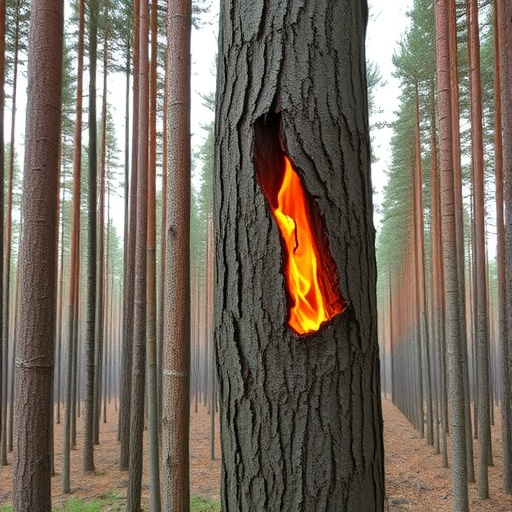
In recent years, the European spruce bark beetle (Ips typographus) has emerged as the foremost biotic threat to Norway spruce (Picea abies) forests throughout Finland, where it is responsible for widespread damage and economic loss in one of the country’s most valuable timber resources. A new comprehensive study conducted by researchers at the University of Eastern Finland sheds light on the spatial dynamics of bark beetle infestations, demonstrating the pronounced tendency of damaged forest stands to cluster in groups, especially in mature spruce forests adjacent to previously affected areas.
This intricate pattern of bark beetle damage reflects a complex interplay between forest stand structure and landscape characteristics, influencing the probability of infestation outbreaks developing into intense hotspots or recurring damage over time. By analyzing an extensive dataset covering 11.4 million hectares of Finnish forestry land, the researchers were able to track salvage logging records from 2012 to 2020, providing a rare, large-scale temporal and spatial perspective on beetle outbreak dynamics across southern Finland.
The European spruce bark beetle thrives under warm and dry climatic conditions, which have become increasingly common in Finland due to ongoing climate change. This climatic trend exacerbates the beetle’s population outbreaks by reducing host tree resistance and facilitating more rapid beetle development cycles, leading to unprecedented levels of tree mortality. Consequently, understanding the spatial patterns and underlying drivers of beetle outbreaks has become critical for devising effective forest management strategies aimed at mitigating damage and enhancing ecosystem resilience.
Applying advanced spatial statistical techniques, the researchers identified damage clusters—defined as aggregated groups of infested stands where beetle activity exceeded expected random distributions. These clusters initially appeared in southeastern Finland during the earlier phases of the study period, subsequently spreading to southern and southwestern regions. Notably, clusters were more abundant in the southeast, although their recurrence in the same locations over time was comparatively infrequent, suggesting a complex spatial dynamism in outbreak persistence.
One of the key findings is the strong correlation between stand age and susceptibility to clustering; mature Norway spruce stands provide ideal substrates for beetle infestation because larger, older trees tend to have weaker defenses and more accessible phloem for beetle colonization. Additionally, proximity to prior damage sites significantly increased the likelihood of new clusters emerging, indicating that beetle populations can persist and capitalize on contiguous patches of vulnerable forest, thereby facilitating local outbreak propagation.
These insights highlight the critical importance of timely detection and intervention. Early identification of infested areas, followed by prompt removal of affected trees through salvage logging, can disrupt the beetle’s life cycle and impede the formation of dense infestation clusters. However, the study underscores that conditions suitable for sustained bark beetle concentration are sporadic, emerging primarily when mature stands coincide with localized and recent outbreaks, meaning that management strategies must be spatially targeted and responsive to real-time infestation dynamics.
From an ecological perspective, the research exemplifies how forest landscape structure, including stand connectivity and spatial distribution of host trees, modulates pest dynamics. Dense, homogenous stands of mature spruces provide contiguous habitats that promote beetle dispersal and outbreak intensification, whereas heterogeneous landscapes with mixed species composition may confer a degree of natural resistance by disrupting beetle movement and colonization success.
This study also serves as a harbinger for future challenges posed by climate change. With trends of rising temperatures and shifting precipitation patterns expected to continue, the frequency and severity of bark beetle outbreaks are likely to increase, threatening forest health, biodiversity, and economic sustainability of timber production across boreal regions. The findings call for integrated forest management approaches that incorporate stand-level silvicultural treatments, landscape diversification, and rigorous monitoring to enhance forest resilience against pest pressures.
Collaboration between governmental forestry agencies, research institutions, and private stakeholders is pivotal to translating these scientific insights into practical management frameworks. By aligning conservation goals with economic imperatives, policymakers can develop adaptive strategies that minimize beetle-related losses while maintaining ecosystem services and long-term forest productivity.
Moreover, the study’s methodological advances in leveraging extensive spatial datasets and salvage logging records represent a significant step forward in pest outbreak research. The use of spatial statistics to delineate damage hotspots provides a scalable and replicable model for other regions facing similar insect pest challenges, enabling more precise risk mapping and resource allocation.
The comprehensive nature of this research illustrates the profound impact that landscape-scale analyses have on understanding pest dynamics under global change scenarios. As forests worldwide confront increasing threats from insects and pathogens exacerbated by climate stressors, such integrative studies will be essential in informing adaptive management and conservation policies.
In sum, the University of Eastern Finland’s research not only clarifies the spatial ecology of European spruce bark beetle outbreaks but also provides critical guidance for safeguarding boreal forests against a mounting pest threat. The nuanced understanding of how stand structure, previous damage, and landscape attributes interact enriches our capacity to predict and mitigate beetle damage, helping to secure the sustainability of Norway spruce forests in a changing world.
Subject of Research: Ips typographus (European spruce bark beetle) damage patterns and forest landscape influence in Finland
Article Title: Assessing the impacts of forest stand structure and landscape on the formation of Ips typographus damage hotspots in Finland
News Publication Date: 17-Sep-2025
Web References: http://dx.doi.org/10.1093/forestry/cpaf058
Image Credits: Alexander Pulgarín Díaz
Keywords: European spruce bark beetle, Ips typographus, Norway spruce, forest pest, bark beetle outbreaks, forest stand structure, spatial clustering, climate change, forest management, salvage logging, Finland, landscape ecology
Tags: bark beetle infestationsclimate change effects on forestryeconomic implications of infestationsFinland timber resource lossforest management strategies in Finlandforest structure dynamicsIps typographus impactlandscape characteristics and pest outbreaksmature spruce forest vulnerabilitiesNorway spruce forest damagesalvage logging analysisspatial patterns of beetle outbreaks