Rivers don’t merely move water; they actively “process” pollution. A new study of a forest-dominated river in central China shows that nitrogen removal—the key biological conversion of reactive nitrogen into nitrogen gas—depends on a shifting mix of microbial activity, sediment chemistry, hydrology, and landscape context.
The work focuses on two nitrogen-removal pathways that operate under different environmental constraints. Denitrification reduces nitrate into gaseous end products, while anaerobic ammonium oxidation (anammox) combines ammonium and nitrite to generate nitrogen gas without requiring the same stepwise intermediates.
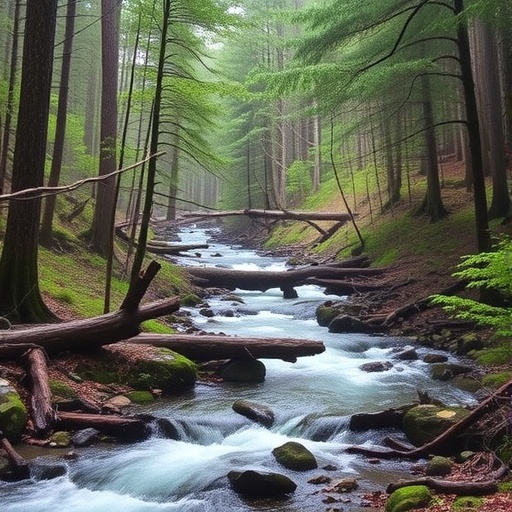
To capture how these processes behave across time and space, researchers sampled water and surface sediments at 18 points along the Jinshui River during both summer and winter. The watershed spans roughly 730 square kilometers and includes a wide altitude range, with forest cover exceeding 95% across much of the upper catchment.
Combining remote sensing with isotope labeling using nitrogen-15, the team quantified nitrogen-cycling rates and traced how nitrogen moved through microbial networks. They also measured water and sediment chemistry and used quantitative PCR to estimate the abundance of microbial functional genes tied to nitrogen transformations.
Denitrification emerged as the dominant sink in both seasons, accounting for about 90% of total measured nitrogen removal in summer and about 95% in winter. Rates were substantially higher during summer, consistent with stronger biological activity and more favorable sediment conditions.
But the controls behind denitrification changed with seasons. In summer, denitrification closely tracked microbial functional genes and local sediment factors such as total nitrogen, organic carbon availability, carbon-to-nitrogen ratios, and moisture. Water chemistry influenced denitrification largely through its effect on sediment habitat and microbial community composition.
Anammox showed a different geographic signature. During summer, altitude and land use—especially forest cover—helped explain variations in anammox activity. The study suggests that in forested areas, lower organic carbon availability may reduce competition from denitrifiers, giving anammox a relative advantage.
In winter, the system tightened around chemistry in the overlying water. Temperature and concentrations of ammonium and nitrate became primary predictors for both denitrification and anammox, likely because cold conditions suppress microbial metabolism and weaken internal sediment recycling.
The researchers also detected a strong coupling between nitrification and denitrification in summer, implying that products from one pathway helped feed the next. This linkage weakened in winter when low temperatures limited microbial activity and the transport of substrates across sediment microzones.
Overall, the findings argue against one-factor explanations. Instead, effective watershed management must treat geography and microscale sediment processes as a coupled system that shifts predictably with seasons.
Subject of Research: Nitrogen cycling and riverine nitrogen removal (denitrification and anammox)
Article Title: Geographical and micro-environmental factors regulate nitrogen removal in a forest-dominated river
News Publication Date: 1-May-2026
Web References: https://doi.org/10.48130/nc-0026-0007
References: Zhang W, Li X, Jiang H, Zhang Q. 2026. Geographical and micro-environmental factors regulate nitrogen removal in a forest-dominated river. Nitrogen Cycling 2: e020. https://doi.org/10.48130/nc-0026-0007
Image Credits: Credit: Wenshi Zhang, Xiaodong Li, Hao Jiang, & Quanfa Zhang
Keywords
Nitrogen cycle, denitrification, anammox, isotope labeling, sediment chemistry, microbial functional genes, seasonal controls, forested watersheds, biogeochemical cycling, river pollution mitigation
Tags: anaerobic ammonium oxidation in freshwater systemsForest nitrogen removalisotope labeling for nitrogen pathwayslandscape influence on nitrogen processingmicrobial functional genes in nitrogen cyclingmicrobial networks in nitrogen cyclingmicrobial nitrogen cycling in riversremote sensing of nitrogen processesriver hydrology and nitrogen removalseasonal shifts in nitrogen removal mechanismsseasonal variation in denitrificationsediment chemistry and nitrogen transformation