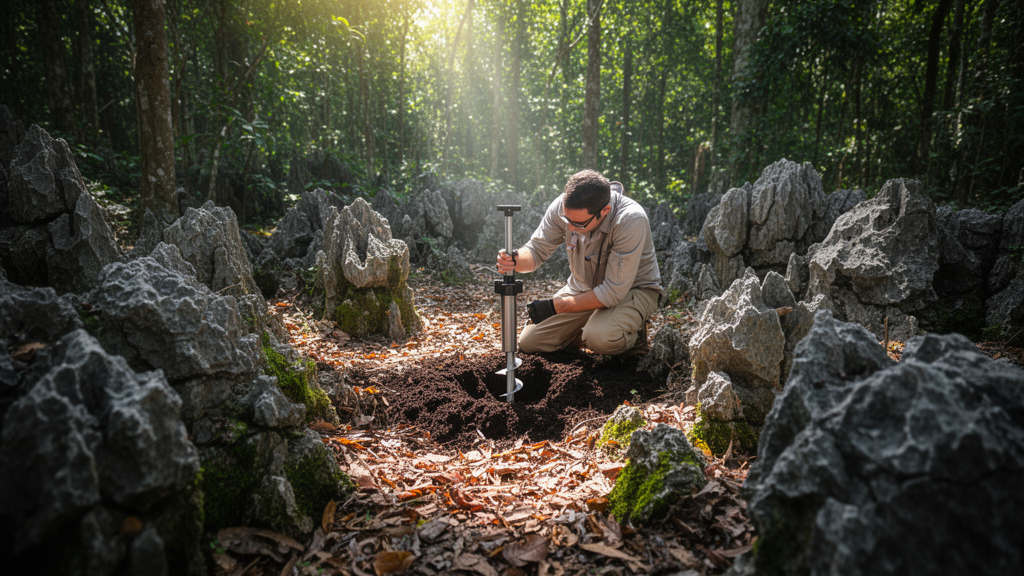
In the subtropical karst forests of southern China, the death or fall of a single canopy tree can open a small gap in the forest ceiling, and new research shows that this modest disturbance leaves a surprisingly deep fingerprint on the soil microbes living below. A year-long study in the Maolan National Nature Reserve in Guizhou Province found that bacterial communities in forest gaps turned over far faster with the seasons than communities in soils under an intact canopy, even though the measurable differences in bulk soil chemistry between the two habitats were modest and often transient.
The study, published in the journal Ecological Processes, sampled soils along a disturbance gradient running from the open centre of forest gaps, through the gap edge, to closed-canopy forest, at four seasonal points between October 2023 and August 2024. The researchers used five naturally formed gaps as experimental blocks, each paired with edge and canopy subplots, and combined high-throughput DNA sequencing of bacteria and fungi with ecological null models, niche analyses and co-occurrence network statistics. In total, the design produced sixty composite soil samples from the top ten centimetres of soil.
The clearest signal came from time-decay relationships, a scaling tool that measures how quickly community similarity declines as the interval between sampling dates grows. In gap soils, the bacterial time-decay slope was significantly steeper than under the closed canopy, meaning bacterial communities replaced themselves more rapidly through the year. Bacterial community dispersion, a measure of how variable composition is among samples, was also significantly higher in gaps. Fungal communities showed seasonal divergence in composition as well, and fungal alpha diversity was significantly higher in gaps during autumn and summer, although bacterial diversity did not differ among habitats in any season.
Soil temperature helped explain why. During the warmer seasons of autumn, spring and summer, soil temperature declined steadily along the gap-edge-canopy gradient, with the open gap warmest and the shaded canopy coolest, but this pattern vanished in winter. The authors argue that this seasonally modulated microclimate, rather than any large shift in bulk soil properties, drove the accelerated turnover. Gap soils did show lower pH in winter and lower total organic carbon in spring, alongside short-lived pulses of ammonium in autumn and dissolved organic carbon in spring, but the study notes that these changes were modest relative to the overall seasonal range.
Extracellular enzyme activities told a similar story of transience. Enzymes involved in carbon, nitrogen and phosphorus acquisition, including cellobiohydrolase, beta-glucosidase and leucine aminopeptidase, were significantly elevated in gap soils during autumn, and several others rose in winter. By spring and summer, however, all five measured enzymes were statistically indistinguishable from closed-canopy levels. The researchers interpret this as evidence that gaps act as transient biogeochemical hotspots, briefly accelerating nutrient availability and organic-matter breakdown before bulk, slowly cycling soil pools are substantially altered.
Beneath the turnover, the study probed how microbial communities are assembled. Using a phylogenetic bin-based null model, the team found that deterministic processes, meaning environmental selection rather than chance, contributed more to community assembly in gap soils than in canopy soils for both bacteria and fungi, with exceptions in spring for bacteria and autumn for fungi. Environmental breadth, a measure of the range of soil conditions a community tolerates, was consistently narrower in gaps across multiple soil variables, indicating stricter filtering at the whole-community scale, even as the niche breadth of individual taxa expanded.
The two microbial kingdoms, however, organised their niches in opposite ways. Fungal communities in gaps showed greater niche overlap and a higher proportion of generalist taxa, a pattern the authors link to the ability of fungal mycelial networks to bridge spatially separated nutrient patches under stress. Bacterial communities in gaps showed reduced niche overlap, suggesting stronger niche partitioning, possibly because repeated surface drying fragments soil water films and isolates bacterial populations into distinct microhabitats. Niche breadth itself was significantly higher in gaps for both bacteria and fungi compared with canopy soils.
Co-occurrence networks, which map statistical associations among dominant taxa rather than verified biological interactions, revealed a structural trade-off. Networks in gap soils were more densely connected, with more edges than canopy networks, yet they contained fewer keystone taxa, the module hubs, connectors and network hubs that disproportionately organise community structure. Combined with a measure of community stability showing lower stability for both bacteria and fungi in gaps, the picture is one of highly connected but decentralised networks, held together by many weak relationships rather than a few influential nodes.
Notably, this reorganisation did not come with a loss of predicted function. Using PICRUSt2, which infers functional potential from 16S rRNA gene data, the researchers found that capacities for indole-3-acetic acid biosynthesis, acetoin and 2,3-butanediol production, antimicrobial compound biosynthesis, nitrogen cycling, sulfur metabolism and oxidative stress resistance were maintained in gap soils, and several were higher than under the canopy in autumn and summer. The critical difference lay in how function related to structure: in closed-canopy soils, predicted functional profiles were associated primarily with keystone-taxon structure, whereas in gap soils they correlated with both keystone taxa and whole-community composition, suggesting that gap communities support functions through redundancy rather than through a few key species.
The authors are careful about the limits of these conclusions. The study covered five naturally formed gaps in a single karst forest, sampled once per season, with gap age and formation history uncontrolled, so the results establish habitat and seasonal associations rather than causal effects of canopy opening. The functional predictions rest on gene-inference tools and correlational networks rather than direct measurements of gene expression or process rates, and the networks were built from samples pooled across seasons. Even so, the findings underscore that small-scale forest disturbances can reshape belowground life in ways that only become visible when the seasons are tracked, and they caution that the network simplification and loss of keystone-associated control observed in gaps may ultimately constrain how well soil microbiomes support forest regeneration as seasonal variability increases.
Subject of Research: Seasonal dynamics of soil bacterial and fungal communities along a forest gap disturbance gradient in a subtropical karst forest
Article Title: Forest gaps amplify seasonal turnover and decouple microbial stability from functional potential in a karst forest
Article References: Chen, W., Lai, S., Chen, K., & Wu, F. (2026). Forest gaps amplify seasonal turnover and decouple microbial stability from functional potential in a karst forest. Ecological Processes, 15(1), Article 92. https://doi.org/10.1186/s13717-026-00748-8
Image Credits: AI Generated
DOI: 10.1186/s13717-026-00748-8
Keywords: forest gaps, soil microbiome, karst forest, seasonal turnover, community assembly, co-occurrence networks, keystone taxa, niche breadth, PICRUSt2, bacterial communities, fungal communities, Guizhou China
News Source: Morgan Morrow. (October 29, 2026). Forest gaps speed up seasonal microbial turnover in karst forest soils. Scienmag.