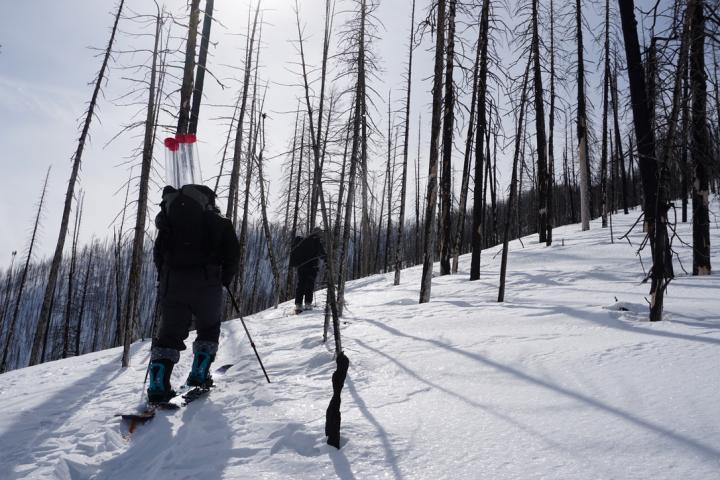
Credit: Christina Aragon | Portland State University
Forest fires are causing snow to melt earlier in the season, a trend occurring across the western U.S. that may affect water supplies and trigger even more fires, according to a new study by a team of researchers at Portland State University (PSU) , the Desert Research Institute (DRI), and the University of Nevada, Reno.
It’s a cycle that will only be exacerbated as the frequency, duration, and severity of forest fires increase with a warmer and drier climate.
The study, published May 2 in the journal Nature Communications, provides new insight into the magnitude and persistence of forest fire disturbance on critical snow-water resources.
Researchers found that more than 11 percent of all forests in the West are currently experiencing earlier snowmelt and snow disappearance as a result of fires.
The team used state-of-the-art laboratory measurements of snow samples, taken in DRI’s Ultra-Trace Ice Core Analytical Laboratory in Reno, Nevada, as well as radiative transfer and geospatial modeling to evaluate the impacts of forest fires on snow for more than a decade following a fire. They found that not only did snow melt an average five days earlier after a fire than before all across the West, but the accelerated timing of the snowmelt continued for as many as 15 years.
“This fire effect on earlier snowmelt is widespread across the West and is persistent for at least a decade following fire,” said Kelly Gleason, the lead author and an assistant professor of environmental science and management in PSU’s College of Liberal Arts and Sciences.
Gleason, who conducted the research as a postdoctoral fellow at the Desert Research Institute, and her team cite two reasons for the earlier snowmelt.
First, the shade provided by the tree canopy gets removed by a fire, allowing more sunlight to hit the snow. Secondly and more importantly, the soot — also known as black carbon — and the charred wood, bark and debris left behind from a fire darkens the snow and lowers its reflectivity. The result is like the difference between wearing a black t-shirt on a sunny day instead of a white one.
In the last 20 years, there’s been a four-fold increase in the amount of energy absorbed by snowpack because of fires across the West.
“Snow is typically very reflective, which is why it appears white, but just a small change in the albedo or reflectivity of the snow surface can have a profound impact on the amount of solar energy absorbed by the snowpack,” said co-author Joe McConnell, a research professor of hydrology and head of the Ultra-Trace Ice Core Analytical Laboratory at DRI. “This solar energy is a key factor driving snowmelt.”
For Western states that rely on snowpack and its runoff into local streams and reservoirs for water, early snowmelt can be a major concern.
“The volume of snowpack and the timing of snowmelt are the dominant drivers of how much water there is and when that water is available downstream,” Gleason said. “The timing is important for forests, fish, and how we allocate reservoir operations; in the winter, we tend to control for flooding, whereas in the summer, we try and hold it back.”
Early snowmelt is also likely to fuel larger and more severe fires across the West, Gleason said.
“Snow is already melting earlier because of climate change,” she said. “When it melts earlier, it’s causing larger and longer-lasting fires on the landscape. Those fires then have a feedback into the snow itself, driving an even earlier snowmelt, which then causes more fires. It’s a vicious cycle.”
Gleason will continue to build on this research in her lab at PSU. She’s in the first year of a grant from NASA that’ll look at the forest fire effects on snow albedo, or how much sunlight energy its surface reflects back into the atmosphere.
###
Funding for the study was provided by the Sulo and Aileen Maki Endowment at the Desert Research Institute. Co-authors also included Monica Arienzo and Nathan Chellman from DRI and Wendy Calvin from the University of Nevada, Reno.
As Oregon’s only urban public research university, Portland State University (PSU) offers tremendous opportunity to 27,000 students from all backgrounds. Our mission to “Let Knowledge Serve the City” reflects our dedication to finding creative, sustainable solutions to local and global problems. Our location in the heart of Portland, one of America’s most dynamic cities, gives our students unmatched access to career connections and an internationally acclaimed culture scene. “U.S. News & World Report” ranks us among the nation’s most innovative universities. http://www.
The Desert Research Institute (DRI) is a recognized world leader in basic and applied interdisciplinary research. Committed to scientific excellence and integrity, DRI faculty, students, and staff have developed scientific knowledge and innovative technologies in research projects around the globe. Since 1959, DRI’s research has advanced scientific knowledge, supported Nevada’s diversifying economy, provided science-based educational opportunities, and informed policy makers, business leaders, and community members. With campuses in Reno and Las Vegas, DRI is one of eight institutions in the Nevada System of Higher Education.
Media Contact:
Jaquelyn Davis
Desert Research Institute
[email protected]
(775) 673-7375
@DRIscience
Media Contact
Kelly Gleason
[email protected]
Related Journal Article
http://dx.