Activated neuronal and astrocytic populations in the dorsal bed nucleus of the stria terminalis modulate peripheral immune responses through the brain-spleen axis during acute inflammation, according to research in the Journal of Neuroinflammation. The brain detects peripheral inflammatory signals and modulates immune responses, yet the participating forebrain mechanisms remain incompletely understood. Researchers found that a neural projection extending from the dorsal bed nucleus of the stria terminalis to the dorsal vagal complex regulates splenic immune responses induced by lipopolysaccharide.
To examine how these forebrain neurons participate in immune regulation, the researchers utilized chemogenetic and optogenetic approaches. Their experiments showed that lipopolysaccharide challenge activates a population of Fos-positive neurons within the dorsal bed nucleus of the stria terminalis that regulates splenic immune cells. Targeted inhibition of these Fos-positive neurons attenuated lipopolysaccharide-induced pro-inflammatory cytokine production and splenic nerve activation.
The research team traced the physical pathway connecting these forebrain structures to peripheral immune organs. Combining neural tracing techniques with optogenetic functional validation provided evidence for a polysynaptic pathway extending from the dorsal bed nucleus of the stria terminalis through the dorsal vagal complex to the spleen. Through this polysynaptic dBNST-DVC-spleen pathway, lipopolysaccharide-activated Fos-positive neurons influence splenic nerve activity. This functional validation confirmed that signaling along the multi-step circuit also alters the number of splenic immune cells.
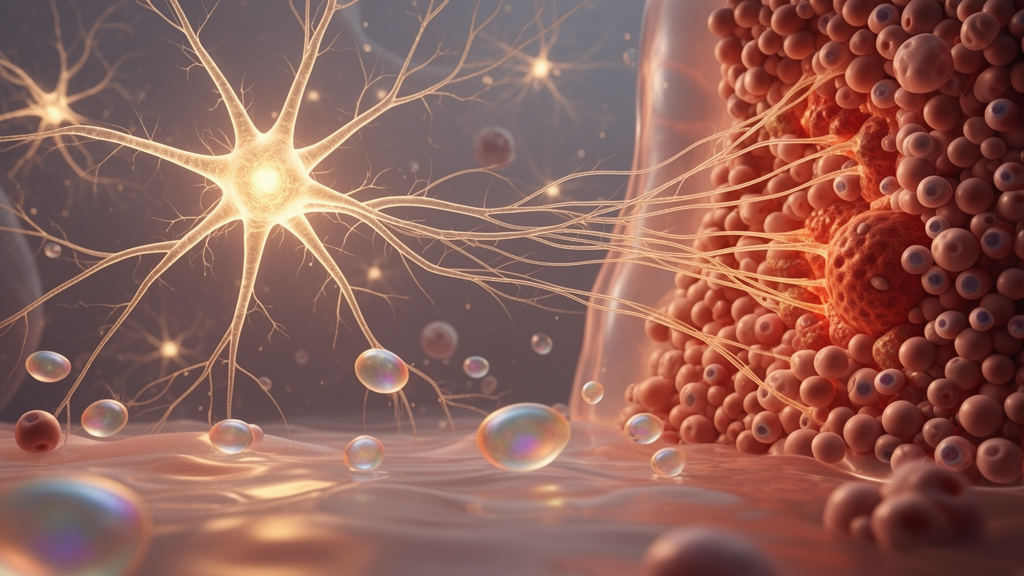
Beyond neuronal circuits, the authors demonstrated that lipopolysaccharide recruits a subpopulation of astrocytes in the dorsal bed nucleus of the stria terminalis. Selective activation of these recruited astrocytes was sufficient to enhance local neuronal excitability within the region. Moreover, selective astrocytic activation altered the number of splenic immune cells.
The authors also uncovered the biochemical mechanism connecting astrocytic recruitment to heightened neuronal activity. Injection of lipopolysaccharide elevates adenosine triphosphate levels around astrocytes in the dorsal bed nucleus of the stria terminalis. This elevation in adenosine triphosphate activates P2Y1 receptors, which promotes local glutamate release. The resulting glutamate release subsequently increases local neuronal excitability across the dorsal bed nucleus.
Together, these complementary actions demonstrate that forebrain neuro-glial interactions govern peripheral immune responses during acute inflammation.
In summary, the findings reveal a coordinated neuron-astrocyte mechanism in the dorsal bed nucleus of the stria terminalis that processes immune signals during acute lipopolysaccharide-induced inflammatory responses. These results implicate astrocytes as important modulators in forebrain regulation of peripheral immunity alongside neuronal populations. By establishing the functionality of the polysynaptic dBNST-DVC-spleen pathway, this study provides a new framework for understanding how forebrain regions regulate splenic immune responses under acute inflammatory conditions.
Subject of Research: Forebrain neural regulation of splenic immune responses
Article Title: Inflammation-activated neuronal and astrocytic populations in the dorsal bed nucleus of the stria terminalis modulate peripheral immune response via the brain-spleen axis
Article References: Xin, X., Tang, Y., Shi, M., Han, W., Xu, X., Zhang, C., Meng, T., Li, Z., Yue, Q., Liu, E., & Sun, J. (2026). Inflammation-activated neuronal and astrocytic populations in the dorsal bed nucleus of the stria terminalis modulate peripheral immune response via the brain-spleen axis. Journal of Neuroinflammation. https://doi.org/10.1186/s12974-026-04093-7
Image Credits: AI Generated
DOI: 10.1186/s12974-026-04093-7
Keywords: dorsal bed nucleus of the stria terminalis, dBNST, dorsal vagal complex, DVC, brain-spleen axis, splenic immune response, splenic nerve activation, Fos-positive neurons, astrocytes, chemogenetics, optogenetics, neural tracing, lipopolysaccharide, pro-inflammatory cytokines, adenosine triphosphate, P2Y1 receptors, glutamate release, neuronal excitability
News Source: Cassandra Pierce. (November 19, 2026). Forebrain Neurons and Astrocytes Regulate Spleen Immune Responses During Inflammation. Scienmag.