• HOME
  • NEWS
  • EXPLORE
    • CAREER
      • Companies
      • Jobs
    • EVENTS
    • iGEM
      • News
      • Team
    • PHOTOS
    • VIDEO
    • WIKI
  • BLOG
  • COMMUNITY
    • FACEBOOK
    • INSTAGRAM
    • TWITTER
Thursday, June 25, 2026
BIOENGINEER.ORG
No Result
View All Result
  • Login
  • HOME
  • NEWS
  • EXPLORE
    • CAREER
      • Companies
      • Jobs
        • Lecturer
        • PhD Studentship
        • Postdoc
        • Research Assistant
    • EVENTS
    • iGEM
      • News
      • Team
    • PHOTOS
    • VIDEO
    • WIKI
  • BLOG
  • COMMUNITY
    • FACEBOOK
    • INSTAGRAM
    • TWITTER
  • HOME
  • NEWS
  • EXPLORE
    • CAREER
      • Companies
      • Jobs
        • Lecturer
        • PhD Studentship
        • Postdoc
        • Research Assistant
    • EVENTS
    • iGEM
      • News
      • Team
    • PHOTOS
    • VIDEO
    • WIKI
  • BLOG
  • COMMUNITY
    • FACEBOOK
    • INSTAGRAM
    • TWITTER
No Result
View All Result
Bioengineer.org
No Result
View All Result
Home NEWS Science News Biology

For evolutionary study finds rare bats in decline, CCNY research

Bioengineer by Bioengineer
February 14, 2020
in Biology
Reading Time: 2 mins read
0
IMAGE
Share on FacebookShare on TwitterShare on LinkedinShare on RedditShare on Telegram

IMAGE

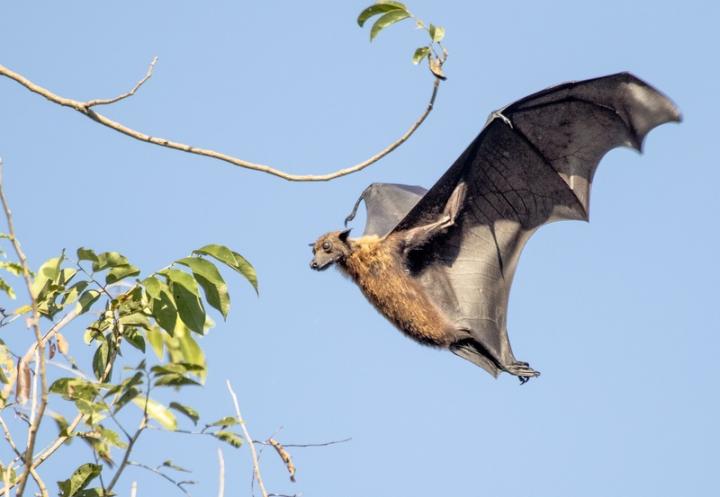
Credit: Photo credit: Skanda de Saram.


A study led by Susan Tsang, a former Fulbright Research Fellow from The City College of New York, reveals dwindling populations and widespread hunting throughout Indonesia and the Philippines of the world’s largest bats, known as flying foxes.

Unfortunately, hunting not only depletes the flying foxes, which are already rare, but also potentially exposes humans to animal-borne pathogens (a process known as zoonosis). “For instance, the current case of Wuhan Coronavirus is thought to have been spread from wild bats to humans through an intermediate host at a wildlife market,” said CCNY biologist and Tsang’s mentor David J. Lohman, an entomologist and two-time Fulbright recipient.

The CCNY experts found that flying foxes originated in a group of islands in Indonesia called Wallacea. They diversified into different species by flying to other islands that presumably lacked competitors and established themselves. Thus, islands are critical to the evolution and conservation of this large group of around 65 mammal species.

“This study provides insight into biodiversity conservation and public health. Islands are frequently home to endemic species found nowhere else,” noted Tsang, who earned a PhD in biology from the Graduate Center, CUNY.

Unfortunately, island-endemic species are more likely to be endangered or go extinct than continental species. Flying foxes are seed dispersers and pollinators of many ecologically and economically important plants, and forest trees on islands often depend on bats for regeneration.

###

Entitled: “Dispersal out of Wallacea spurs diversification of Pteropus flying foxes, the world’s largest bats (Mammalia: Chiroptera),” the study is the cover article in the Feb. 14 issue of “Journal of Biogeography.”

It was co-authored by Y-Lan Nguyen, a 2015 graduate of the Macaulay Honors College at CCNY. Other collaborators included scientists from Indonesia, the Philippines, Singapore and Japan.

A second paper on the outcome of a study on bat-borne viruses in Southeast Asia is being drafted. Future work will also examine the environmental impact of flying foxes on plant diversification and terrestrial/marine ecosystem dynamics.

Media Contact
Jay Mwamba
[email protected]
212-650-7580

Original Source

https://www.ccny.cuny.edu/news/fieldwork-remote-islands-evolutionary-study-finds-rare-bats-decline-ccny-research

Tags: BiologyEntomologyEvolutionParasitologyVirologyZoology/Veterinary Science
Share12Tweet8Share2ShareShareShare2

Related Posts

Natural Hallucinogens: Evolution’s Ecological Tools, Not Mere Chemical Byproducts

June 25, 2026

This Famous Butterfly Revealed: Three Distinct Species Hidden in One

June 25, 2026

Scientists Attack Soybean Cyst Nematode by Starving Its Food Source

June 25, 2026

Decoding the Secret Code of a Crucial Immune Sensor

June 24, 2026
Please login to join discussion

POPULAR NEWS

  • Saying Goodbye to PGY-6: Pediatric Fellowship Realities

    103 shares
    Share 41 Tweet 26
  • Multi-Hospital Study Reveals Long Covid Burden Is Twice as High as Current Estimates

    92 shares
    Share 36 Tweet 23
  • Detection of EDCs in Breast Milk and Infant Urine Up to Six Months Highlights Early Exposure Risks

    77 shares
    Share 31 Tweet 19
  • New Drug Candidate Developed at McMaster Shows Potential for Treating Brain Cancer

    58 shares
    Share 23 Tweet 15

About

We bring you the latest biotechnology news from best research centers and universities around the world. Check our website.

Follow us

Recent News

Tracking Lanthanide-Labeled Microplastics in Plants

POSTECH Researchers Slash Cost of Reconstituted Cell-Free Systems by 95%

AI and Physics Collaborate to Design Advanced Hydrogen Storage Materials

Subscribe to Blog via Email

Enter your email address to subscribe to this blog and receive notifications of new posts by email.

Join 82 other subscribers
  • Contact Us

Bioengineer.org © Copyright 2023 All Rights Reserved.

Welcome Back!

Login to your account below

Forgotten Password?

Retrieve your password

Please enter your username or email address to reset your password.

Log In
No Result
View All Result
  • Homepages
    • Home Page 1
    • Home Page 2
  • News
  • National
  • Business
  • Health
  • Lifestyle
  • Science

Bioengineer.org © Copyright 2023 All Rights Reserved.