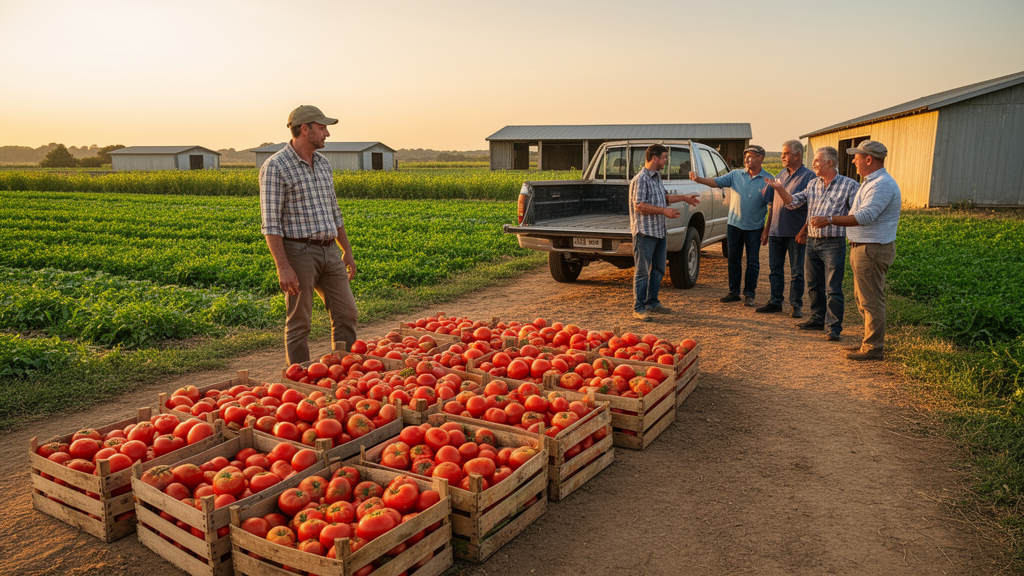
Food loss in smallholder farming systems is usually treated as a technical and logistical problem, something to be fixed with better crates, cooler storage, or improved harvesting tools. A new synthesis of multi-year research-for-development work in Pakistan and Sri Lanka argues that this framing misses the point. Drawing on food loss assessments, laboratory investigations, stakeholder consultations, foresight exercises, value chain analyses, and pilot interventions across mango and tomato supply chains, the researchers conclude that persistent losses are better understood as a manifestation of deeper coordination failures that prevent producers, intermediaries, and institutions from recognising, creating, and capturing value.
The study, published in Frontiers in Sustainable Food Systems, synthesises lessons from an evolving portfolio of research activities rather than reporting findings from a single research design. The authors, based at the University of Queensland, the International Islamic University in Islamabad, and the Institute of Policy Studies of Sri Lanka, describe how their programme initially set out to measure the extent and drivers of food loss. As the work progressed, a broader pattern emerged: across commodities, locations, and supply chains, quality deterioration, weak incentives for quality preservation, limited trust, fragmented market relationships, and constrained organisational capabilities repeatedly undermined attempts to create and capture value, even where technically feasible solutions existed.
The empirical backbone of the synthesis comes from detailed measurements in horticultural systems characterised by high perishability and significant smallholder participation. In Sri Lanka, multi-method investigations estimated mango post-harvest losses of 29% to 33%, with losses potentially reduced to around 6% under best-practice conditions. Losses were strongly associated with poor cultivar selection, immature harvesting, exposure to heat, and inadequate field handling. Comparable assessments in Pakistan estimated on-farm handling and packaging losses of approximately 20% to 30%, compounded by premature harvesting and inadequate orchard management. In both countries, quality deterioration often began long before produce became physically unmarketable, eroding value through depressed prices, reduced demand, and diminished consumer confidence.
The tomato evidence illustrates how losses accumulate through a sequence of decisions rather than a single event. In Sri Lanka, tomato losses varied widely across retail outlets: average daily losses were around 5%, equivalent to approximately LKR 4,751 per retailer, while in worst-case scenarios losses reached 44%, or LKR 4,360 per retailer handling around 15 kg per day. A retailer-level loss assessment in Kandy District found average losses of approximately 13% of tomatoes handled, but quality deterioration generated economic losses considerably larger than those implied by physical losses alone. Retailers with stronger supplier relationships and better handling practices experienced lower losses, pointing to the influence of coordination and organisational arrangements on outcomes.
Perhaps the most striking finding concerns packaging. Transport trials moving tomatoes from the Dambulla Economic Centre to markets in Colombo showed that plastic crates reduced mechanical damage and disease incidence from 11.37% to 2.54%, and reduced physiological weight loss from 4.56% to 2.92%. Despite this clear evidence, adoption remained virtually non-existent outside supermarket chains. The authors attribute this to a cost-benefit asymmetry: producers, collectors, and transporters bear the upfront capital investment and operational costs, including cleaning, slower loading, theft risks, and vehicle incompatibility, while retailers and consumers capture the gains from reduced damage and better quality. Supermarkets succeeded because they operate as integrated businesses capable of internalising both costs and gains.
By contrast, packaging adoption in the Sri Lankan mango sector is markedly higher because consumers actively reward premium quality. Transport trials demonstrated that upgrading standard cardboard boxes to an improved corrugated design reduced mechanical damage and disease incidence from 7.02% to 2.22%, and physiological weight loss from 11.94% to 8.08%. When the product has a higher potential payout, the authors note, it pays to commit effort to safeguarding quality. In mango systems where poor on-farm practices compromised quality at source, the result was a suboptimal low-quality-low-price equilibrium that drove out quality-oriented buyers and sellers.
To organise these observations, the researchers adapted the Awareness-Motivation-Capability (AMC) framework, originally developed in strategic management to explain how firms respond to competitive opportunities and threats, and later extended to organisational responses to externalities in global value chains. Applied to smallholder systems, the framework helps explain why technically feasible interventions frequently fail to generate lasting change: effective responses depend not simply on the availability of technologies but on whether actors are aware of opportunities, motivated to pursue them, and capable of implementing the changes required. In settings where states of nature are difficult to anticipate and probabilities poorly understood, information creates value only when actors recognise the contingencies to which it relates, a distinction the authors draw from the literature on the value of awareness versus the value of information.
Five interrelated insights emerge from the synthesis. First, food loss is fundamentally a value creation problem rather than simply a loss mitigation problem, since substantial losses occur through deterioration in quality, nutritional value, food safety, and shelf life rather than through reductions in weight or volume. Second, awareness expands the perceived opportunity set: actors cannot respond to opportunities they do not perceive, and food loss assessments functioned as processes for revealing previously unrecognised possibilities. Third, motivation depends on credible pathways for value capture; stakeholders who recognised the benefits of quality improvement often remained reluctant to invest because potential returns were uncertain, delayed, or likely to be appropriated by others. Fourth, capability constraints are frequently the binding constraint to change, as financial barriers, inadequate infrastructure, insufficient labour skills, and weak institutional support prevented behavioural adaptation despite individual intentions. Fifth, collective action is essential for capability development and for aligning private and social objectives, since many opportunities could not be realised by individual actors acting alone.
These insights support two complementary ideas advanced by the authors. Food-as-a-Service (FaaS) conceptualises food not as an undifferentiated commodity but as a bundle of services delivered to consumers, including quality assurance, traceability, consistency, and sustainability, attributes that increasingly shape value creation in advanced economies yet remain weakly recognised and rewarded in emerging-economy food systems. The Four-Ps approach, bringing together public institutions, private firms, philanthropic organisations, and community groups, provides a practical mechanism for mobilising the complementary resources and capabilities needed to realise these opportunities, particularly where markets and governments alone cannot coordinate investment and collective action. The authors also point to export-led commercialisation as a motivational pathway: Sri Lanka’s Tom EJC and Pakistan’s Rataiwala mango cultivars illustrate how premium prices resembling quality-contingent contracts can motivate behavioural change when combined with investments in stakeholder capabilities.
The authors are careful about the limits of their evidence. Because the paper synthesises lessons from a multi-year programme rather than testing formal hypotheses through a single research design, the evidence is better suited for generating and integrating insights than for establishing causal relationships between specific interventions and observed outcomes. The synthesis draws on selected horticultural systems in two countries, and the authors caution against generalising to other commodities, regions, or institutional settings. Comparisons between Pakistan and Sri Lanka are analytical contrasts rather than formal comparative case studies. Future research, they suggest, should examine how awareness, motivation, and capability interact under different institutional settings, explore mechanisms through which service attributes can be recognised and rewarded, and investigate how partnership arrangements contribute to capability development. The enduring lesson, they argue, is that food loss mitigation is not simply about reducing losses but about creating the conditions that allow food system actors to recognise opportunities, respond to uncertainty, and work collectively to generate greater economic, social, and environmental value.
Subject of Research: Coordination failures and value creation in smallholder horticultural food loss research in Pakistan and Sri Lanka
Article Title: Value creation in horticultural systems: insights from value chain research in Pakistan and Sri Lanka
Article References: Mallawaarachchi, T., Ejaz, N., & Thibbotuwawa, M. (2026). Value creation in horticultural systems: insights from value chain research in Pakistan and Sri Lanka. Frontiers in Sustainable Food Systems, 10, 1939070. https://doi.org/10.3389/fsufs.2026.1939070
Image Credits: AI Generated
DOI: 10.3389/fsufs.2026.1939070
Keywords: food loss, value creation, horticulture, smallholder farming, coordination failures, Pakistan, Sri Lanka, mango, tomato, Awareness-Motivation-Capability framework, Food-as-a-Service, research-for-development
News Source: Alan Morgan. (October 30, 2026). Food loss in smallholder farms may be a coordination failure, not a technical one. Scienmag.