• HOME
  • NEWS
  • EXPLORE
    • CAREER
      • Companies
      • Jobs
    • EVENTS
    • iGEM
      • News
      • Team
    • PHOTOS
    • VIDEO
    • WIKI
  • BLOG
  • COMMUNITY
    • FACEBOOK
    • INSTAGRAM
    • TWITTER
Sunday, June 28, 2026
BIOENGINEER.ORG
No Result
View All Result
  • Login
  • HOME
  • NEWS
  • EXPLORE
    • CAREER
      • Companies
      • Jobs
        • Lecturer
        • PhD Studentship
        • Postdoc
        • Research Assistant
    • EVENTS
    • iGEM
      • News
      • Team
    • PHOTOS
    • VIDEO
    • WIKI
  • BLOG
  • COMMUNITY
    • FACEBOOK
    • INSTAGRAM
    • TWITTER
  • HOME
  • NEWS
  • EXPLORE
    • CAREER
      • Companies
      • Jobs
        • Lecturer
        • PhD Studentship
        • Postdoc
        • Research Assistant
    • EVENTS
    • iGEM
      • News
      • Team
    • PHOTOS
    • VIDEO
    • WIKI
  • BLOG
  • COMMUNITY
    • FACEBOOK
    • INSTAGRAM
    • TWITTER
No Result
View All Result
Bioengineer.org
No Result
View All Result
Home NEWS Science News Biology

Following the insect meltdown, numbers of orb web spiders have drastically declined

Bioengineer by Bioengineer
April 23, 2020
in Biology
Reading Time: 3 mins read
0
IMAGE
Share on FacebookShare on TwitterShare on LinkedinShare on RedditShare on Telegram

IMAGE

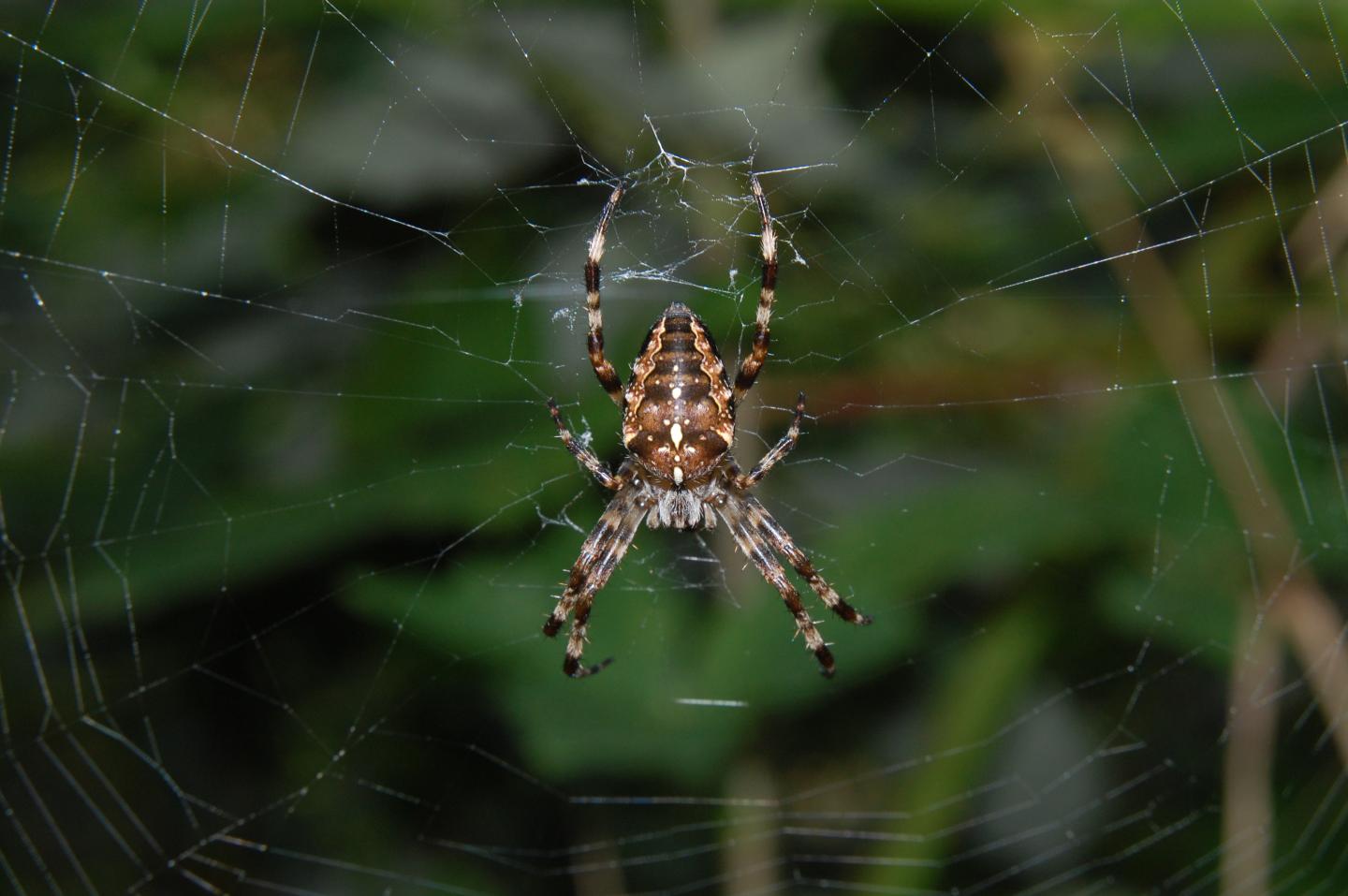
Credit: Rainer Altenkamp

The abundance of large orb web spiders in the Swiss midland has declined drastically over the last 40 years. The main reason for this is the shrinking food supply available to these insectivorous animals. This is demonstrated in a study conducted by researchers from the University of Basel and Ghent University (Belgium), as reported in the scientific journal Insects.

The approximately 48,400 known spider species around the world are among the most important insectivorous animals on earth. One group of these, the orb web spiders, spin conspicuous wheel-shaped webs. The perhaps best known and so far very common orb web spider species in Europe is the European garden spider Araneus diadematus. Apart from house gardens, their preferred habitats include parks, graveyards, hedgerows, forest edges and clearings.

Average population density of the spider about 140 times lower

The European garden spider is easily recognizable by the bright, cross-shaped mark on the upper side of its abdomen. The females of this spider species which measures 10 to 18 mm as adults, legs not included, spins webs with a diameter of about 30 cm. In late summer 2019, the entomologists determined the population density of the European garden spider in the Swiss midland in 20 representative habitats: they counted the spider webs in test plots ranging from 200 to 1,000 square meters and converted these values to the number of webs per square meter.

The results: in comparison with data from the 1970s and 1980s, the abundance of this spider has decreased alarmingly. The average population density in Switzerland, for example, is 140 times lower than the previous European average value. In two thirds of the sample plots inspected, no spider webs were found at all. The webs contained significantly fewer insects than in previous studies. Furthermore, the web threads were found to be considerably thinner, as is the case when spiders are malnourished.

Small flying insects as food

Most species of orb web spiders feed almost exclusively on small flying insects, such as flies, midges, and aphids, which are most affected by insect declines. That the population density of the European garden spider dropped to a very low level in more recent times, has also been shown in a study conducted in Northern Belgium. Not only the European garden spider – which still exists almost everywhere in the Swiss midland – but also other web-spinning spider species are now found less frequently than in the last century. “The results of our study are a strong indication for an insect meltdown in large parts of Europe,” says lead author Dr. Martin Nyffeler from the University of Basel. The study furthermore suggests that those animals that feed on insects are affected by it, too: “If the abundance of insects and their natural enemies is decreasing drastically, ecosystems become impoverished and may eventually collapse.”

###

More information

PD Dr. Martin Nyffeler, University of Basel, Section of Conservation Biology, Tel. +41 61 702 07, E-Mail: [email protected]

Media Contact
Christoph Dieffenbacher
[email protected]

Original Source

https://www.unibas.ch/en/News-Events/News/Uni-Research/Following-the-insect-meltdown-numbers-of-orb-web-spiders-have-drastically-declined.html?null

Related Journal Article

http://dx.doi.org/10.3390/insects11040248

Tags: BiodiversityBiologyEcology/EnvironmentZoology/Veterinary Science
Share12Tweet8Share2ShareShareShare2

Related Posts

Natural Hallucinogens: Evolution’s Ecological Tools, Not Mere Chemical Byproducts

June 25, 2026

This Famous Butterfly Revealed: Three Distinct Species Hidden in One

June 25, 2026

Scientists Attack Soybean Cyst Nematode by Starving Its Food Source

June 25, 2026

Decoding the Secret Code of a Crucial Immune Sensor

June 24, 2026
Please login to join discussion

POPULAR NEWS

  • Saying Goodbye to PGY-6: Pediatric Fellowship Realities

    103 shares
    Share 41 Tweet 26
  • Multi-Hospital Study Reveals Long Covid Burden Is Twice as High as Current Estimates

    92 shares
    Share 36 Tweet 23
  • Detection of EDCs in Breast Milk and Infant Urine Up to Six Months Highlights Early Exposure Risks

    77 shares
    Share 31 Tweet 19
  • New Drug Candidate Developed at McMaster Shows Potential for Treating Brain Cancer

    58 shares
    Share 23 Tweet 15

About

We bring you the latest biotechnology news from best research centers and universities around the world. Check our website.

Follow us

Recent News

Tracking Lanthanide-Labeled Microplastics in Plants

POSTECH Researchers Slash Cost of Reconstituted Cell-Free Systems by 95%

AI and Physics Collaborate to Design Advanced Hydrogen Storage Materials

Subscribe to Blog via Email

Success! An email was just sent to confirm your subscription. Please find the email now and click 'Confirm' to start subscribing.

Join 82 other subscribers
  • Contact Us

Bioengineer.org © Copyright 2023 All Rights Reserved.

Welcome Back!

Login to your account below

Forgotten Password?

Retrieve your password

Please enter your username or email address to reset your password.

Log In
No Result
View All Result
  • Homepages
    • Home Page 1
    • Home Page 2
  • News
  • National
  • Business
  • Health
  • Lifestyle
  • Science

Bioengineer.org © Copyright 2023 All Rights Reserved.