• HOME
  • NEWS
  • EXPLORE
    • CAREER
      • Companies
      • Jobs
    • EVENTS
    • iGEM
      • News
      • Team
    • PHOTOS
    • VIDEO
    • WIKI
  • BLOG
  • COMMUNITY
    • FACEBOOK
    • INSTAGRAM
    • TWITTER
Friday, June 26, 2026
BIOENGINEER.ORG
No Result
View All Result
  • Login
  • HOME
  • NEWS
  • EXPLORE
    • CAREER
      • Companies
      • Jobs
        • Lecturer
        • PhD Studentship
        • Postdoc
        • Research Assistant
    • EVENTS
    • iGEM
      • News
      • Team
    • PHOTOS
    • VIDEO
    • WIKI
  • BLOG
  • COMMUNITY
    • FACEBOOK
    • INSTAGRAM
    • TWITTER
  • HOME
  • NEWS
  • EXPLORE
    • CAREER
      • Companies
      • Jobs
        • Lecturer
        • PhD Studentship
        • Postdoc
        • Research Assistant
    • EVENTS
    • iGEM
      • News
      • Team
    • PHOTOS
    • VIDEO
    • WIKI
  • BLOG
  • COMMUNITY
    • FACEBOOK
    • INSTAGRAM
    • TWITTER
No Result
View All Result
Bioengineer.org
No Result
View All Result
Home NEWS Science News Biology

Following scientific literature review, Imperial Brands calls for legalisation of snus in EU

Bioengineer by Bioengineer
December 19, 2019
in Biology
Reading Time: 2 mins read
0
IMAGE
Share on FacebookShare on TwitterShare on LinkedinShare on RedditShare on Telegram

IMAGE

Credit: Imperial Brands


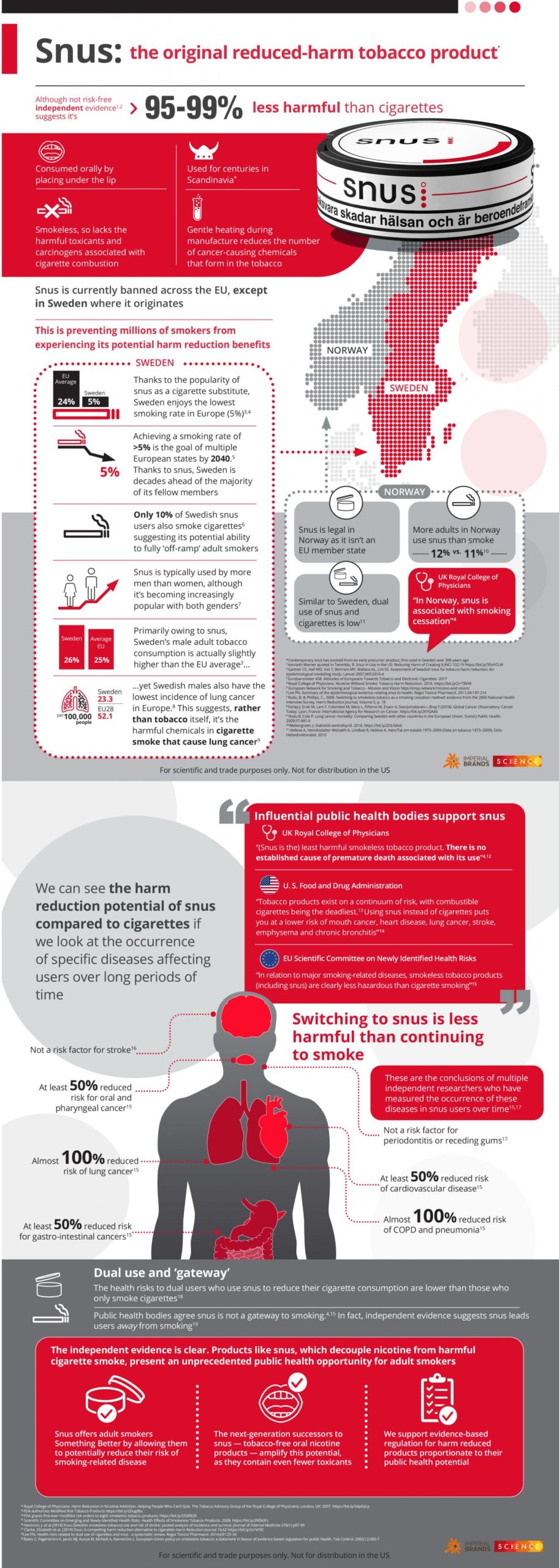
Following a new literature review* of the harm reduction potential of snus, Imperial Brands – owners of leading snus brand Skruf – has urged the European Union (EU) to re-examine its position on the product.

Published in the prestigious Harm Reduction Journal, the scientific literature review encouragingly indicates snus use is not a significant risk factor in the development of several cancers (inc. lung, oral and pancreatic), COPD, cardiovascular disease or diabetes.

The review also contributes to the growing evidence base substantiating the Tobacco Harm Reduction (THR) potential of snus compared to smoking, comparing the prevalence of use against the reported incidence of tobacco-related diseases across the EU.

Dr Grant O’Connell, Director of Strategic Science and Policy Engagement at Imperial Brands, comments: “Research suggests the health risks associated with snus use, where nicotine is decoupled from harmful tobacco smoke, are considerably lower – around 90-95%** – than those associated with cigarettes.

“Snus should therefore be officially regarded as a reduced harm tobacco product, as advocated by the United Kingdom Royal College of Physicians*** .”

Dr Alan Hardacre, Head of Group Corporate Affairs at Imperial Brands, adds: “Modern snus is a compelling alternative to the various medically licensed – but largely ineffective – nicotine replacement therapies.

“Given the compelling long-term scientific evidence gathered from Sweden and Norway, we again urge the EU to revisit its ban on snus that’s currently in place across the rest of its Member States.

“The ban continues to be detrimental to European public health and so we urge the European Commission to base future decisions on the ever-increasing scientific evidence base demonstrating the harm reduction potential of products like snus.”

Dr O’Connell concludes: “We must not let this important opportunity to make a genuine difference to EU-wide public health pass us by.”

###

*Snus: A Compelling Harm Reduction Alternative to Cigarettes, Harm Reduction Journal https://harmreductionjournal.biomedcentral.com/track/pdf/10.1186/s12954-019-0335-1

** The relative risks of a low-nitrosamine smokeless tobacco product compared with smoking cigarettes: Estimates of a panel of experts, Cancer Epidemiology Biomarkers and Prevention 13 2035-2042 http://cebp.aacrjournals.org Gartner CE, Hall WD, Vos T, Bertram MY, Wallace AL, Lim SS. Assessment of Swedish snus for tobacco harm reduction: An epidemiological modelling study. Lancet 2007;369:2010-4

*** https://www.rcplondon.ac.uk/file/3563/download

Media Contact
Rob Taylor
[email protected]
0044-797-374-3483

Original Source

https://harmreductionjournal.biomedcentral.com/track/pdf/10.1186/s12954-019-0335-1

Related Journal Article

http://dx.doi.org/10.1186/s12954-019-0335-1

Tags: AddictionCell BiologyClinical TrialsEpidemiologyMedicine/HealthPublic HealthSmoking/TobaccoSocial/Behavioral ScienceToxicology
Share13Tweet8Share2ShareShareShare2

Related Posts

Natural Hallucinogens: Evolution’s Ecological Tools, Not Mere Chemical Byproducts

June 25, 2026

This Famous Butterfly Revealed: Three Distinct Species Hidden in One

June 25, 2026

Scientists Attack Soybean Cyst Nematode by Starving Its Food Source

June 25, 2026

Decoding the Secret Code of a Crucial Immune Sensor

June 24, 2026
Please login to join discussion

POPULAR NEWS

  • Saying Goodbye to PGY-6: Pediatric Fellowship Realities

    103 shares
    Share 41 Tweet 26
  • Multi-Hospital Study Reveals Long Covid Burden Is Twice as High as Current Estimates

    92 shares
    Share 36 Tweet 23
  • Detection of EDCs in Breast Milk and Infant Urine Up to Six Months Highlights Early Exposure Risks

    77 shares
    Share 31 Tweet 19
  • New Drug Candidate Developed at McMaster Shows Potential for Treating Brain Cancer

    58 shares
    Share 23 Tweet 15

About

We bring you the latest biotechnology news from best research centers and universities around the world. Check our website.

Follow us

Recent News

Tracking Lanthanide-Labeled Microplastics in Plants

POSTECH Researchers Slash Cost of Reconstituted Cell-Free Systems by 95%

AI and Physics Collaborate to Design Advanced Hydrogen Storage Materials

Subscribe to Blog via Email

Success! An email was just sent to confirm your subscription. Please find the email now and click 'Confirm' to start subscribing.

Join 82 other subscribers
  • Contact Us

Bioengineer.org © Copyright 2023 All Rights Reserved.

Welcome Back!

Login to your account below

Forgotten Password?

Retrieve your password

Please enter your username or email address to reset your password.

Log In
No Result
View All Result
  • Homepages
    • Home Page 1
    • Home Page 2
  • News
  • National
  • Business
  • Health
  • Lifestyle
  • Science

Bioengineer.org © Copyright 2023 All Rights Reserved.