Pumpkin leaves are quietly becoming one of the most talked-about vegetables in the world of functional foods. Long appreciated in parts of Asia and Africa as a nutritious green, the tender shoots of Cucurbita moschata are now attracting serious scientific attention for reasons that go far beyond tradition. A new study published in BMC Plant Biology by a team at the Guangdong Academy of Agricultural Sciences has mapped, in extraordinary molecular detail, how a simple agricultural practice—spraying nutrients directly onto the leaves—can transform the flavour chemistry of this emerging crop. The findings reveal not only a practical recipe for better-tasting greens but also an unexpected biosynthetic route to one of the food world’s most coveted aroma molecules.
The research team, led by Liting Deng and corresponding author Junxing Li, employed a comprehensive foodomics approach, combining untargeted metabolomics with transcriptome sequencing to capture a full portrait of what makes fragrant pumpkin leaves taste and smell the way they do. Across untreated leaves, the researchers identified a staggering 1003 metabolites, of which 40 were volatile aroma compounds. The chemical inventory was dominated by six classes: phenolic acids with 150 representatives, amino acids and their derivatives with 93, organic acids with 83, free fatty acids and saccharides with 77 each, and flavonols with 70. Together these six categories accounted for more than 54 percent of everything the team detected.
That catalogue alone carries significant nutritional implications. Phenolic acids and flavonols are among the most intensively studied classes of plant secondary metabolites, widely associated with antioxidant and anti-inflammatory activity in the human diet. Their abundance in pumpkin leaves, the authors argue, supports the vegetable’s positioning as a health-functional food rather than a mere culinary curiosity. But the study’s central question was not simply what the leaves contain—it was how their flavour chemistry responds to intervention, and whether growers could deliberately steer that chemistry toward a more desirable eating experience.
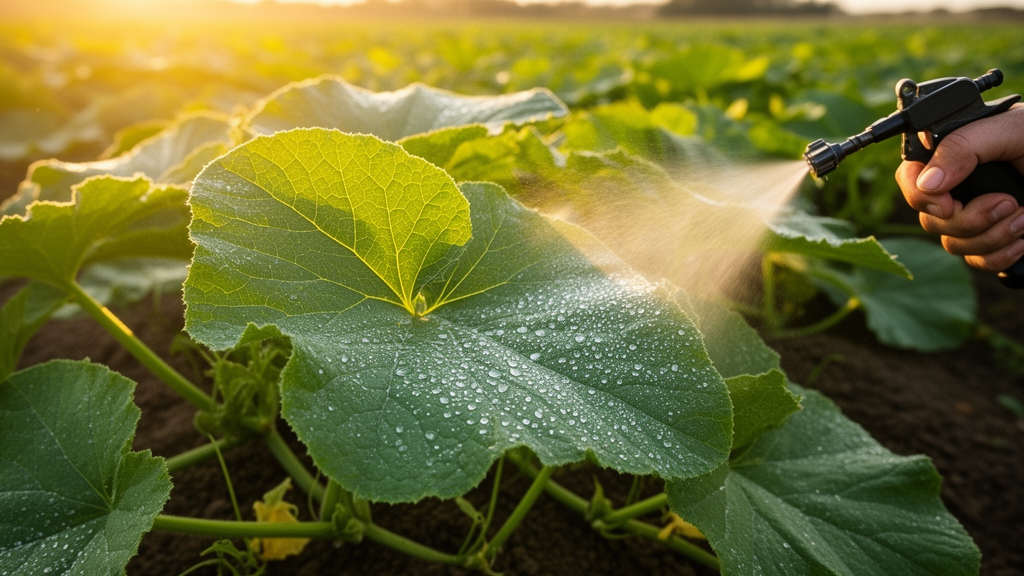
The intervention in question was a combined foliar formulation, a nutrient spray applied directly to the leaf surface. Foliar feeding is an established agronomic technique that bypasses the soil-root system entirely, delivering dissolved nutrients through the cuticle and stomata where they can be absorbed rapidly into metabolic pathways. Because amino acids and aromatic compounds vary dramatically across pumpkin leaf cultivars and growing conditions, flavour has been notoriously difficult to regulate. The new results suggest that this difficulty may be more tractable than previously assumed.
The metabolic consequences of the spray were striking. Of the 28 amino acids and derivatives significantly regulated after treatment, 23 accumulated substantially. The headline result concerned glutamic acid, the amino acid that anchors the savoury umami taste and serves as a fundamental building block of proteins. Glutamic acid rose by 50 percent following foliar feeding, becoming the single most abundant metabolite in the treated leaves. For a vegetable whose culinary appeal depends heavily on savoury depth, that shift represents a meaningful upgrade in eating quality achieved through nothing more exotic than a targeted nutrient spray.
The aroma story proved even more dramatic. The compound 2-acetyl-1-pyrroline, universally abbreviated 2-AP, is the molecule responsible for the taro-like fragrance prized in fragrant pumpkin leaves—and, famously, for the popcorn-like scent of pandan and premium jasmine rice. In the treated leaves, 2-AP levels surged by 189 percent. Simultaneously, (Z)-3-hexen-1-ol, the volatile behind the fresh-cut-grass smell that many consumers find harsh or overly green, dropped by 65.5 percent. The combined effect was a rebalancing of the leaf’s volatile profile toward sweetness and warmth and away from raw vegetal pungency, a shift the authors describe as a prominent improvement in the vegetable’s aroma characteristics.
Understanding how the spray produced these changes required the transcriptomic half of the study. By sequencing gene expression in treated and untreated leaves and integrating those data with the metabolite measurements, the researchers uncovered what appears to be an alternative biosynthetic route to 2-AP—one that runs through the polyamine putrescine rather than the pathways more commonly described in aromatic rice. At the centre of this route sits a gene designated CmoADC, which encodes arginine decarboxylase, the enzyme that channels arginine into putrescine production. Both the metabolite and the gene responded emphatically to foliar feeding: putrescine was up-regulated 2.48-fold, while CmoADC expression jumped 8.33-fold, making it one of the most strongly induced transcripts in the entire dataset.
The regulatory architecture behind these changes appears to involve plant hormones acting through transcription factors. A large proportion of the differentially expressed transcription factors identified in the study were hormone-responsive, hinting that the foliar formulation does not simply dump raw materials into metabolic pools but instead re-tunes the plant’s own signalling networks. Direct measurement of the phytohormone landscape reinforced this interpretation: of the 66 hormone-related compounds the team quantified, 42 were significantly impacted by the treatment, including 18 cytokinin-associated and 11 auxin-associated compounds. Cytokinins are classically linked to nitrogen metabolism and amino acid biosynthesis, which fits neatly with the observed accumulation of glutamic acid and its relatives, while auxin signalling has well-documented connections to secondary metabolism and volatile formation.
For agriculture, the practical message is that flavour quality in leafy vegetables can be engineered through metabolically informed management rather than left to cultivar choice alone. The combined foliar formulation improved amino acid nutrition and umami intensity while simultaneously amplifying the taro-like aroma through a putrescine-dependent 2-AP pathway, giving growers a defined, science-backed lever for quality improvement. Because the treatment acts on the leaf itself and operates within the plant’s existing biochemistry, it offers a relatively low-cost strategy that could be adapted to other fragrant vegetables where 2-AP or related volatiles determine market value.
For plant science, the study adds a compelling piece to the puzzle of how 2-acetyl-1-pyrroline is actually made. The involvement of arginine decarboxylase and putrescine suggests that nitrogen-rich precursors, mobilised in response to nutrient availability and hormone signalling, feed directly into aroma biosynthesis. As pumpkin leaves continue their journey from regional staple to global functional vegetable, work like this demonstrates how metabolomics and transcriptomics together can turn a traditional green into a precisely flavoured, nutritionally optimised crop—one spray at a time.
Subject of Research: Effects of foliar feeding on amino acid and 2-acetyl-1-pyrroline aroma metabolism in fragrant pumpkin leaves
Article Title: Responses of amino acid and aroma metabolism of fragrant pumpkin leaves to foliar feeding: insights from metabolomic and transcriptomic technologies
Article References: Deng, L., Luo, J., Zhao, G., Liu, X., Wu, H., Gong, H., Zheng, X., Wu, X., Dai, Z., Wang, H., Chen, C., Wang, X., Zheng, Y., & Li, J. (2026). Responses of amino acid and aroma metabolism of fragrant pumpkin leaves to foliar feeding: insights from metabolomic and transcriptomic technologies. BMC Plant Biology. https://doi.org/10.1186/s12870-026-10145-0
Image Credits: AI Generated
DOI: 10.1186/s12870-026-10145-0
Keywords: pumpkin leaves, foliar feeding, metabolomics, transcriptomics, 2-acetyl-1-pyrroline, putrescine, glutamic acid, umami, aroma biosynthesis, phytohormones, flavour chemistry, Cucurbita moschata
News Source: Alan Morgan. (October 16, 2026). Foliar Feeding Supercharges Umami and Taro-Like Aroma in Fragrant Pumpkin Leaves. Scienmag.