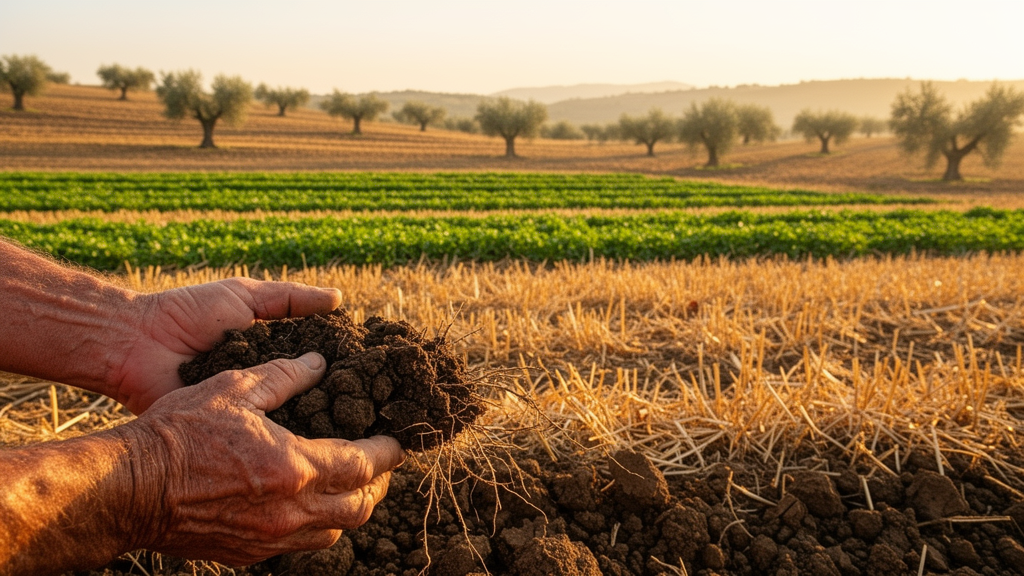
Twenty years of patient, disciplined farming may be one of the most powerful climate technologies hiding in plain sight. A new long-term study from California’s Central Valley, published in the journal SOIL, shows that combining reduced tillage with winter cover crops over two decades fundamentally rebuilt the soil itself: aggregate stability more than doubled, surface carbon stocks roughly doubled, and the soil’s capacity to hold water at field capacity rose by 13 percent. The findings, from researchers at the University of California, Merced and UC Davis, offer some of the clearest mechanistic evidence yet that conservation agriculture can restore degraded Mediterranean soils while locking away carbon.
The research team, led by Jennifer Alvarez-Sagrero and Teamrat Ghezzehei, sampled a long-running field experiment at the Conservation Agriculture Systems Innovation facility in Five Points, California, where plots have been managed since 1999 under contrasting regimes. The comparison pitted the two management extremes against each other: reduced tillage with cover crops on one end, and standard intensive tillage with bare winter fallow on the other. The standard system mirrored conventional San Joaquin Valley operations, with residue shredding, multiple disk passes, subsoiling to depths of up to 460 millimeters, and the creation of a fine, powdery seedbed. The conservation system progressively eliminated disturbance, achieving true zero-tillage by 2012, with planting beds left undisturbed and tractor traffic restricted to permanent furrows.
The cover crops themselves evolved over the experiment. Early mixtures of triticale, cereal rye, and vetch gave way to more diverse blends including pea, fava bean, radish, and Phacelia from 2010 onward. Legumes were inoculated with nitrogen-fixing bacteria, seeded in late autumn, and terminated in mid-March. In no-till plots, residues were left on the surface as protective mulch, achieving more than 90 percent ground cover, compared with less than 20 percent under standard tillage. Over 20 years, cover crops received only about 25 centimeters of supplemental irrigation in total, relying almost entirely on natural rainfall, which makes the measured soil improvements all the more striking in a region averaging just 178 millimeters of annual precipitation.
The most dramatic single result concerned soil structure. When aggregates from the 2 to 4 millimeter size class were subjected to wet sieving, the conservation plots retained 46.9 percent of their mass as stable aggregates, compared with just 9.6 percent under standard tillage without cover crops, a 136 percent increase. The 4 to 8 millimeter class showed a similar pattern. Intriguingly, the intermediate treatments revealed that cover crops under standard tillage improved stability more than reduced tillage without cover crops, suggesting that continuous carbon inputs from roots and residues are the primary biological engine of aggregate formation, with reduced disturbance acting as a synergistic amplifier rather than a standalone fix.
Carbon accumulation was equally impressive. In the top 5 centimeters, total carbon stocks under conservation management reached 1.04 kilograms per square meter, roughly double the 0.52 kilograms per square meter measured under conventional management. At 5 to 10 centimeters, the conservation plots still carried 36 percent more carbon. Nitrogen stocks rose in parallel, up 63 percent in the surface layer, and carbon-to-nitrogen ratios widened, indicating that a larger share of the accumulated organic matter retained plant-derived characteristics rather than being fully processed by microbes. Infrared spectroscopy supported this interpretation, showing a significantly lower proportion of microbially processed organic matter under conservation management.
But the study’s deepest insight came from density fractionation, a technique that physically separates soil organic matter into functionally distinct pools. The free light fraction represents fresh, unprotected plant litter. The occluded light fraction consists of organic matter physically trapped inside soil aggregates, where reduced oxygen diffusion and limited microbial access slow decomposition. The heavy fraction, or mineral-associated organic matter, is bound to clay and silt surfaces through sorption and complexation. Under conservation management, the occluded light fraction held 44.1 percent of total recovered carbon, compared with 35.4 percent under conventional management, while the heavy fraction’s share declined. This shift indicates that after two decades, aggregate-mediated physical protection has become the dominant pathway for continued carbon sequestration, a transition consistent with theoretical frameworks proposing that mineral-associated carbon approaches saturation limits within 15 to 20 years of conservation management.
The saturation analysis carried an important caveat. Using the global framework of Georgiou and colleagues, which estimates theoretical maximum carbon storage on mineral surfaces at 86 milligrams of carbon per gram of mineral for high-activity clays, the team calculated that the conservation plots had reached only 11.5 percent saturation, and conventional plots just 7.4 percent. On its face, this suggests vast untapped mineralogical capacity. But the authors caution that in Mediterranean systems, the realized ceiling on carbon accumulation is set by environmental constraints, including low precipitation, seasonal aridity, and limited carbon inputs during dry months, rather than by mineral surface availability. Closing the remaining gap would require fundamentally different interventions, such as organic amendments, altered irrigation, or deeper-rooted perennial systems, not simply more years of the same conservation practices.
The physical transformation of the soil was equally measurable. Bulk density in the surface layer under conservation management was 0.99 grams per cubic centimeter, 15 percent lower than the 1.16 grams per cubic centimeter under conventional management, reflecting a looser, more porous structure. Total porosity in the top 5 centimeters rose to 50.6 percent, and volumetric water content at field capacity, defined as the water retained at a matric potential of minus 33 kilopascals, reached 26.1 percent versus 23.3 percent, a 13 percent enhancement. These changes were concentrated in the surface horizon, and at 5 to 10 centimeters the porosity pattern actually inverted, with conservation plots showing slightly lower porosity, plausibly because conventional tillage transiently loosens the subsoil during each seasonal pass while no-till leaves it functionally undisturbed.
Saturated hydraulic conductivity, a measure of how quickly water moves through saturated soil, did not differ significantly between treatments at either depth, despite nominally higher means under conservation management. The authors attribute this to the extreme spatial variability characteristic of saturated conductivity in heterogeneous Mediterranean soils, and suggest that future work using X-ray computed tomography could resolve the pore-network architecture governing water movement. A first-order calculation suggested that roughly 19 percent of the cumulative carbon added by cover crops over two decades was retained in the sampled soil layers, with the remainder either mineralized or transported below the 10-centimeter sampling depth, an order-of-magnitude estimate subject to substantial year-to-year variation.
The implications extend well beyond one California field. Soils hold approximately 3000 petagrams of carbon, more than three times the amount stored in the atmosphere and vegetation combined, and agriculture has created a global soil carbon debt of 116 petagrams. Croplands could sequester more than 0.28 petagrams of carbon annually through improved management. This study demonstrates that two decades of conservation agriculture can simultaneously restore soil structural integrity, enhance water retention in water-limited systems, and reorganize carbon protection mechanisms toward physically protected forms that persist within stable aggregates. For carbon market protocols, the shift toward aggregate-mediated protection matters because physically protected carbon may respond differently to environmental perturbations than mineral-sorptive carbon, affecting permanence accounting. For farmers in Mediterranean climates worldwide, the message is that patient, integrated adoption of reduced tillage and cover cropping can rebuild the soil from the ground up, one season at a time.
Subject of Research: Soil science and conservation agriculture
Article Title: Two decades of conservation agriculture enhances soil structure, carbon sequestration, and water retention in Mediterranean soils
Article References: Alvarez-Sagrero, J., Berhe, A. A., Chacon, S. S., Mitchell, J. P., & Ghezzehei, T. A. (2026). Two decades of conservation agriculture enhances soil structure, carbon sequestration, and water retention in Mediterranean soils. SOIL, 12(2), 979-998. https://doi.org/10.5194/soil-12-979-2026
Image Credits: AI Generated
Keywords: soil carbon, conservation agriculture, cover crops, no-till, aggregate stability, water retention, Mediterranean climate, carbon sequestration, decades, conservation, agriculture, enhances
News Source: Alan Morgan. (October 16, 2026). Two Decades of Conservation Agriculture Rebuild Soil Structure and Double Surface Carbon in Mediterranean Farmland. Scienmag.