


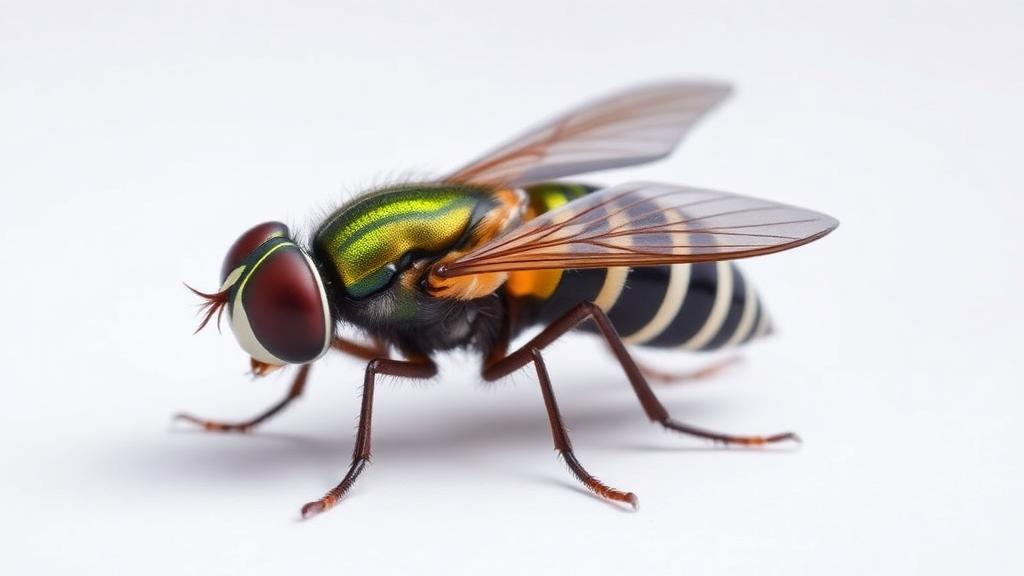
Hexanucleotide repeat expansions in the C9orf72 gene are the most common known genetic cause of amyotrophic lateral sclerosis (ALS) and frontotemporal dementia (FTD), yet how age, sex, repeat length and neural circuit identity shape the resulting pathology remains poorly resolved. A new study in Acta Neuropathologica Communications addresses this gap by building a Drosophila model in which G4C2 repeats were expressed specifically in mushroom body neurons, a brain region the authors describe as critical for memory, locomotion and sleep. The work, published on 26 October 2026 as an open-access research article, is presented as an accepted manuscript shared early for faster access and is subject to further edits before the final version of record.
When the researchers expressed 44 copies of the G4C2 repeat in these fly neurons, a characteristic cascade of age-dependent damage emerged. The flies developed axonal thinning, accumulation of repeat-associated non-AUG (RAN) translated GR-GFP dipeptide repeat proteins, premature movement of endogenous TDP-43 from the nucleus to the cytoplasm, increased caspase activity, and a loss of presynaptic active zones as the animals aged. Behaviorally, expression of the 44-copy repeat produced defects in locomotion and spontaneous alternation, along with fragmentation of sleep architecture during aging, in a sex-dependent manner. According to the authors, these phenotypes recapitulate core features of FTD.
One of the study’s most striking findings concerns repeat length. The shorter 12-copy G4C2 repeat, which is traditionally treated as a benign control, also produced detectable RAN translation and intermediate phenotypes in aging mushroom body neurons. The authors interpret this as evidence that length- and tissue-associated factors modulate repeat toxicity, meaning that even short repeats are not necessarily inert in vulnerable neurons over time.
Searching for mechanisms, the team found a reduction of the glypican Dally-like protein (Dlp) in flies expressing the 44-copy repeat during aging, which they link to disruptions of Wnt-related signaling associated with TDP-43 proteinopathies. Restoring Dlp expression in the mushroom body neurons mitigated the locomotor and spontaneous alternation defects and prevented the loss of presynaptic active zones. However, axonal thinning and TDP-43 mislocalization were not significantly improved by Dlp restoration, leading the authors to conclude that multiple mechanisms contribute to G4C2-induced toxicity rather than a single Dlp-dependent pathway.
The fly findings were extended to human cells. Suppression of GPC6, a human ortholog of Dlp, using CRISPRi in TDP-43 knock-down induced neurons identified GPC6 as a significant contributor to TDP-43-dependent synaptic loss. This cross-species consistency supports the idea that glypican-dependent mechanisms may be relevant to human disease, although the human experiments involved cells with TDP-43 knockdown rather than patient neurons carrying C9orf72 expansions.
Overall, the study delivers an aging-sensitive, circuit-specific model of C9orf72-associated neurodegenerative phenotypes and highlights potential roles for dipeptide repeat accumulation and Dlp/GPC6-dependent synaptic loss in FTD pathomechanisms. As an animal and cell model study, it identifies candidate mechanisms and therapeutic targets for further investigation rather than demonstrating clinical benefit, and the authors note that the influence of age, sex, repeat length and circuit specificity on neuronal pathology remains incompletely understood. The open-access article, authored by Brijesh S. Chauhan, Megan A. Brennan, Peter C. Forstmeier and colleagues with senior author Daniela C. Zarnescu, is citable under its permanent DOI while the final version of record is prepared.
Subject of Research: A Drosophila model of C9orf72 hexanucleotide repeat-induced TDP-43 pathology and dementia-relevant phenotypes involving the glypican Dlp/GPC6
Article Title: C9orf72-associated G4C2 hexanucleotide repeat expression in Drosophila mushroom bodies causes age-dependent TDP-43 pathology and dementia relevant phenotypes mediated in part by the glypican Dlp/GPC6
Article References: Chauhan, B. S., Brennan, M. A., Forstmeier, P. C., Yifu, H., Godfrey, R. K., Van Keuren-Jensen, K., Sattler, R., Ichida, J., & Zarnescu, D. C. (2026). C9orf72-associated G4C2 hexanucleotide repeat expression in Drosophila mushroom bodies causes age-dependent TDP-43 pathology and dementia relevant phenotypes mediated in part by the glypican Dlp/GPC6. Acta Neuropathologica Communications. https://doi.org/10.1186/s40478-026-02471-z
Image Credits: AI Generated
DOI: 10.1186/s40478-026-02471-z
Keywords: C9orf72, G4C2 repeats, TDP-43, frontotemporal dementia, ALS, Drosophila, mushroom bodies, Dlp, GPC6, dipeptide repeats, synaptic loss, RAN translation
News Source: Cassandra Pierce. (October 29, 2026). Fly Model Links C9orf72 Repeats to Age-Dependent TDP-43 Pathology and Dementia-Like Phenotypes. Scienmag.



