• HOME
  • NEWS
  • EXPLORE
    • CAREER
      • Companies
      • Jobs
    • EVENTS
    • iGEM
      • News
      • Team
    • PHOTOS
    • VIDEO
    • WIKI
  • BLOG
  • COMMUNITY
    • FACEBOOK
    • INSTAGRAM
    • TWITTER
Monday, June 29, 2026
BIOENGINEER.ORG
No Result
View All Result
  • Login
  • HOME
  • NEWS
  • EXPLORE
    • CAREER
      • Companies
      • Jobs
        • Lecturer
        • PhD Studentship
        • Postdoc
        • Research Assistant
    • EVENTS
    • iGEM
      • News
      • Team
    • PHOTOS
    • VIDEO
    • WIKI
  • BLOG
  • COMMUNITY
    • FACEBOOK
    • INSTAGRAM
    • TWITTER
  • HOME
  • NEWS
  • EXPLORE
    • CAREER
      • Companies
      • Jobs
        • Lecturer
        • PhD Studentship
        • Postdoc
        • Research Assistant
    • EVENTS
    • iGEM
      • News
      • Team
    • PHOTOS
    • VIDEO
    • WIKI
  • BLOG
  • COMMUNITY
    • FACEBOOK
    • INSTAGRAM
    • TWITTER
No Result
View All Result
Bioengineer.org
No Result
View All Result
Home NEWS Science News Chemistry

Fluorine enables separation-free ‘chiral chromatographic analysis’

Bioengineer by Bioengineer
July 2, 2020
in Chemistry
Reading Time: 2 mins read
0
IMAGE
Share on FacebookShare on TwitterShare on LinkedinShare on RedditShare on Telegram

IMAGE

Credit: ZHAO Yanchun

Researchers from the Shanghai Institute of Organic Chemistry of the Chinese Academy of Sciences recently developed a new platform for rapid chiral analysis, producing chromatogram-like output without the need for separation. The study was published in Cell Reports Physical Science.

Molecules not superimposable on their mirror images are chiral and play essential roles in the pharmaceutical industry, material sciences, and the origin of life. Distinguishing between mirror-image molecules is in great demand, but existing approaches usually achieve this goal with compromise in accuracy or efficiency.

Specifically, chromatographic methods resolve chiral molecules through easily interpretable chromatogram peaks, but require time-consuming separation. Chiroptical responsive systems allow in-situ chiral analysis, but are often plagued by sample interference issues.

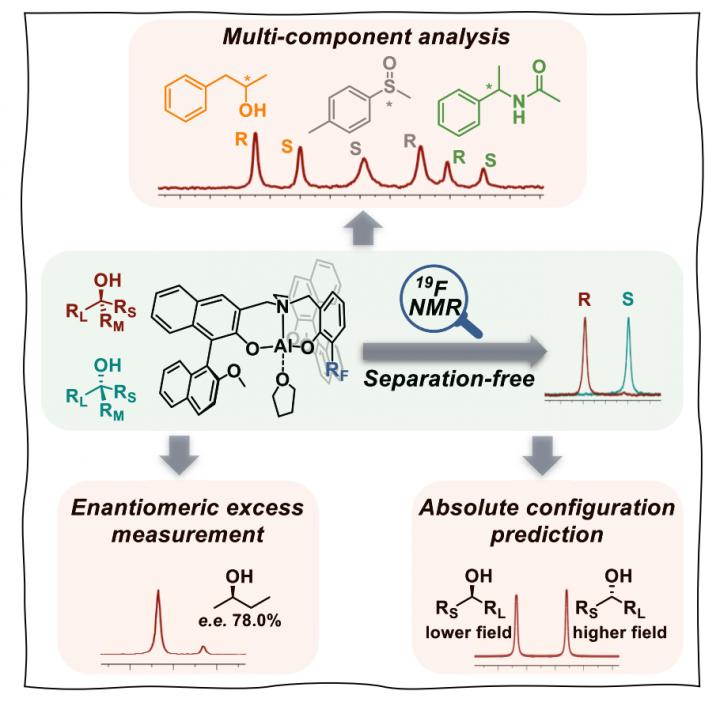
In this study, the researchers developed a series of 19F-labeled chiral aluminum complexes that reversibly bind to various Lewis basic analytes.

The inclusion of chiral analytes to the confined binding pocket produced chromatogram-like 19F NMR signals, allowing rapid and unambiguous chiral analysis.

The method is operationally simple and effectively resolved a wide range of chiral molecules, including alcohols, ethers, amides, carbamates, oxazolidinones, sulfoxides, and sulfoximines.

The study shows that simultaneous analysis of three different classes of chiral compounds can be achieved in the absence of separation.

According to the researchers, the new method may also be used to determine the enantiopurity of crude reaction products and the assignment of absolute configurations. When used in conjunction with an autosampling NMR spectrometer, greater than 1,000 chiral analyses can be performed in a day.

“Such a method has the potential to simultaneously identify multiple analytes and existing interferences, which may eventually lead to real-time chiral analysis in complex biologically relevant systems,” said ZHAO Yanchun, corresponding author of the study.

###

This work was financially supported by the National Natural Science Foundation of China and the CAS Key Laboratory of Organofluorine Chemistry.

Media Contact
ZHAO Yanchun
[email protected]

Original Source

http://english.cas.cn/newsroom/research_news/chem/202007/t20200702_239516.shtml

Related Journal Article

http://dx.doi.org/10.1016/j.xcrp.2020.100100

Tags: Chemistry/Physics/Materials SciencesMolecular PhysicsPolymer Chemistry
Share12Tweet8Share2ShareShareShare2

Related Posts

AI and Physics Collaborate to Design Advanced Hydrogen Storage Materials

June 25, 2026

International Team Including Dresden Scientists Develops Novel Designer Proteins for Advanced Study of Living Tissue

June 25, 2026

New Study Uncovers Key Factors Driving Water Chemistry in Nanoscale Environments

June 25, 2026

Plasma Technology Extends Catalyst Lifespan in Hydrogen Production

June 24, 2026
Please login to join discussion

POPULAR NEWS

  • Saying Goodbye to PGY-6: Pediatric Fellowship Realities

    103 shares
    Share 41 Tweet 26
  • Multi-Hospital Study Reveals Long Covid Burden Is Twice as High as Current Estimates

    92 shares
    Share 36 Tweet 23
  • Detection of EDCs in Breast Milk and Infant Urine Up to Six Months Highlights Early Exposure Risks

    77 shares
    Share 31 Tweet 19
  • New Drug Candidate Developed at McMaster Shows Potential for Treating Brain Cancer

    58 shares
    Share 23 Tweet 15

About

We bring you the latest biotechnology news from best research centers and universities around the world. Check our website.

Follow us

Recent News

Tracking Lanthanide-Labeled Microplastics in Plants

POSTECH Researchers Slash Cost of Reconstituted Cell-Free Systems by 95%

AI and Physics Collaborate to Design Advanced Hydrogen Storage Materials

Subscribe to Blog via Email

Success! An email was just sent to confirm your subscription. Please find the email now and click 'Confirm' to start subscribing.

Join 82 other subscribers
  • Contact Us

Bioengineer.org © Copyright 2023 All Rights Reserved.

Welcome Back!

Login to your account below

Forgotten Password?

Retrieve your password

Please enter your username or email address to reset your password.

Log In
No Result
View All Result
  • Homepages
    • Home Page 1
    • Home Page 2
  • News
  • National
  • Business
  • Health
  • Lifestyle
  • Science

Bioengineer.org © Copyright 2023 All Rights Reserved.